This short message to inform readers that this blog will not be updated for the foreseeable future. All previous posts remain available, so if you want to get started in Islamic art History and Market, I recommend the following:
I put a lot of care and effort in writing each post, and I am not willing to compromise on quality just to produce content. So, this is goodbye for now! I am not excluding posting again at some point, but for now, life has other plans for me and I won’t be able to free the time needed to write interesting and insightful texts.
Finally, and most importantly, I wish to thank all the readers who have been following this blog and have contributed, one way or the other, to its success. Take care, stay curious, be happy!
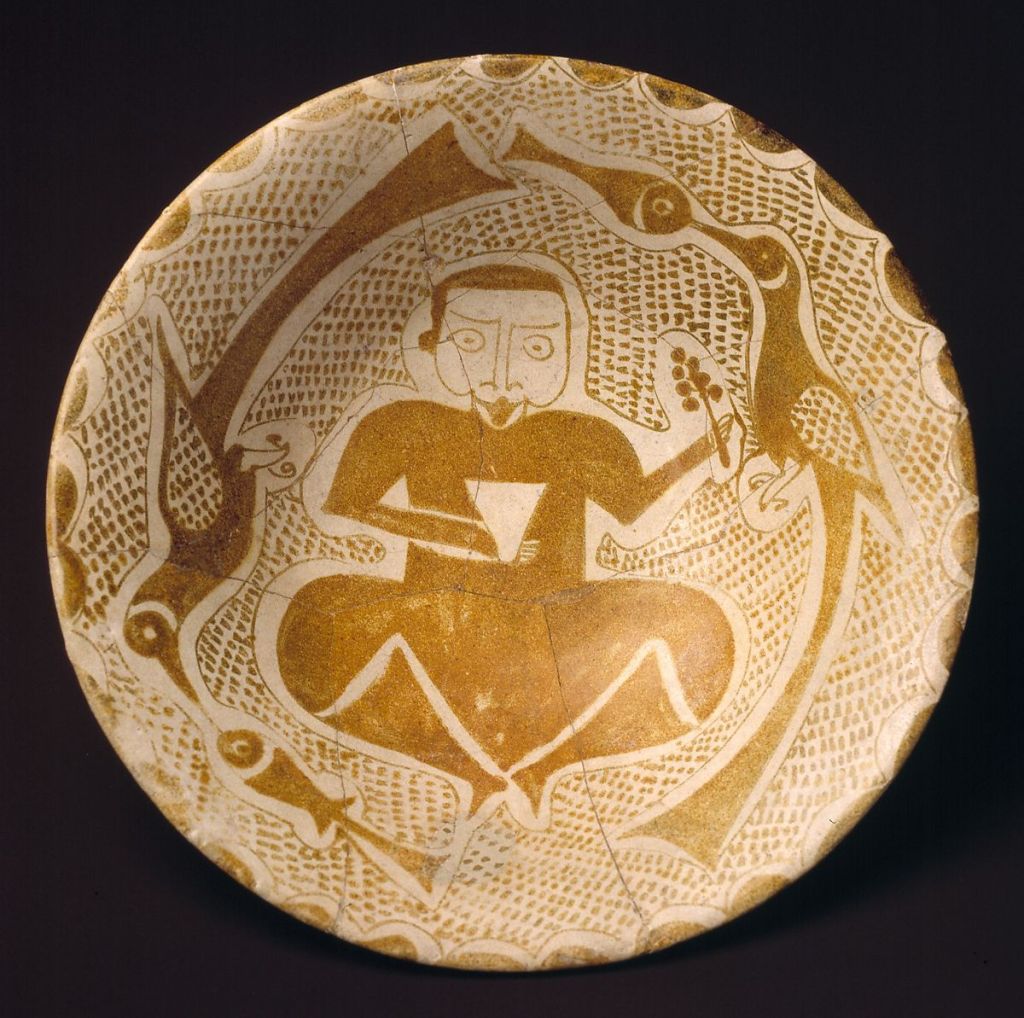
Bowl, Iraq, 10th century MET Museum, NY (1977.126)
I cannot believe 2024 is already here. It seems like this year has flown by, but I’m saying that every year. On a personal note, 2023 has been a strong year, full of positive moments, but that has also demanded a lot of resilience and hard work. I already know 2024 will also required a lot of focus and dedication to be able to manage it all, but I’m excited about it.
But enough about me! What happened on the Islamic & Indian art market this year? In short: a lot, and because the year went so fast, I thought now would be a perfect time to review the key moments of the British and French auction houses that have brought us so much excitement. Let’s rewind the year, but not necessarily in chronological order as this has proven to be a bit monotonous to write (and I’d assume to read). After that, I’ll give you some of my predictions for 2024!
All the prices given below include buyer premium.
Carved panel, Anatolia (?), 13th c. Sotheby’s 26.4, 87
Key moments of 2023 in London and Paris
The market year started in February with two back-to-back auctions by Ader which included many Indian paintings that sold quite well. In hindsight, this gave the tone for the sales to come. In February, an Ottoman Qur’an juz from 15th century Anatolia valued at €8,000-12,000 sold for €96,000. In March, the highest result was with two Company School paintings of the Taj Mahal and the Buland Darwaza valued €6,000-8,000 and sold for €30,720. Both auctions achieved a total of €1,105,422, to which were added €299,654 from a third sale in July of the collection of famous French collector Philippe Magloire, bringing the total for the year to €1,405,076, a 325% progression since the previous year (during which only one auction was held), and put Ader on the third place of the French podium.
Glass cup, Rim Encheres, 10.3, 10
Rim Encheres also held an auction in March, selling only 36% of the lots for a total of €248,573. Given the fact that the house is only two years old, expectations differ, but we can already highlight that the objects sold most often within their estimate, which somehow gives a feeling of fairness in the midst of the over-the-top estimates we particularly saw on London’s market. The most successful artefact was a gold sandwich glass cup from 11th c. Iran or Syria, valued €40,000-50,000 and sold for €52,000.
Bonhams also held an auction in Paris in the spring, which brought £229,793. Several lots were described as coming from a royal collection without more details.
Shahnama (detail), Sothebys 26.4, 41
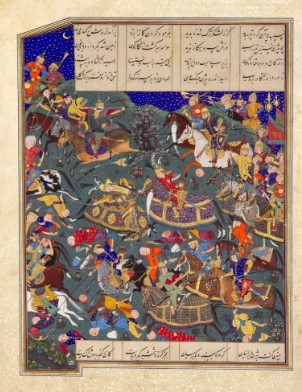
Sotheby’s dominated both Islamic weeks in 2023, and with them the whole market, holding three auctions for a total around £29,643,612, a 59% progression compared to 2022. April saw another folio from Shah Tahmasp Shahnama depicting “Bihzan slaying Nastihan” come on the market, this time a fight scene which was expected to do less than previous folios with less violent paintings, especially the extraordinary depiction of “Rustam recovers Rakhsh from Afrasiyab’s herd” sold in October 2022 for £8,061,700. “Bihzan slaying Nastihan” sold for £4,875,800.
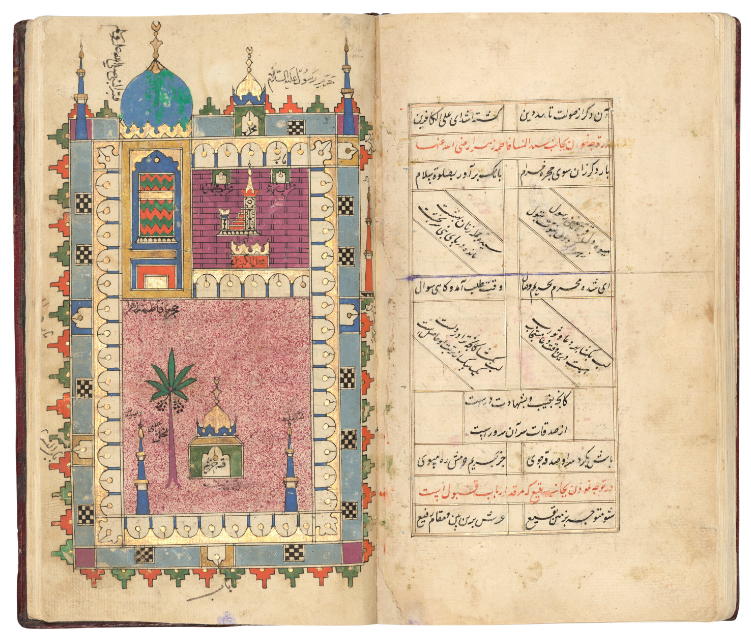
The big surprise was Christie’s overall result, sitting at £17,826,655, a 41% decrease compared to 2022. One must admit that 2022 was a particularly rich year for the house, with the sale of several multimillion lots, including a page from Shah Tahmasp’s Shahnama for £4,8 millions in March and a Mughal pashmina carpet for £,5,2 millions in October 2022. In 2023, only two objects passed the million; a gold finial from Tipu Sultan’s throne for £1,8 millions in April, and a rare signed and dated Meccan manuscript of the Futuh al-Haramaynfor £.1,2 millions, sold against a very low estimate of £20,000-30,000.
Roseberys surpassed £1 million in April with an auction that included archaeology and a few contemporary pieces. Roseberys’ strategy is quantity over price, with auctions composed of more than 500 lots each and inviting estimates for old and new collectors. This approach has clearly worked for the house this year, with exciting biding battles, especially a dated and signed Mamluk astronomical treatise produced in 697/ 1298 in Egypt or Syria, valued £600-800 for its poor preservation state and sold £182,000.
Similarly to Roseberys, Chiswick favoured quantity over price without compromising on quality neither, with catalogues of 300 to 400 lots each time. The other asset of the house for the past few years has been the progressive sale of a single-owner collection, mainly composed of Persian pieces, which overall sold more than 95% of the lots over 6 sales. The top lot in April was a 17th c. Safavid ceramic tile showing the bust of a man holding a blue and white ceramic vase, which sold for £25,000.
Tipu Sultan sword, Bonhams 23.5, 175
The main surprise of the year was brought by Bonhams, which achieved a total result of £17,826,655 in 2023, a 976% progression from 2022 (this percentage is not a typo). I wrote in November 2022 that Bonhams was not doing too well financially, recording their lowest result in 10 years, but 2023 saw them rise again. In May, records were broken by the sale for £14,080,900 of the bedchamber sword of Tipu Sultan, climbing to the second place of most expensive Islamic art object ever sold at auction.
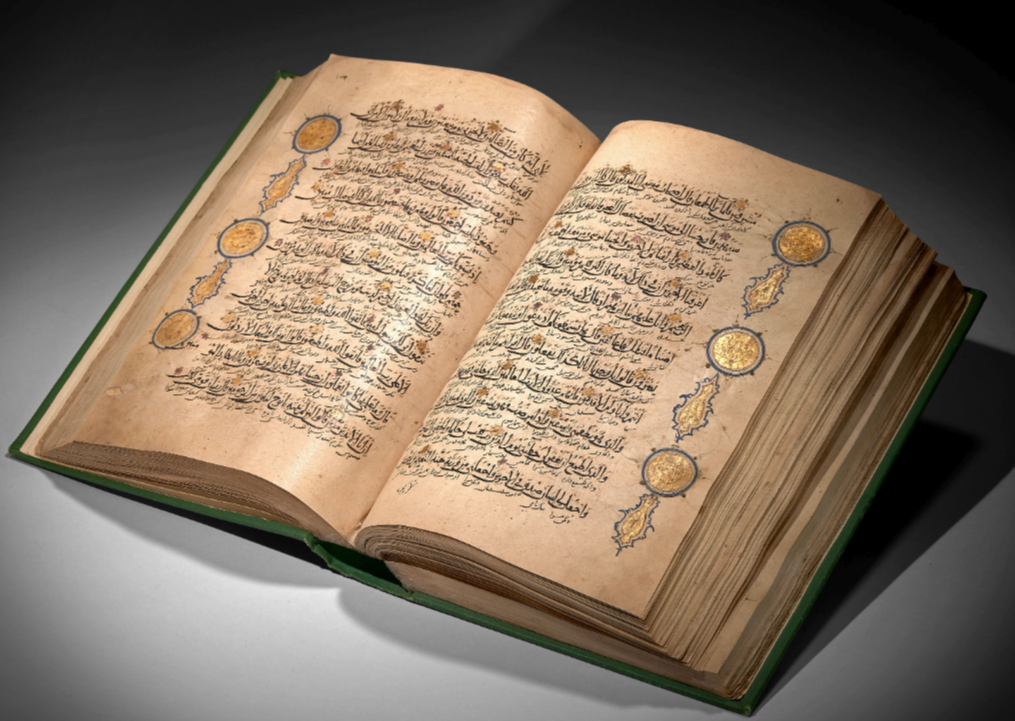
Also in May, Artcurial held their first auction of the year, which was crowned by the presentation of an Abbasid Qur’an from the end of the 12th century, valued at only €20,000-30,000 and sold without surprise for €406,720.
Qur’an, 12th c., Artcurial 24.5, lot 101
Like in 2022, Millon arrived in first place of the Parisian market with a overall result of €2,528,631 for two main and two online sales. June auction highlight was also a 12th century Qur’an, this time in Kufic script, sold within its estimate for €150,000.
Qur’an (detail), 12th c., Millon 14.6, 177
Sotheby’s progression this year is partly due to the Shahnama page sold in April, and partly to the immense success of the sale of Edith and Stuart Carry Welch’s collection in October which made £10,853,253 in total, £ 8,102,600 for Islamic and Indian art only. The second part of the Welch sale was online, the 56 Islamic and Indian lots bringing an additional £127,763. The ‘normal’ October auction included two unsold top lots, a halftone result compared to April but that still made £6,718,554, nearly a million more than Christie’s, which brought £5,766,218. Christie’s also had a single-owner auction next to the ‘normal’ sale, offering a large selection of Indian and Persian paintings from the collection of Toby Falk, renowned Islamic art history scholar who passed away in 1997.
Sidenote: Scholarly and conversation jobs don’t pay that well, at least these days, so I would love to understand how Stuart Cary Welch and Toby Falk managed to constitute collections as extensive and packed with masterpieces. Let’s not forget S.C. Welch owned a page of Shah Tahmasp’s Shahnama, the most expensive manuscript in the world, which sold in 2011 for £7,433,250. In the 70s and 80s, the Islamic art market was not as big as it is now, but even then, both collectors must have spent fortunes buying some of these pieces. There is clearly a secret here I do not possess. If someone knows, please share. End of sidenote.
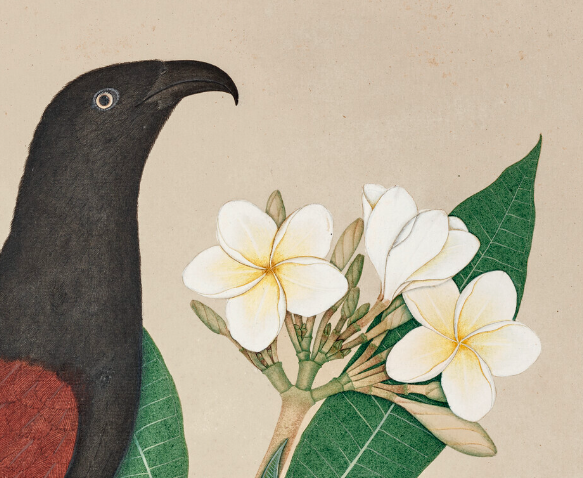
Coucal, Christie’s
The biggest success from the Welch collection was the painting of “an Assembly of Village Elders with William Fraser’s munshi and diwan”, beautifully depicted around 1816, valued £150,000-250,000 and sold for £952,500. It had been acquired by Welch in 1980 for an amount I couldn’t retrieve. Toby Falk’s highlight was the painting of “a lesser coucal on a frangipani branch” made in 1777 for Elijah Impey, valued £80,000-120,000, sold for £504,000.
The Islamic week was followed in November by Bonhams eventful sale of the so-called Harvard world map, a Mecca-centred World Map made in Safavid Persia in the 17th century, which got its nickname due to the fact it was on long term loan to the Harvard Art Museums until 2014. The lot was first withdraw from the sale, then reintegrated, and finally sold for £1,863,400, against an estimate of £1,500,000-2,000,000.
The “Harvard world map”, Bonhams 14.11, 192p
Artcurial November auction was not nearly as profitable as April’s, reaching only €474,797 thanks to the presentation of a 14th century Mamluk domed casket sold for €183,680. Overall Artcurial arrives second on the Parisian market with a total result of €1,478,955, a 32% progression since 2022 (excluding archaeology that is managed by a different expert). This result is due to a clever choice to offer smaller, carefully curated catalogues centred on few unpublished pieces with stellar provenance and great catalogue work. To be noted that Pingannaud-David expertise is also making moves outside of Artcurial, namely with Gros & Delettrez, a house mainly known for their orientalist painting sales. For the very last auction of the year, they presented a small catalogue of 34 lots centred on an extraordinary “Damascus room”, unpublished and in great condition. At the time of writing, the results were yet to be published, but we can already note that the main part of the room sold for €340,000 hammer.
Rim Encheres held a small but successful auction in December, selling 92% of the lots for a total of €128,583, including an Ottoman kilij sabre with pommel and sheath entirely covered in red coral and turquoise, sold for €22,100.
Finally, Millon made around €1,026,244.83 with their second main auction, which consisted in parts in a large private collection constituted in the 19th century and preserved in an extraordinary apartment in Bordeaux. You can see some of the amazing setting in a presentation video by the expert Anne-Sophie Joncoux-Pilorget. The auction itself surprised everybody when a 14th c. Mamluk silver-inlaid brass candlestick valued €20,000-40,000 sold for €180,000.
This is the tricky part of this article, and my predictions might end up completely off tracks. The Islamic and Indian art market is difficult to predict due to its very diverse nature. Aside from archaeology, no other market covers geographic and chronological ranges as large, not to mention the whole panel of artistic media, from engraved animal bones to entire architectures. What comes on the market also depends on what experts are able to source and who is willing to sell, so all this to say that there are a lot of unknowns from one season to another. That being said, looking at 2023, we can go into 2024 with a few expectations.
Three pages of Shah Tahmasp’s Shahnama were sold since 2022, and though none got offered in the autumn Islamic week, it wouldn’t be surprising to see more appear on the market this year given the continuous success of previous pages. That being said, collectors might decide to hold off selling their piece for a few years to create an event as big as the presentation of “Rustam kicking the boulder” by Christie’s in April 2022.
Tipu Sultan’s sword, Bonhams 14.11
Given the results achieved in 2023 by all kind of Tipu Sultan’s memorabilia, we would probably be right to expect more to come on the market in 2024. The sale of Tipu Sultan’s bedchamber sword by Bonhams aside, Christie’s also made the top 22 in April by selling a gold finial from Tipu’s Throne for £1,855,000, and Sotheby’s sold a sword with ruby eyes for £1,197,500. Christie’s sold another sword for £100,800 in October, while two other remained unsold. Bonhams sold a gilt-copper hilted steel sword from Tipu’s armoury in November for £89,300, as well as various artefacts such as a engraving and newspapers. Autumn auctions has shown that buyers will not jump blindly on every object marked Tipu Sultan, even when the provenance is solid, and my assumption is that the price of the bedchamber sword will remain extraordinary for the years to come, thanks to a perfect storm of long and prestigious provenance and clever marketing.
Hajj map (detail), Sotheby’s 26.4, 2
It seems that a small but highly lucrative niche is getting carved around rare religious and history manuscripts. In April, Sotheby’s achieved high results on two unexpected items, a Hajj map made in 1329/ 1911, valued £10,000-15,000 and sold £40,640, and a copy of the Kitab akhbar Makkah dated 77/ 1374 (history of Mecca), valued £200,000-300,000, sold £762,000. In June, the trend continued with the Abbasid Qur’an sold by Artcurial for €406,720, as well a Mamluk copy of the 7th volume of the Kitab al-tamhid of Abd al-Barr, dated 695/ 1296, sold in the same auction for €59,040 against an estimate of €8,000-12,000. The volume was remarkable for many reasons, including its known calligrapher, its preservation and the historical notes it contains. In October, Christie’s sold a large 18th c. Kashmiri prayer book for an astonishing £108,360 against a valuation of £15,000-25,000, and the aforementioned copy of the Futuh al-Haramayn made in Mecca in 1003/ 1595 for £1,250,000. I’ll be interesting to see where this goes.
Copper ewer, Chiswick 31.10, 9
Finally, medieval metalworks might be making a come-back, maybe. I am never confident when it comes to medieval metalworks and ceramics, buyer’s appeal for both media being quite unpredictable, but the recent results might be the beginning of something. In April, Sotheby’s sold a 12th c. Khurasan feline-form incense burner for £215,900, more than twice its high estimate (£70,000-90,000), Christie’s sold another one the next day for £126,000 (est. £50,000-70,000), as well as an Anatolian Siirt silver-inlaid bronze candlestick for £107,100 (est. £40,000-60,000). Chiswick best results in October were two 12th or 13th c. ewers, a silver-inlaid bronze one for £11,250 and a copper-inlaid brass one for £9,375. In Paris, Artcurial sold the aforementioned Mamluk domed round casket made in the first half of the 14th c. for more than twice its low estimate, and Millon sold their Mamluk candlestick for 9 times its low estimate. Objectively, I was not expecting this kind of results, and I’m intrigued to see what the new year will bring for mediaeval metalworks. See you in April for more!
Welcome back dear reader of this humble blog, I hope you had a good summer! Autumn is already here, and with that, London Islamic week is arriving quickly.
A short disclaimer before we start: this blog article is coming out very late, is shorter and a rougher than planned. I caught a bad cold last week and have been completely unable to get any work done for several days. Instead of completely abandoning the writing, I decided to publish an “as is” version. Hopefully this will still be informative, and I will review the results later on.
This season, 8 auctions will be held between the Wednesday 25th and the Tuesday 31st October, as follow:
Sotheby’s 18th to 27th October, online: “The Edith & Stuart Cary Welch Collection”, 260 lots
Sotheby’s 25th October, AM: “The Edith & Stuart Cary Welch Collection”, 130 lots
Sotheby’s 25th October, PM: “Art of the Islamic World & India”, 157 lots
Christie’s 26th October, “Art of the Islamic and Indian Worlds including Rugs and Carpets”, 215 lots
Christie’s 27th October, “An Eye Enchanted: Indian Paintings from the Collection of Toby Falk”, 152 lots
Roseberys 30th October: “Antiquities, Islamic & Indian Arts”, 542 lots (including 67 antiquities and 21 contemporary)
Chiswick 31st October, AM: “Property of a European Collector, part VI”, 84 lots
Chiswick 31st October, PM: “Islamic & Indian arts”, 354 lots
Some will have noticed I have left Plakas auctions out of this review, despite them having a sale scheduled on the 24th. Plakas have no named expert, and the authenticity a number of objects presented in the catalogue is highly questionable. They are also plagiarising the work of known experts, namely the complete description of a near complete late 12th c. Abbasid Qur’an sold at Artcurial earlier this year. Plakas is selling one page of this manuscript and just copied and pasted Artcurial text, including the provenance. This is wrong on many levels and actions are being taken as I write, so I will not discuss this further.[efn_note]Thank you to the Artcurial team for confirming this information, including the fact that the provenance of the page sold at Plakas is not the same as the rest of the manuscript.[/efn_note]
Nushaba recognises Alexander, Persia, 15th c, Christie’s 26/10, lot 57
Because Bonhams delayed their previous auction, they will hold their next one on the 14th November and their online sale from the 11th till the 15th November. Separating themselves from their competitors has worked quite well, achieving the second-highest result since 2010 with the sale of Tipu Sultan’s bedchamber sword. If you want to know more about it, check the Top 20 of the most expensive Islamic art objects ever sold, part 1 and part 2.
Lastly, and before jumping in the auctions, let’s note that this Islamic week is Beatrice Campi’s last at Chiswick auctions. Beatrice built the Islamic and Indian department from scratch 6 years ago and has positioned the house as a solid player on the London market for affordable art. The future is now very uncertain for the department, as finding a replacement for Beatrice is proving to be a struggle, but I wish to congratulate Beatrice on 6 beautiful years, and I cannot wait to see what she’ll do next. In the same vain, Behnaz Atighi Moghaddam, head of sales at Christie’s, has now gone on personal leave, and corridor conversations are questioning the future structure of the Islamic art department.
Tinted drawing, Benares, c. 1880, Chiswick 31/10, lot 108
Beautiful Objects and Hefty Prices
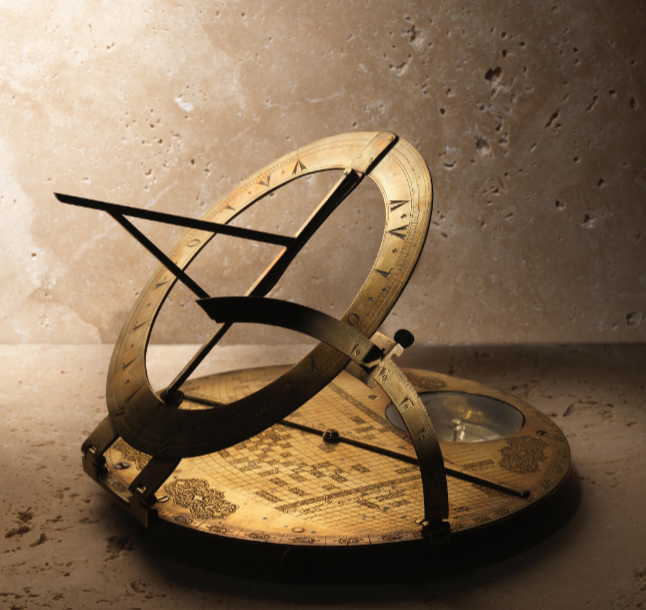
Sotheby’s opens this Islamic week with 120 lots, on top of which is an Abbasid astrolabe, maybe made in Baghdad circa 900, valued at £1,500,000-2,500,000. The artefact comes with an Egyptian and European provenance and a well written notice. I have little opinion when it comes to astrolabes but given the high estimate, I am quite interested to follow the sale. This is most likely a museum piece which might interest institutions of the Gulf, so we might see some action.
Safavid Qur’an, 983H/ 1575-76, Sotheby’s 25/10, lot 21 (detail)
Christie’s biggest entry is a 16th century Safavid ‘Palmette and Bird’ carpet, valued at £2,000,000-3,000,000, from the collection of baron Edmond de Rothschild, previously published and presented several time at auctions. It was sold most recently at Sotheby’s New York in 2013 for $1,930,500, so 10 years later, this carpet might break records.
Chiswick and Roseberys thankfully maintain their prices. Roseberys highest valued object is a Still Life by the Indian artist F.N. Souza dated 1986, valued £30,000-50,000. Roseberys has slowly but surely been including more contemporary pieces in their Islamic and Indian art catalogues, but having a contemporary painting as the top lot is unusual, so I am curious to see what repercussion this might have on future auctions. The second most expensive lot is the full book collection of Pr JM Rogers, Islamic art historian and pioneer, who passed away in 2002. This includes around 900 books, valued at £15,000-20,000, which will most likely be bought by a museum or a library. Two uncommon top lots!
Chiswick went with a more traditional route by presenting a large Mamluk brass candlestick for £15,000-20,000 in their afternoon auction. According to the description, it was recently bought in France, but I couldn’t retrieve from where (I didn’t look too hard to be fair). The blazon engraved on the body indicates it was produced in the second half of the 15th century, but without further precision.[efn_note]According to M. Meinecke (1972), quoted by Julia Gonnella on Museum with no Frontiers, 47 amirs of the late Burji period used this particular blazon.[/efn_note] Chiswick is also offering the last part of the single-owner collection they have been selling for the past three years, the star lot being a 12th/13th Persian coper-inlaid brass ewer valued at £2,000-3,000. The auction of the five previous parts all did really well, including several white-gloves sales, and we can expect similar results this time around. What an amazing collection!
Safavid gold-damascened iron finial, Roseberys 30/10, lot 374
Additionally, we can only regret the lack of provenance on many lots from all four auction houses. At the risk of sounding like a broken record, at this point in time, undisclosed provenance in catalogue should not an acceptable practice. Auction houses obviously do their due diligence, but the opacity of the market has real consequences. We know artefacts and manuscripts are being looted or stolen from small, unpublished collections to be sold through port-francs, this is nothing new, and the only way to combat this is by being crystal-clear on provenance. Christie’s is selling Persian and Kashmiri manuscripts with no provenance line (lot 90and 91), and an Eastern Kufic Qur’an section from 11th/12th c. Persia with, for provenance, “By repute Private Collection, London, since circa 1990”. How was this even green-lit? In the same fashion, Sotheby’s is offering a beautiful 15th c. Central Asian silk robe, again we no provenance. Stay tuned for more discussion on provenance on the ART Informant podcast.
Building on Success
10th c. Qur’an, Sotheby’s 25/10, lot 11 (detail)
This season feels like a summary of the biggest success in London and Paris these past years. Sotheby’s second highest lot is a 10th century illuminated Qur’an of 247 leaves, including some replaced in the early 20th c., valued at £800,000-1,200,000. The manuscript is extraordinary, described in the catalogue as the earliest surviving Qur’an written in gold on paper, but unfortunately it comes with no provenance. Its presentation in the auction comes after the successful sale of a late 12th c. Abbasid Qur’an at Artcurial, Paris, in May this year, which achieved €406,720 (with premium). Christie’s also builds on that success with an Eastern Kufic section of 42ff from late 11th c. Persia, given at £80,000-120,000.
Unsurprisingly, we are seeing lots of historical swords in Sotheby’s and Christie’s catalogues. This comes after the record-breaking sale of Tipu Sultan’s bedchamber sword, sold earlier this year at Bonhams for £14,080,900, and which is today the 2nd most expensive piece of Islamic art ever sold (but you already knew that since you have read my Top22 blogs). Christie’s fully capitalises on that success with their second highest lot, a sword and scabbard from the personal armoury of Tipu Sultan, dated 1224 H./ 1796-97, valued £1,500,000-2,000,000 (same as Bonhams sword). The provenance is impressive: after Tipu Sultan’s demise, the blade went directly to Charles, 1st Marquess and 2nd Earl Cornwallis (d. 1805) and remained in the family until the cost of living crisis hit the UK and they couldn’t afford heating their castle. Joking aside, this sword is objectively more beautiful than the one sold at Bonhams, with a gold-inlaid hilt in the form of a tiger head, which makes the estimate almost conservative. Two other swords and a mustketoon from Tipu Sultan’s collection are also offered for more affordable ranges (lots 101-103), while Sotheby’s presents one gold-overlaid katar dagger with tiger stripe motifs for £60,000-80,000, attributed to Mysore with the mention of Tipu Sultan in the catalogue entry. The craze for Tipu Sultan lives.
Tipu Sultan’s sword, Christie’s 26/10, lot 100
Sotheby’s also offers a composite sword, the blade, most likely 16th century Safavid, bears an dedication to Süleyman the Magnificent (r.1520-66), while the marine-ivory hilt is most likely 18th century. Valued at £100,000-150,000, the historical name might attract buyers, in the same fashion as Awrangzeb’s sword “the army conquest” sold in the previous Islamic week for roughly 5 times its estimate.
For the previous Islamic week, I wrote that the high-end auction houses, particularly Sotheby’s, were expanding their range to objects generally sold on the Parisian art market, or by more affordable houses such as Roseberys and Chiswick. The operation was a success for Sotheby’s, prices achieving surprising heights. To be fair, estimates were high to begin with, with, for instance, a 19th c. Sub-Saharan Qur’an offered for £8,000-12,000, sold £31,750, or an Algerian wooden Arabic practice board valued £3,000-5,000, sold £20,320. Sotheby’s continues their expansion this season with manuscripts from East and West Africa, Dagestan, as well as wooden boards and printed hajj certificates that would normally be considered more as ethnographic curiosities than luxury art pieces. Some of the prices are particularly high. We can, for instance, question the estimate of An illuminated Qur’an from 17th century Algeria, valued £50,000-70,000. While the manuscript is of undoubtable quality and dated volumes from this time and region are rare, North African premodern production has never been a best seller on the London market. These manuscripts are usually favoured by the Parisian market which has more historical ties with the region. This strategy makes sense for Sotheby’s, but it might be detrimental to the Parisian market on the short and long term, we’ll have to wait and see.
The expansion of the field is once again demonstrated by Roseberys catalogue, which has arguably the most diverse selection (also the largest). It includes several lithographs and early Iranian prints, as well as sub-Saharan manuscripts, Chinese Qur’an sections, and interesting Christian volumes in Syriac and Arabic, including a partial Old Testament from 18th c. Syria or Egypt, previously sold in Paris by Rim Encheres for €800 and offered here for £1,000-1,500.
Biblical manuscript, 17th c., Roseberys 30/10, lot 135
India in the spotlight
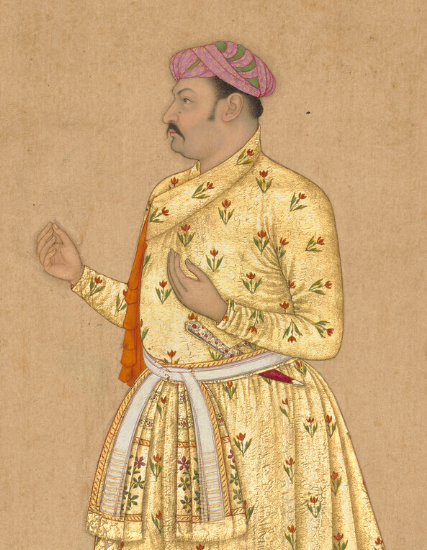
Abu’l Hasan Asaf Khan, c. 1615, Christie’s 26/10, lot 5
The excitement this season comes from the auction of two major art collections: Edith & Stuart Cary Welch Collection sold by Sotheby’s, and Toby Falk’s collection presented by Christie’s, two important scholars of Indian painting in particular. The Welch collection is sold in two parts, live on the 25th October in the morning, and online from the 18th to the 27th. Sotheby’s made the interesting choice to present the collection has a whole under the Islamic and Indian department instead of splitting between departments, maybe following owner instructions, or to capitalise on the Welch name, known by collectors of Islamic and Indian art but not necessarily by others. The live catalogue includes Chinese, Japanese, and of course Indian artworks, while the online catalogue also includes Persian and European works, with generally lower estimates. Toby Falk’s collection is mainly composed of Indian paintings, with some Persian and Ottoman inclusions here and there. The quality of both collections reflect the impeccable taste of their owners, as well as their access to exclusive material via a network of merchants and collectors it would be interesting to investigate.
Amateurs of Indian arts on lower budgets will particularly appreciate Chiswick afternoon catalogue, which includes almost half on Indian objects, from painting to furniture, jewellery, musical instruments, and other. The prevalence of Indian paintings and objects in Islamic and Indian art auction is nothing new, but it is particularly visible this season and we can question how the market will be able to absorb this influx, especially given the two collector sales come on top of Christie’s and Sotheby’s selection in the main sale catalogues.
My Top 5
I did it for the previous Islamic week after someone asked me and really enjoyed picking 5 items among the treasures offered. This top 5 is just what I would buy if I had the funds regardless of market value or trends. In no particular order:
Roseberys, lot 500: A picchvai of Krishna fluting among rising lotus flowers, India, mid-20th century. This is the cutest wall-hanging I have ever seen, that is it.
Sotheby’s, E&SCW Collection, lot 77: Anonymous, “Whose Sleeves? (Tagasode)”, Momoyama-Edo Period, late 16th-early 17th century. Not Islamic but I adore these Japanese painted folding screens. I posted a different one on Instagram last year and I’m excited to see this one!
Christie’s, lot 50: A Hispano-moresque carved and bone-inlaid cabinet, Spain, 16th/17th c. My love for architectural cabinets will live forever.
Chiswick, lot 283: A Safavid tile mosaic with yellow peacock, 17th c. Collecting architectural ceramic goes against my principles, however I really love this production of Safavid architectural mosaic, they are so lively and colourful.
Christie’s, TF collection, lot 9: A peri in a garden, Mughal India, 16th c. The fineness of this depiction is absolutely striking.
A picchvai of Krishna fluting, India, mid-20th c.
Roseberys 30/10/23, lot 500 (detail)
Welcome back for the part 2 of this Top 20, in which we will explore the 12 most expensive pieces of Islamic art ever sold. Yes, 12, despite Part 1 already covering numbers 20 to 11. When initially drafting the list, I forgot to number one of the entries, and I then found another piece which I had completely forgotten about (it was sold in 2010, to be fair). Let’s not dwell too much on my methods, hope that I haven’t forgotten anything else (I might have, in all honesty), and let’s consider these as two bonus entries in this Top… 22! For reminder, I purposefully excluded the “Maharajas & Mughal Magnificence” auction held at Christie’s New York in June 2019, which was composed of jewelled pieces, gems and paintings from the Al-Thani collection, some being questionably “Islamic”. As well, I only went back to 2010 for ease and I did not take into account inflation, so the prices discussed here and in part 1 are as they were at the time of the sale. Without further delays, let’s jump in!
All prices include premium. Click on the auction date and estimate to access the catalogue notice.
12 (Bonus entry) – £ 4,521,250: A Mamluk silver & copper-inlaid brass candlestick, Egypt or Syria, 1340-5
Starting with the only Mamluk object in this list, this silver and copper-inlaid brass candlestick, remarkable for several reasons. The shield-shaped blazon is that of Tuquztamur al-Hamawi, a mamluk who had known a prodigious ascension from slave to cup-bearer of the sultan Ibn Qala’un, to Viceroy of Syria from 743/ 1342 till 746/ 1345. His mark is found on a number of objects listed in the auction catalogue. Interestingly, the inscription on the candlestick mentions Qushtumur, Tuquztamur’s major-domo and not Tuquztamur himself. The blazon is made of silver and a thick layer of red copper, which is not the most common feature of Mamluk brass objects and really highlights the coat of arm among the beautiful decoration of vegetal elements. The candlestick was in Europe in the 19th century, where it disappeared in private collections after being sold in 1897.
Mamluk brass Candlestick, Sotheby’s 06.04.11, 325
11 (Bonus entry) – £ 4,842,000: “Rustam kicking the boulder”, Shah Tahmasp’s Shahnama, Tabriz, c. 1530
This is the first page in this top 20 of the infamous Shahnama made for the Safavid king Shah Tahmasp (r. 1524-1576). It was presented by Christie’s in 2022, more than 10 years since the last page sold, which, unsurprisingly, created a lot of excitement. This manuscript is considered as the peak of refinement of Persian painting, and the results of centuries of aesthetic research by makers working under a royal patronage. Consequently, there are four pages of Shah Tahmasp’s Shahnama in this top 10 alone, an impressive number considering there is no other Persian manuscript nor painting in the whole top 20.
For a bit of context, the manuscript was started for the first king of the Safavid dynasty, Shah Isma’il (r. 1501-1524) and finished for his successor. Very quickly after its completion, Shah Tahmasp gifted the manuscript to the Ottoman sultan Selim II (r. 1556-1574) who added it to the royal collection in Topkapi palace. The manuscript stayed there until the beginning of the 20th century, when pages mysteriously appeared on the French art market in 1903. The whole history of the manuscript is explained by Dr Firuza Melville, director of research of Cambridge Shahnama centre for Persian Studies in an episode of the ART Informant dedicated to the Shahnama and recorded on the occasion of the sale of another page. The page itself dazzles by its level of precision and the number of intricate details on every elements. The use of a large amount of gold, speckled in the margin and to signify the sky, as well as silver to depict shimmering water (now blackened due to unreversible oxidation) highlight the immense luxury of the manuscript, but the circular composition with the hero Rustam at its centre also shows some weaknesses, Rustam position being a bit awkward. This might explain why the page “only” sold for £4.8M despite the general enthusiasm for the sale.
“Rustam kicks the boulder”, Shah Tahmasp’s Shahnamah, Christie’s, 31.03.22, 41
10 – £ 4,875,800: “Bizhan slays Nastihan”, Shah Tahmasp’s Shahnama, Tabriz, c. 1530
This second page of Shah Tahmasp’s Shahnama was sold in the last spring Islamic week. After the sale of the aforementioned “Rustam kicking the boulder” page at Christie’s, other owners became inclined to sell. Sotheby’s offered this page with an estimate of £4 – 6 millions following the success of that first page, and more especially the record-breaking sale of another page presented later in this ranking. As I wrote in my overview of the Islamic week, “usually, fight scenes sell for less than other types of illustrations, but this is the most sumptuous Persian manuscript ever created, so the rule might not apply”. In the end, the rule did apply and the page sold on the lowest range of its estimate (bearing in mind the final price includes the buyer’s premium of around 14%), despite being a night scene, generally more visually sticking than day scenes, and a level of details that makes this page a perpetual rediscovery.
“Bizhan slays Nastihan”, Shah Tahmasp’s Shahnamah, Sotheby’s 26.04.23, 41
9 – £ 5,323,500: Portrait of Suleyman by a Follower of Gentile Bellini, Venice, c. 1520
This is where we enter the realm of the surreal, starting with a surprise. Indeed, I was not expecting this portrait of Suleyman to make the list. Valued £250,000-350,000, it sold for more than 15 times its high estimate, which is slightly puzzling given the absence of signature or date. The painting illustrates the blurry and arbitrary definition of “Islamic arts” on the art market, as well as the central role of catalogue notices in sale strategy. I am not a specialist of 15th century Venetian painting and have no opinion on the attribution, including whether this painting is the long lost model for Albrecht Durer portrait of the sultan made in 1526 (musée Bonnat, Bayonne), but I am certainly intrigued by this painting thanks to the thorough research and precise description in the catalogue. This painting could have gone unnoticed if sold in an “Old Masters” auction, instead, it made the list! I wonder if it was bought by an Islamic art or a Renaissance painting collector.
Portrait of Suleyman, Sotheby’s 01.05.19, 129
8 – £ 5,359,950: A blue & white Pottery Charger, Iznik, Ottoman Turkey, c. 1480
When this extraordinary ceramic plate was presented at Sotheby’s back in 2018, everybody was expecting to sell quite well given the obvious aesthetic qualities of the blue and white decoration. Sold for more than 10 times is high estimate, the “Debbane charger”, named after its previous owner, is one of the rare examples of Iznik ceramics produced in Ottoman Anatolia during the reigns of Mehmet II (‘the Conqueror’, r.1451-81) and his son, Bayezid II (r.1481-1512). Only four other large dishes of that type are known, all with a similar decoration of central floret surrounded by split-palmette rum‘ motifs and hatayi flowers in two shades of blue and white. The production of these dishes is very limited in time, usually dated to the 1470s and 1480s, and shines for its technical and aesthetic prodigality. The estimate was surprisingly conservative but it certainly helped Sotheby’s in breaking a record.
Debbane Charger, Sotheby’s 24.10.18, 134
7 – £ 5,442,000: A square Pashmina Carpet, Mughal India, c. 1650
The estimate and overall price of this 17th century carpet, produced in northern India, are justified by the rarity of Mughal carpets, especially complete ones, the excellent state of preservation and careful restorations, and the unusual square format. It was most likely made during the reign of emperor Shah Jahan (r. 1628-1658), during which floral designs spread (pardon the pun) to all artistic media, including architecture such as the Taj Mahal, album painting (my book will come out one day), and, of course, textile. This carpet was published and exhibited in the 1990s and 2000s, which seems to have compensated the provenance only going back to 1991 in the eyes of buyers.
Mughal Carpet, Christie’s 27.10.22, 200
6 – £ 6,201,250: A Kerman ‘vase’ carpet, Persia, 17th century
This is the lot I had forgotten about… Sold in 2010, it held the record of most expensive carpet in the world for a few years. Valued at £200,000-300,000, it sold for more than 17 times its high estimate, which is remarkable by itself, but the most spectacular is definitely the vibrant blue used in an usually large quantity to enhance the branches of saz leaves. The term ‘vase’ carpet was first coined by carpet scholar Dr. May Beattie, in reference to the vase motif inspired by Chinese design, not visible on this carpet but on others such as one in the Saint Louis Art Museum. The term also refers to a specific production in the Kerman region during the 17th century, characterised by its technique, which I will abstain from trying to explain, carpets not being my forte. This one was in an European collection in the early 20th century and was published in Pope’s A Survey of Persian Art in 1938. An impressive carpet with an impressive pedigree.
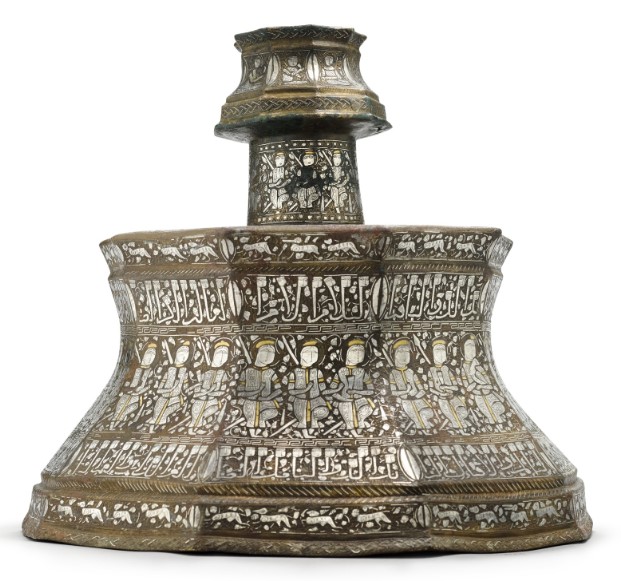
5 – £ 6,632,400: A gold and silver-inlaid brass Candlestick, probably Mosul, circa 1275
This candlestick was maybe made in Mosul after the city conquest by the Mongol in 1262, and belongs to a group of similar facetted candlesticks with concave body, this one being exceptional for the large scale of the figures animating the facets. Made by an anonymous maker, it bears no date nor dedication, just phrases of benediction. It is a deceptively small object, the base being only 30cm in diameter, but it is quite remarkable for the quality of its ornamentation and the overall state of preservation. It came with an European provenance dating back to the 1960s and was previously sold in Paris in 2003 for a price I couldn’t retrieve.
Candlestick, Mossul, c. 1275, Sotheby’s 27.10.21, 170
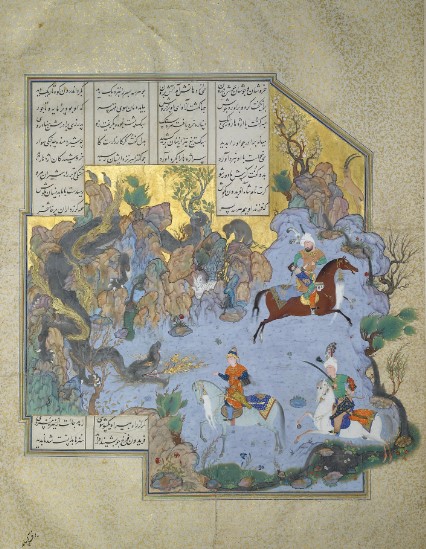
4 – £ 7,433,250: “Faridun tests his Sons”, Shah Tahmasp’s Shahnama, Tabriz, c. 1530
This page was part of the sale of Stuart Cary Welch’s collection in 2011, a few year after his passing. A pioneer in many aspects of Islamic art history, SC Welch started collecting Islamic and Indian art very early, and by the end of his life, he had amassed one of the most comprehensive collections, of works on paper in particular. This folio of Shah Tahmasp’s Shahnama was the crown jewel of his collection, Welch writing: “acquiring it: the costliest acquisition I had ever made. Terrible effort, but successful (a Triumph!) – “
The scene depicts the hero Faridun, in the guise of a Dragon, testing his three sons on their way back from Yemen, where they married the three daughters of the king. The dragon is shown descending from a rocky mountain, facing the three brothers: the eldest is fleeing (“No wise man fights with dragon foes“), the second has drawn his sword to fight (“If combat’s needed I can fight“), the youngest is yelling at the beast (“Out of our path, fell monster, step aside“). The painting is a masterpiece of narration, highlighted with the luxury and level of detail that characterise the whole manuscript. Given this, the rarity of Shahnama pages on the market at the time, and the prestigious provenance, the result was not a surprise.
“Faridun tests his sons”, Shah Tahmasp’s Shahnamah, Sotheby’s, 06.04.11, 78
3 – £ 8,061,700: “Rustam recovers Rakhsh”, Shah Tahmasp’s Shahnama, Tabriz, c. 1530
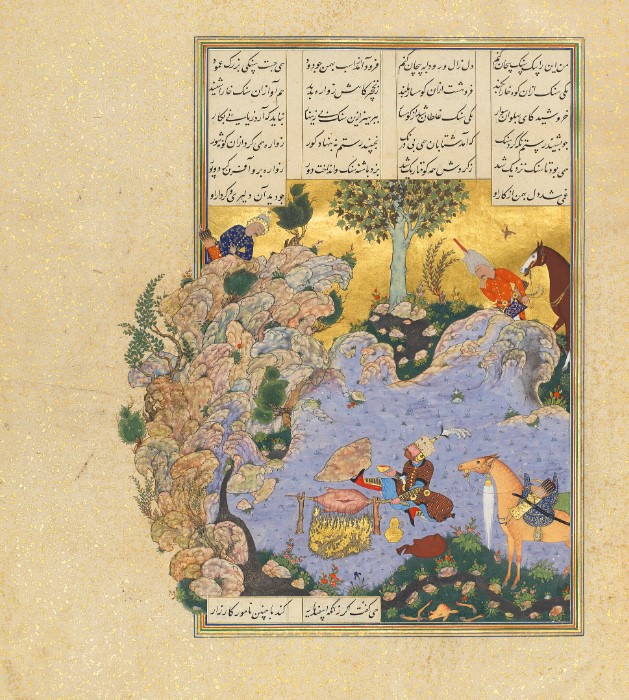
Here is the most expensive Persian painting ever sold, and unsurprisingly it is a page from Shah Tahmasp’s Shahnama. It was previously sold at Christie’s in 1988 and only reappeared in 2022 after the successful sale of another page (#9). The scene depicts the moment when the hero Rustam discovers his horse Rakhsh amongst Afrasiyab’s herd. Rustam, dressed in his leopard-skin cap, frees the royal herd, to the surprise of the royal herdsmen. Rustam was given the chestnut horse by his father Zal who had promised to find him a horse worthy of his warrior status. According to Rustam “Its body was a wonder to behold,Like saffron petals, mottled red and gold; Brave as a lion, a camel for its height,An elephant in massive strength and might”. The painting is striking for its lyricism and its bright colour palette, especially the vibrant lapis blue that constitutes the sky. Dr Firuza Melville talked about this marvellous page in the ART Informant podcast.
“Rustam recovers Rakhsh”, Shah Tahmasp’s Shahnamah, Sotheby’s 26.04.23, 49
As mentioned in the introduction, I only went back to 2010 in this ranking, however this list would not have been complete without mentioning the sale of the Abbasid Ka’ba Key and the controversy that followed. For a few years, this artefact was the most expensive Islamic art object ever sold, bought at a time where Saudi Arabia and Qatar were throwing millions at the market to constitute their collections (before 2008, the record was held by a 10th century Umayyad bronze fountainhead in the form of a hind, sold at Christie’s in 1997 for £3.6 millions, now in the Museum of Islamic art in Doha (acc. MW.7.1997).
Less than 60 Ka’ba keys are known, all in public collections, so the apparition of this Abbasid key from an anonymous Lebanese collection was an exciting surprise for everybody. It was believed to be the second oldest key in existence, dated less than 20 years after the oldest one (now in Topkapi palace, Istanbul). It was sold for £9.2 millions, over 18 times the estimate, but only 2 weeks after the sale, doubts were raised regarding its authenticity, prompting Sotheby’s to annul the result. The key was brought to the British Museum for further analysis and was given back to its initial owner shortly after: it was a fake.
The fake Abbasid Ka’ba key, Sotheby’s 9.04.08, 51
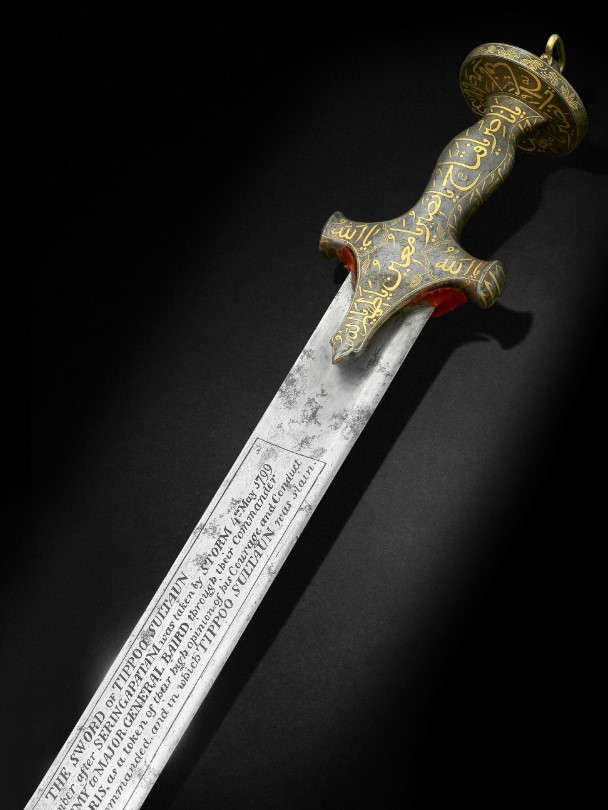
2 – £ 14,080,900: The Bedchamber Sword of Tipu Sultan, India, 18th Century
Valued at £1,500,000, the bedchamber sword of Tipu Sultan recently sold for almost 10 times more. The sword itself is of great quality and in an almost pristine state of preservation, but let’s be honest, this price is hardly justified. The sword was ‘found’ in Tipu Sultan’s private apartments after his death in 1799 and offered to the Major General David Baird. It remained in his family until 2003 when it was sold in London for £150,000 (against an estimate of £150,000-250,000). Bonhams recognised the craze for everything Tipu Sultan and presented the sword 20 years later for 10 times the estimate, and it became the 2nd most expensive Islamic art object ever sold. In the mind of many, Tipu Sultan represents the fight against oppression led by corporate greed, so the irony is not lost that his possessions now make millions of pound on London art market.
Tipu Sultan’s sword, Bonhams, 23.05.23, 175
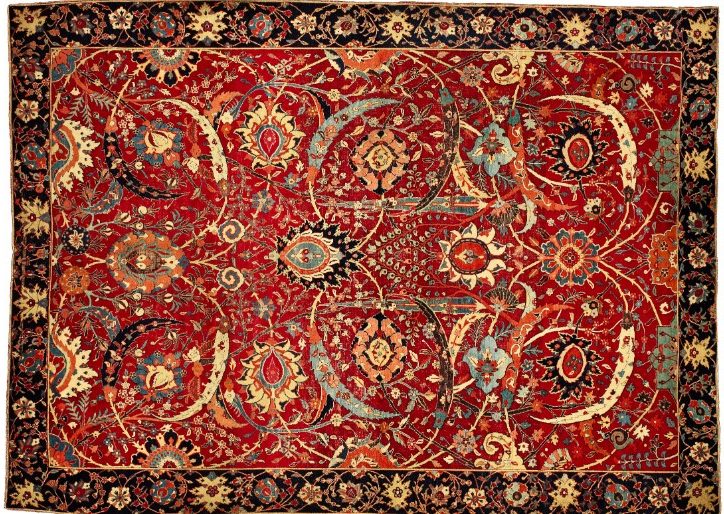
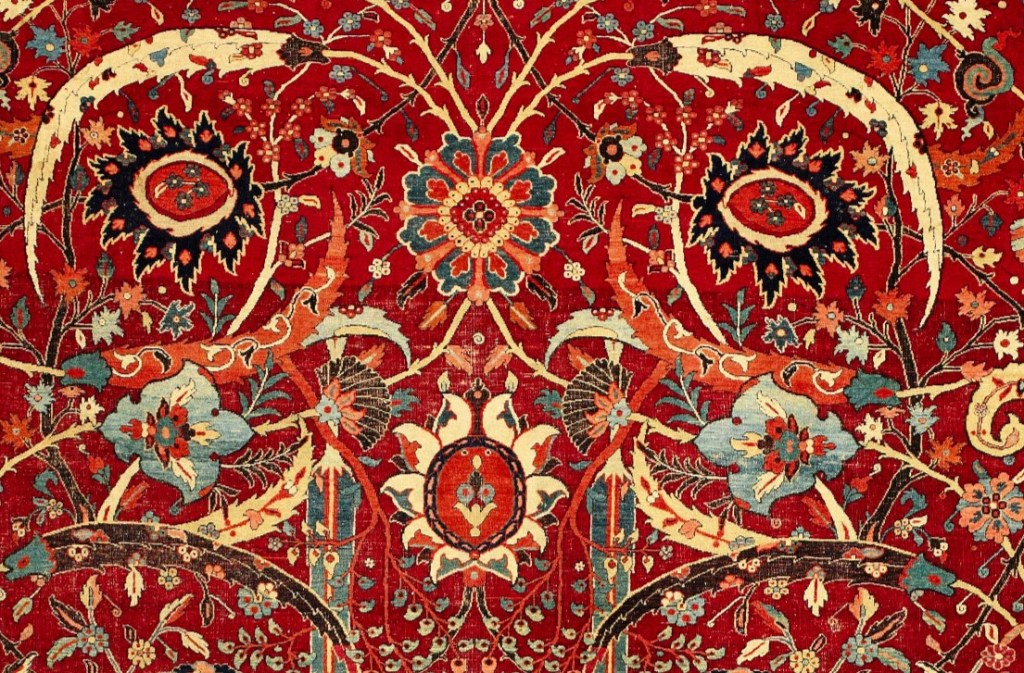
1 – $33,765,000: The Clark Sickle-Leaf carpet, prob. Kerman, Persia, 17th Century
Here it is, the most expensive Islamic art object ever sold at auction, the so-called Clark sickle-leaf carpet, from the same production as the blue carpet aforementioned (#6). Sotheby’s wrote a very comprehensive entry that I will not paraphrase, I encourage you to give it a read. This carpet is striking by the size of its motifs, especially the long saz leaves that divide the space, as well as its bold red colour and its almost perfect state of preservation. Not to mention its provenance: this carpet was exhibited at least 9 times in 60 years, and published countless more, Arthur U. Pope writing in 1939: “The Clark-Corcoran carpet is definitely the finest of the group, and is surely one of the outstanding examples of Persian carpet weaving.” (Survey of Persian Art, vol. VI, 1939, pp. 2385-2386, quoted from Sotheby’s catalogue). According to the author, this carpet would have been woven as a dais for the shah’s throne. This was never confirmed but the image stuck for many years. So, would you have paid $33.8 millions for it (£26.5M; €30.8M in today conversion)?
Clark Sickle-Leaf carpet, Sotheby’s NY 5.06.13, lot 12Detail of the Clark Sickle-Leaf carpet, Sotheby’s NY 5.06.13

















 Isabelle Imbert