This short message to inform readers that this blog will not be updated for the foreseeable future. All previous posts remain available, so if you want to get started in Islamic art History and Market, I recommend the following:
I put a lot of care and effort in writing each post, and I am not willing to compromise on quality just to produce content. So, this is goodbye for now! I am not excluding posting again at some point, but for now, life has other plans for me and I won’t be able to free the time needed to write interesting and insightful texts.
Finally, and most importantly, I wish to thank all the readers who have been following this blog and have contributed, one way or the other, to its success. Take care, stay curious, be happy!
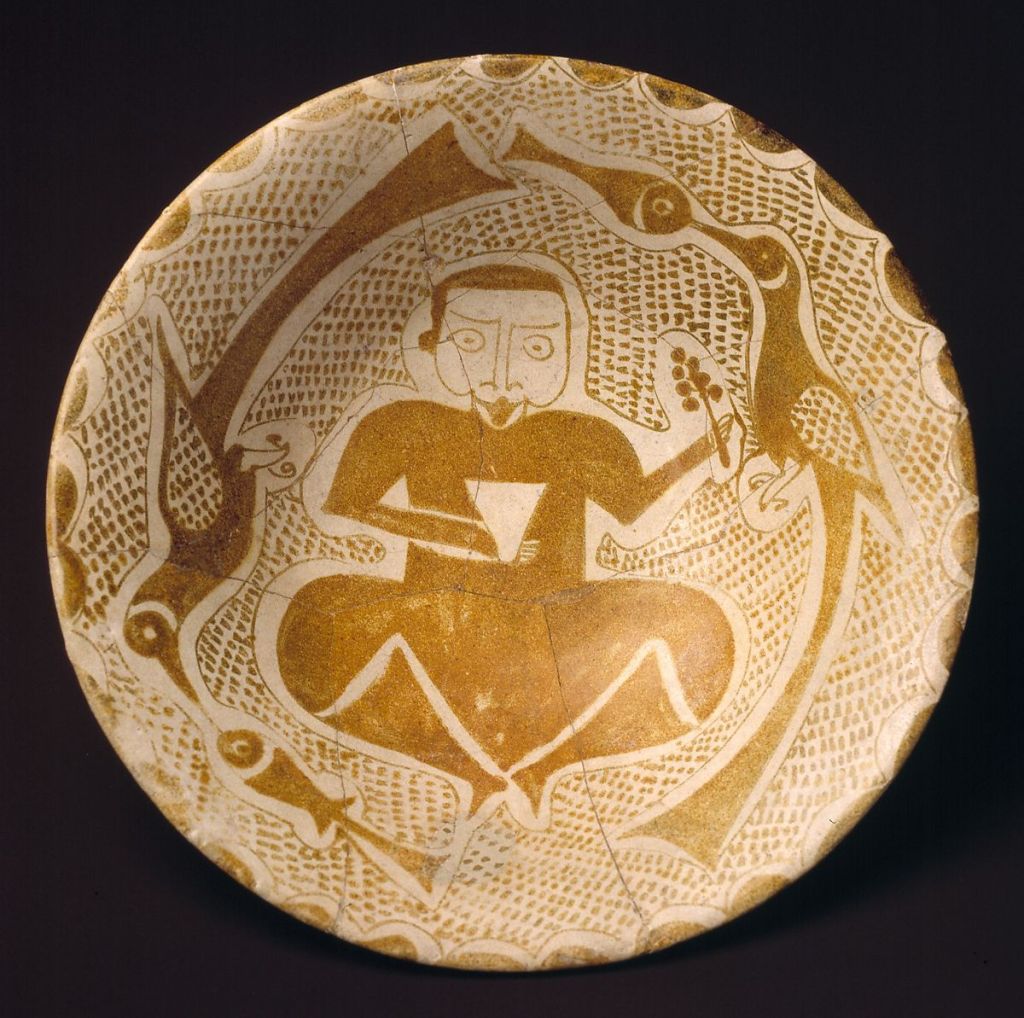
Bowl, Iraq, 10th century MET Museum, NY (1977.126)
I finally have a spare minute to do a part 2 of my Islamic week review, but because it was already three weeks ago, I’m going to share only a few additional thoughts, including on “current affairs”. With these 2-part posts, I’m trying a new, shorter format, that’ll allow me to publish more often, and that is hopefully nice to read. Let me know what you think of it!
To restore or not to restore, here is the (undisclosed) question
Some are going to say that I am on a personal crusade against big auction houses, which is completely false, but we need to talk about restoration practices. They are inherently not a bad thing, but as always, I find the lack of transparency problematic.
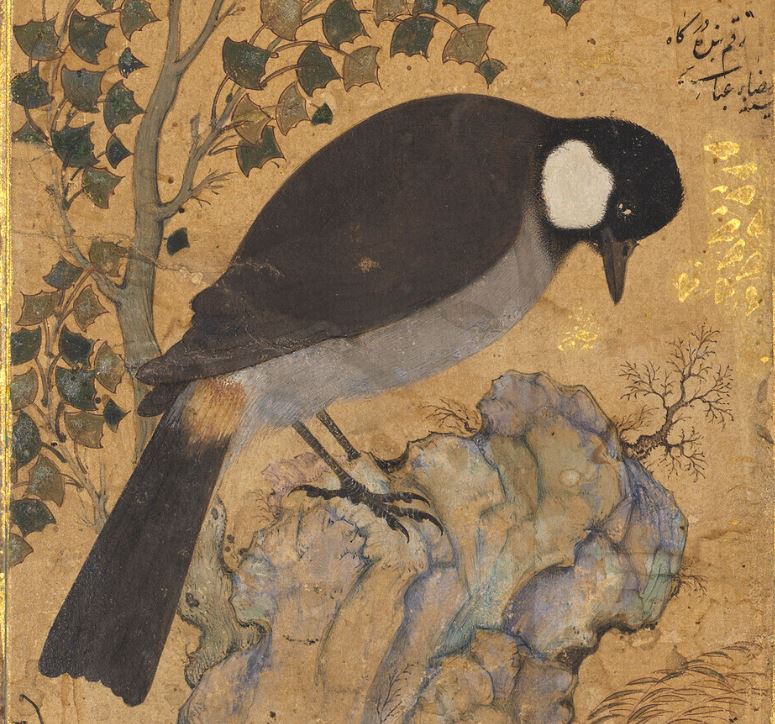
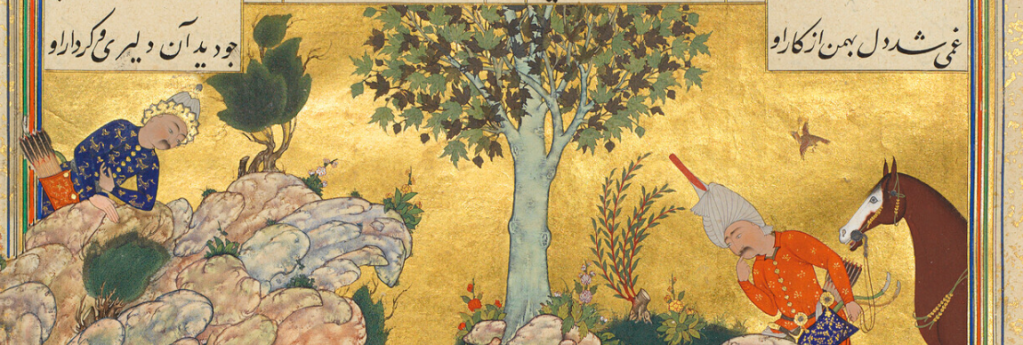
Christie’s sold a painting of a bird signed by the famous Safavid painter Riza ‘Abbasi for £163,800, against an estimate of £100,000-150,000. It was an event to see this painting on the art market again, as the catalogue noted that it was previously sold in 1961 as part of the sale of the Sevadijan collection. Unfortunately, this is not exactly true. As I mentioned in my initial review of the Islamic week, the painting was sold last June in Versailles by Chevau-Leger Encheres for €36,000, against a laughable estimate of €100-150 (talk to specialists, people).1 This auction is not mentioned as part of the provenance in Christie’s auction catalogue. Legally, all bases were covered with the 1961auction, and there was no need to add any information on more recent movements. The problem this omission raises is ethical, and it is misleading to imply that the page had been in a single collection since 1961, when it is, in fact, not the case. The other issue is that between June and October 2022, the painting was restored.
It is a common practice for auction houses to send prestigious pieces such as this one to the restorer. It is particularly common for metalworks, where silver or gold get injected to revive the inlays. Now, I am not against restorations, on the contrary. Restorations are part of the history of individual artworks, and it is great to see a beautiful piece getting back to its former glory. It also makes sense economically, everybody prefers buying pieces in good state rather than completely decrepit. However, restorations should be documented, and in the case of the art market, they should be disclosed. In Western museums, restorations are carefully analysed, weighted and documented. As well, the restoration in case of compensation or loss: “should be detectable by common examination methods.”2 There is no such guideline for auction houses.
The restorations were not mentioned in Christie’s condition report available on the website and laid below, which probably indicates they were conducted by the vendor, as the auction house has an obligation to mention them in condition reports (but not in the catalogue):
This painting is in good and stable condition overall. There are small areas of discoloration on the cream and illuminated background. The gilded areas bear faint discoloration in some areas and some surface craquelure. The pigments used on the bird eye bear light craquelure, as seen from the catalogue image. The multicoloured rock and part of the bird bears small and faint water stains which are only visible upon close inspection. Small area of crease along the left and middle of the painting. The ink of the signature is very slightly flaked, but remains fully legible. The illuminated outer margins include light areas of rubbing and slight discoloration as a result of light exposure. The painting has been pasted down on a blue card as part of the album page it once belonged to.
I will not assume anything regarding Christie’s knowledge, but this shows, once again, the importance of thorough and documented provenance. Collectors should be made aware of potential restorations carried out on their newly acquired piece, as, again, it is part of the history. It is also an element buyers take into account when purchasing a piece, and it is an important piece of information for future restorations. I hope the person or organisation responsible for the repaints on Riza Abbasi’s painting gave all the documentation to the buyer.
The stars shine bright in Paris…
Lustre Lantern,Syria,12th/13th c. Artcurial 15/11/22, lot 66, 111520 €
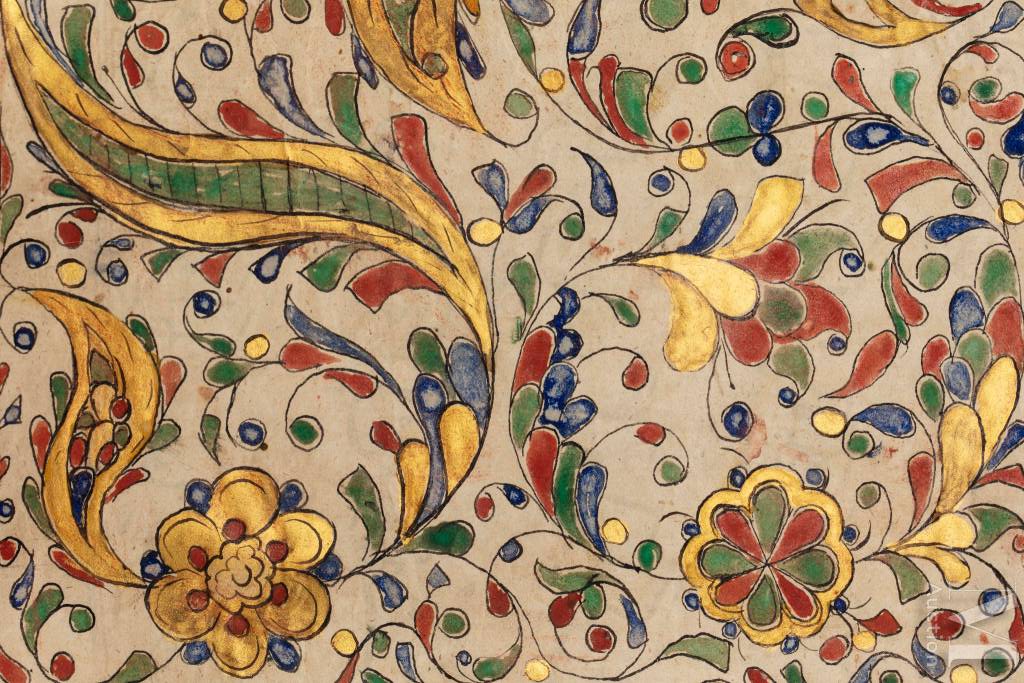
The auction season has started in Paris, and the first results deserve their dramatic title. The auction house Artcurial held their Islamic art auction on the 15th November, under the expertise of Pingannaud-David. They achieved a whooping 813,735€ total (including premium, as for all prices thereafter), an impressive result given that Pingannaud-David expertise was only created a year ago, and that their first auction at Artcurial this summer made only 211,336€. This massive progression is due to a combination of factors, starting with a better selection. Indian painting, which has proven to be quite unpopular in French auctions, was almost completely absent from the catalogue, replaced by a large amount of manuscripts and arms, which are more in favour. Estimates were also scaled down, with very affordable pieces of good quality. Finally, most of the objects had excellent provenances (yes, I’m going to write about provenance again). Objects from R. Froment’s collection were presented, acquired by between the 1950s and 1980s, as well as a selection of manuscripts from the collection of Princess Roxane Qajar (written Kadjar), descendant of Muhammad ‘Ali Shah Qajar (r. 1907-1909). It doesn’t get any better than that. Some of these manuscripts achieved expected high prices, such as the incredibly rare album of illumination motifs from the end of the 19th century, sold 65,600€ against an estimate of 8,000-12,000€. Some prices came as a surprise, such as the 36,736€ paid for a 19th century copy of Khosrow va Shirin value 1,500-2,000€ (dated and signed, admittedly). Among the other success, a rare lustre lantern from 12thor 13th century Ayyubid Syria, sold by Jean Soustiel to R. Froment in 1970, valued 15,000-20,000€ and sold for 111,520€, proving that Medieval ceramics require good provenance to sell well, and an Iznik panel of 3 tiles, proved circa 1570-80, from the same collection, sold at €81,344 against 20,000-30,000€. The craze for Iznik ceramics continues!
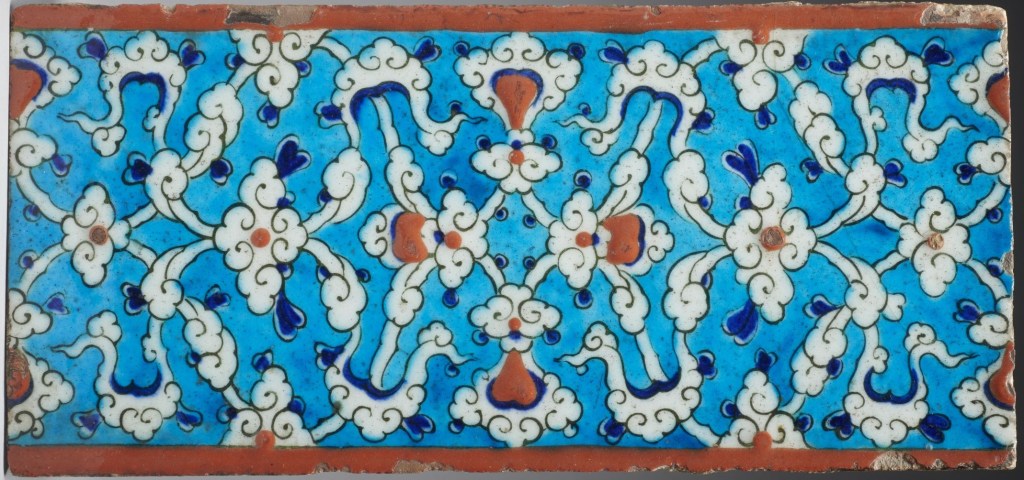
Iznik border, Ottoman Turkey, c. 1560-80, Artcurial 15/11/22, lot 80, 20992€
…But not on Medieval metalworks
What also continues is the funk in which Medieval metalworks seem to have fallen. Only one was offered, a 12th-13th c. Seljuk silver and copper-inlaid bronze inkwell, which looked nice on pictures (I wasn’t in Paris for the exhibition), but had no provenance other than Sotheby’s 2008. Medieval metalworks didn’t sell in London last month neither, apart at Chiswick which sold everything anyway. Two Egyptian pieces valued at £40,000-60,000 remained unsold at Christie’s, despite the hanging lamp having a provenance line; Sotheby’s kept more than half of their items, etc. I wonder why these artworks fell out of fashion so fast. I mentioned above undisclosed restorations, and of course the question of provenance that is now an important argument, but that’s not all. Rumour has it that many fakes were sold over the years, which would explain the disdain, but I haven’t seen any major public scandal that would have notoriously tainted the medium. This needs further investigation, so I’ll keep my eyes peeled!
The rest of the season will be quite busy: On the 23rd November, Millon will have their third “Orient classique, Trendy, Arty” auction with a large selection at various prices; the 2nd December, Collin du Boccage will present lots from the library of an Orientalist (expertised by Pingannaud-David), Millon will have their main auction on the 13th December, and the 14th December will hold a single-owner numismatic auction, which genuinely excites me. We will have to wait until the beginning of 2023 for Ader (expert Camille Cellier) and Rim Encheres (expert Rim Mezghani), which haven’t announced the dates yet. Stay tuned!
Detail of a Qur’an, Oriental Europe, 1290/ 1872, Millon 23/11/2022, lot 219, 5,000-6,000€
I am grateful to the person behind the account @completement.marteau for posting first about it in June.
The Islamic week just finished in London, and what a week it has been. Starting on a personal note, it’s been a busy one for me, and I am so grateful to have been able to see so many amazing experts, scholars, collectors and enthusiasts, who make the field of Islamic arts genuinely exciting. And of course, having the opportunity to see so many artworks is a privilege I never take for granted.
This blog article will be in two parts. I will give my thoughts on the main topics here, and will deep-dive more on certain items in the next one, keeping both articles easy to read and quick to write.
All prices include premium.
Now, there is a lot to say about the auctions. Bonhams opened the week with a catalogue of 157 lots and sold only 41% for a total of £471,697.50, while the online auction sold 46% of their 249 for £268,605.75. The next day, Sotheby’s sold 56% of their catalogue of 195 lots for a total of £14,224,727. On the Thursday, Christie’s sold 90% of their 264 lots for £15,989,353, a record for Christie’s London in the past 15 years, only surpassed in May 2019 when three lots were sold for more than £3 million each. On the Friday, Chiswick won the whole week by achieving a white-glove sale in their single-owner morning auction, selling 100% of the 89 lots for £141,361. The afternoon auction also did well with 63% sold of their 360 lots for £327,401. Finally, Roseberys sold 66% of their 418 lots (excluding archaeology) for a total of £736,918, an impressive total.
Pitchwai celebrating Nandi, India, 20th c, Roseberys 28/10/22, lot 468, £2,470
The downfall of Bonhams
We need to talk about Bonhams first. I am usually quite critical of auction houses and catalogues that are not up to the standard that we should expect, but this is heartbreaking. Bonhams’ Islamic and Indian art department has been in decline for the past 10 years, and this is their worse Islamic week sale so far (excluding secondary and online auctions).
Bonhams Islamic week results over the last 10 years.
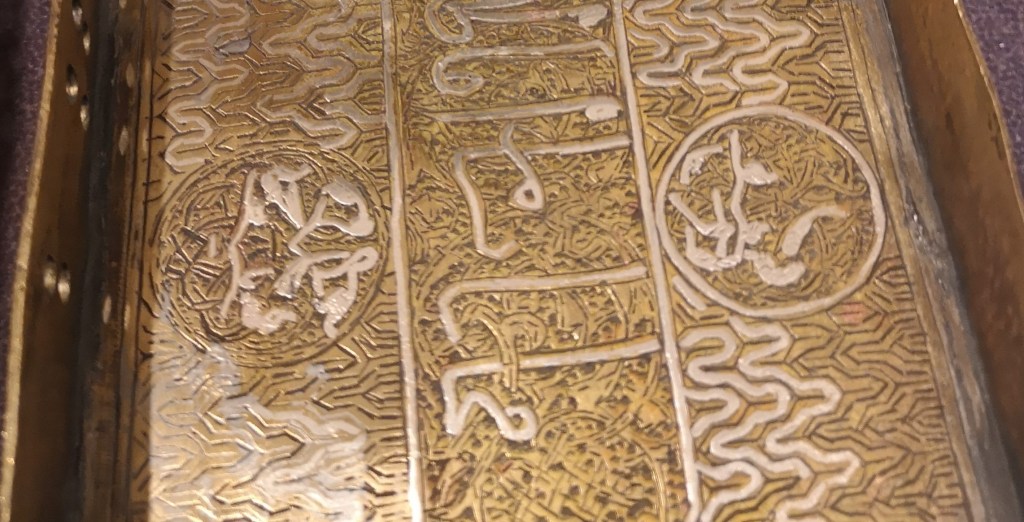
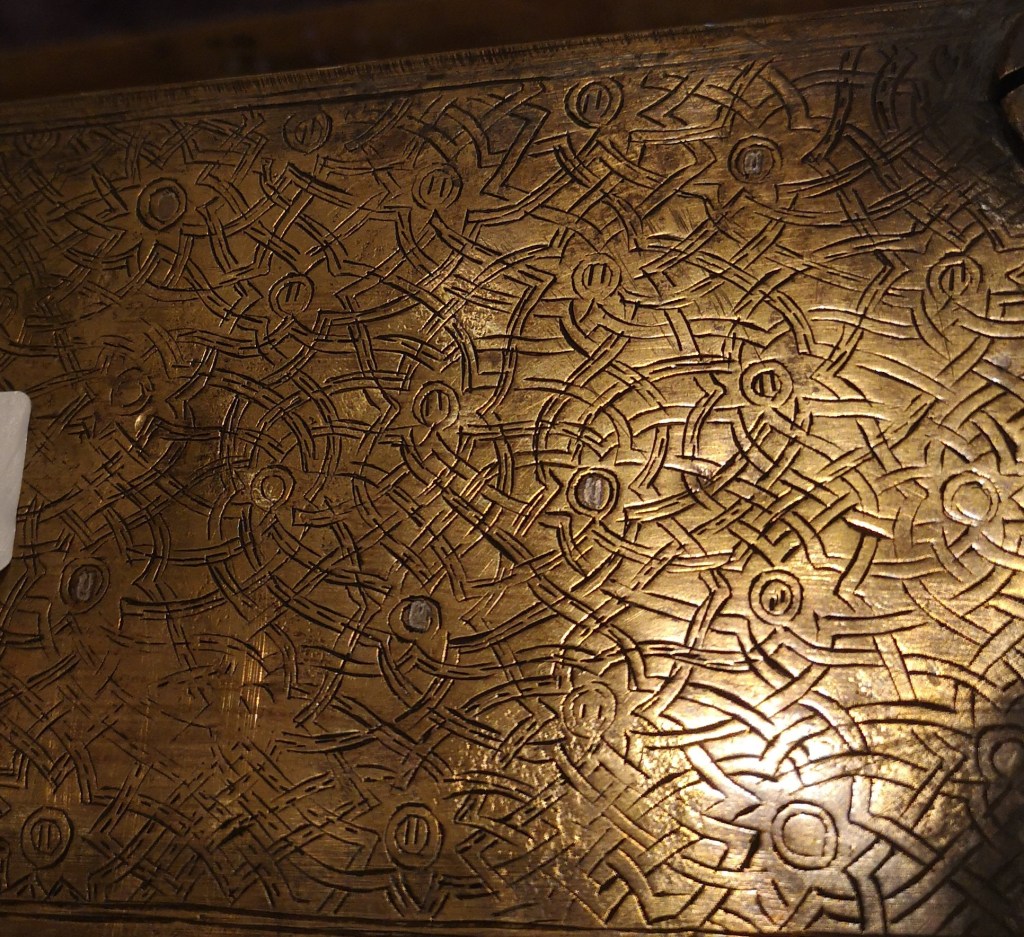
This can be explained by past mistakes, but mainly by a catalogue that felt rushed and incomplete, and lots presented with a number of issues more or less disclosed. I am not going to repeat here what I previously wrote about the importance of providing provenance for the top lots (and ideally not a previous auction catalogue as sole provenance, but that’s beside the point for now), however I’ll add that condition reports should be as precise and thorough as provenance. I will only give one example, as it feels like beating a dead horse, the Mamluk pen-case, the auction top lot valued £90,000-120,000 and remained unsold. Upon close examination, it appears that the silver incrustations were most likely later restorations, the same with the engravings at the bottom of the box. This was not described in the catalogue, and the inlay restorations were barely mentioned in the condition report, while the addition of the engravings at the bottom were omitted. The object looked good in picture and from the far, but the semi-lack of transparency (some later additions were described) and the not so great details up-close discouraged buyers. Now, I am of course not saying that objects should be pristine, obviously, damages and restorations are part of their history, but they should not be concealed shamefully, on the contrary. This is not a problem exclusive to Bonhams, I’ll talk about it more in part 2 of this review.
Detail of Bonhams 25/10/22 lot 36 showing the later restorations of the silver inlaysDetail of Bonhams 25/10/22 lot 36 showing the later engravings below the box
In contrast, Bonhams’ top sale is a small portrait of a Persian dignitary signed by the famous painter Abu’l-Hasan Ghaffari Kashani (d. 1282/1865-6), who worked at the court of Qajar rulers Muhammad Shah and Nasir al-Din Shah period, and signed this piece in 1262 H./ 1845-46. It also came with stellar provenance and a good catalogue entry full of references. Valued at £15,000-20,000, it sold for £40,620.
I think Bonhams is currently struggling to find its place in a complex and rapidly evolving market. It cannot compete with Christie’s and Sotheby’s as it did in the past, and it’s not in the same market division as Chiswick and Roseberys, so it sits oddly in the middle. The effort of the Islamic and Indian art department to expend their selection, notably by adding a Sikh art section, is truly commendable, but they might need to revamp further, while pushing on provenance and transparency to repair their reputation.
Panel of three Safavid Kubachi tiles, Iran, 17th c., Chiswick 28/10/22, lot 14, £1,125
Expected results, good surprises…
Of course, everybody was waiting to see how much would achieve the page from Shah Tahmasp’s Shahnama, offered by Sotheby’s for £4,000,000-6,000,000. Well, it did not disappoint, reaching £8,061,700, beating the record set with another page sold in 2011 for £7.4 millions as part of the collection of Stuart Cary Welch. Two main biders were competing on the phones, so we’ll have to wait until the buyer reveals themselves, if they do. If you want to learn more about this page, you can still listen to the ART Informant podcast episode with Dr Firuza Melville.
A big surprise was the 11th c. Andalusia oil lamp offered with an estimate of £300,000 – 400,000 and sold for £1,608,000. Maybe because I was captivated by so many gorgeous pieces, I didn’t notice this lamp during the exhibition, I completely walked past it! I regret it now, especially because this type of telescopic lamps are incredibly rare.
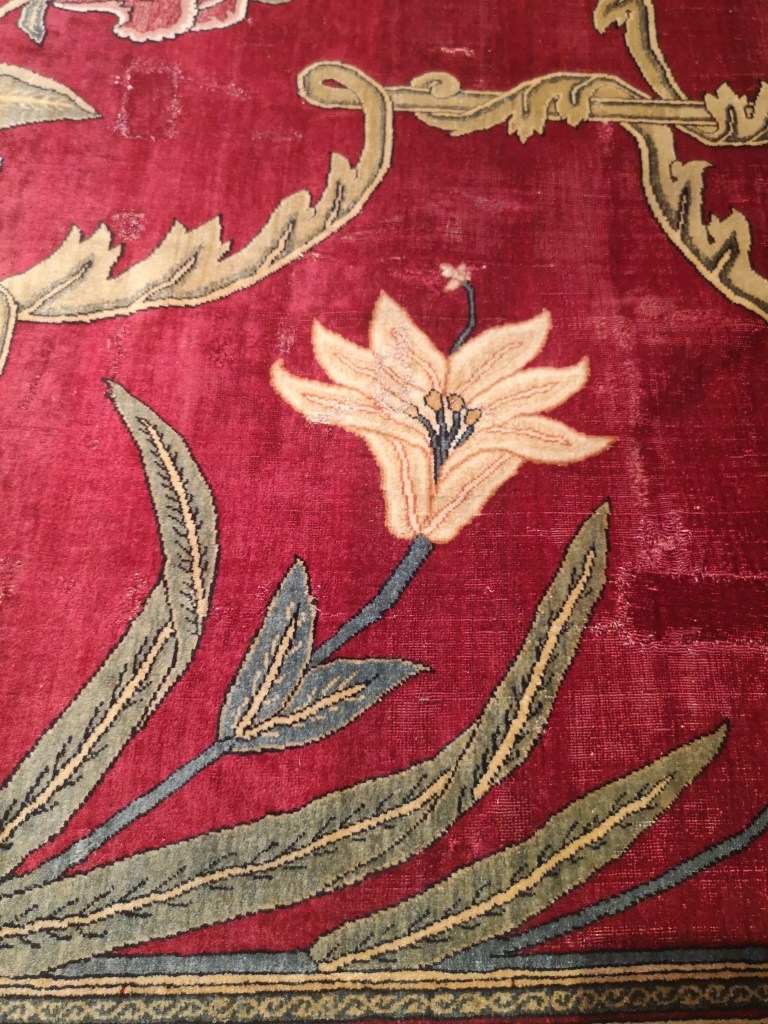
I wrote in my previous blog that I would wait to see what the market decide regarding the Mughal pashmina carpet valued £2,500,000-3,500,000. It was sold for £5,442,000, also breaking the record on carpet auctions.
Mughal pashmina carpet, India, c. 1650, Christie’s 27/10/22, lot 200, £5,442,000
More surprisingly were the £1,002,000 achieved by an 8th c. Kufic Qur’an section of 162 folios, sold against an estimate of £350,000-450,000. I wrote a few years ago that Kufic Qur’ans popularity was decreasing, and I admit that I was wrong. I don’t understand why this manuscript did so well, I can only hope the new owner will not disbound it to sell the pages separately. Sotheby’s also did well, selling the monumental Qur’an page for £819,000 (£650,000 hammer, same as Millon’s page sold last June).
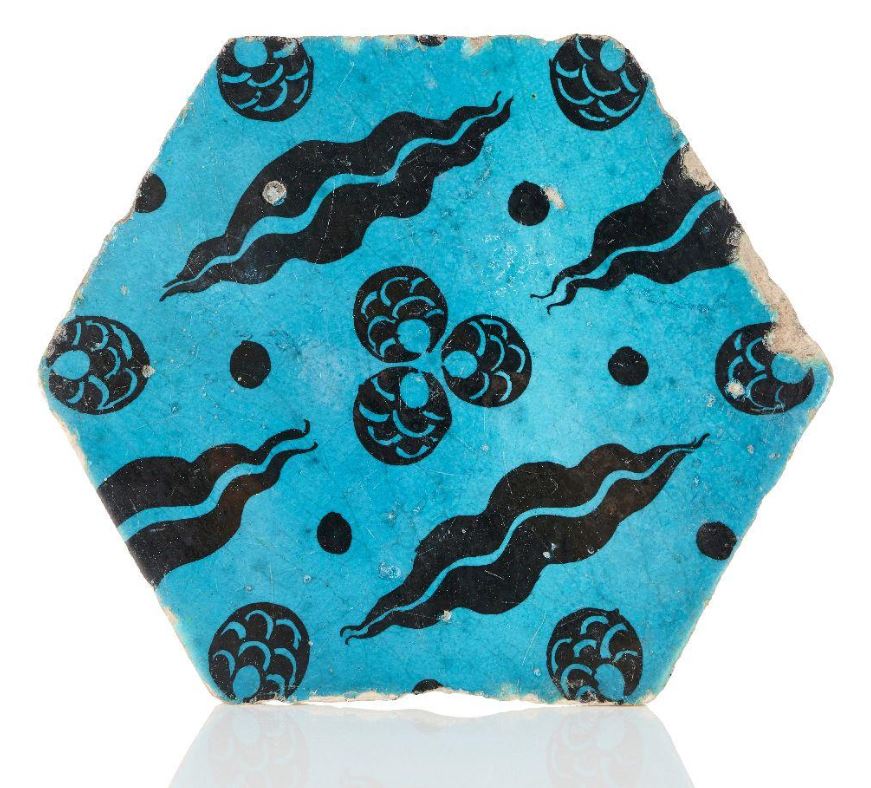
Unsurprisingly, Turkish Iznik ceramics did very well. Christie’s sold a delightful 16th century jug with the most amazing lavender colour for £906,000, against an estimate of £120,000-180,000. Roseberys exploded the percentage value of their hexagonal Cintimani tile from 16th c. Ottoman Syria, selling it £114,400, 186.5% from the high estimate of £4,000.
Finally, let’s mention Chiswick, which also had an excellent day on Friday, starting with the very first lot, a lovely cast openwork bronze incense burner in the shape of a lion from 12th c. Khorassan, sold for £11,250. This was included in the fourth part of their single-owner sale, this one achieving a rare 100% of lots sold. In the afternoon, a portrait of a prince from 18th c. Deccan reached £17,500.
Cintimani tile, Syria, 16th century, Roseberys 28/10/22, lot 85, £114,000
… And bad news
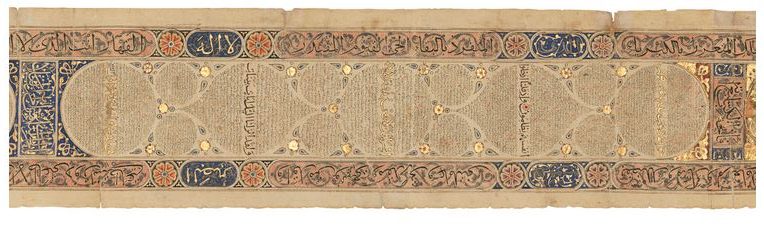
After the scandal of Timurid Qur’an, sold in 2020 for £7.016.250, that turned out to have been stolen from Afghanistan in 2019, another huge controversy is coming to Christie’s. The extraordinary 14th century Il-khanid Qur’an scroll, offered for £250,000-350,000 and sold for £1,602,000, has started to make some noise in Turkey, where some write that it was allegedly stolen. It was apparently offered for sale in 2010, but was withdrawn and removed from the online and print catalogue after it was discovered as allegedly stolen. Christie’s put it back for auction this October, 12 years later, most likely because the legal status of the piece changed (supposedly), but Turkish authorities are currently investigating. You can read about this on halk.com.tr and on karar.com.
The catalogue entry only mentions “Djafar Ghazi, Munich” as a provenance, which is thin. Jafar Ghazi was a famous Iranian collector and businessman who acquired a large amount of manuscripts. His collection was dispersed after his passing in 2007. To my knowledge, there is no record on how he acquired this Qur’an, and we can only assume it came to the UK as part of the dispersion, but I imagine it moved legally between Germany and the UK. This case could potentially be bad for Christie’s reputation, which was already not at its highest, but we’ll have to wait for the investigation to finish. More to come, I’m afraid.
Qur’an scroll, 754H/ 1353-54 (detail), Christie’s 27/10/22, lot 28, £1,602,000
This spring, London Islamic Week will be focused on four auctions: Bonhams opens on the 29th March with a catalogue of 248 lots; the 30th March, Sotheby’s presents a catalogue of 169 lots; Christie’s on the 31st March offers 209 lots; Rosebery’s closes the week on the 1st April with a large catalogue of 456 lots including 104 antiquities. To learn more about Rosebery’s auction, you can listen to the ART Informant podcast episode with Alice Bailey, Head of the Islamic and Indian Arts department.
Chiswick will hold their Spring auction later in April, while Dreawatts Islamic department is on hold since the expert left.
I hesitated a while to write this short article, as I was unsure how to approach it. However, it seems interesting to take a look at the current status of London art market and try to make sense of it.
“Rustam kicking away the boulder pushed by Bahman”, Shah Tahmasp’s Shahnama, fol. 451 (detail). Christie’s, 31.03.22, £2,5,000,000-4,000,000
The highlight of the show is indubitably the page from Shah Tahmap’s Shahnama, offered by Christie’s for £2,5 to 4 millions. The valuation is justified given the fact that the last page from the same manuscript sold in public auction went for more than £8 millions.1 This copy of the Shahnama, the book of kings, was started for Shah Isma’il, first king of the Safavid dynasty in Persia (1501-1722), and was finished by his successor Shah Tahmasp. The paintings are the apotheosis of Persian painting for their refinement, iconography, technique… In short, seeing one of the manuscript’s pages is always an event, and I am particularly excited for it. Not many will be able to bid on the lot and I would not be surprised if it ended in Qatar or the U.A.E. Beside the beauty of the page, we can also applaud the neatly documented provenance.
For the specialists and aficionados of Persian carpet – which I am not, so I’ll keep this brief – Christie’s is offering a so-called Polonaise carpet for £1 million, which should also do quite well, as carpets seem to be of stable value.
Battle of Pollilur (detail), Sotheby’s 30.03.22, lot 70, £500,000-800,000
These are the only two items over the million. Sotheby’s biggest lot is a massive painting from early 19th century India, depicting the battle of Pollilur, which opposed Mysore armies led by Haidar Ali and the British troops of the East India Company. The whole composition is 978.5 by 219 cm and was most likely intended as an advanced preparative study for a mural. Offered at £500,000 to 800,000, the sale constitutes a peak for later Indian painting other than Company School2, and is definitely on trend with the current interest of buyers for 17th to 19th century Indian painting.
The huge gap between Christie’s and Sotheby’s create an imbalance echoed in the entire catalogue. The important size reduction of auction catalogues, almost automatically triggers an increase of prices, but some in Sotheby’s catalogue are very difficult to justify. A 13th century silver-inlaid qalamdanis offered for £200,000-300,000. The state of preservation is nice, and some silver incrustations have been restored, but the box isn’t signed nor dedicated, while the shape or decor are not particularly rare, so I fail to understand the valuation rationale. More debatable is the so-called Abbasid rock-crystal bowl, valued at £100,000-150,000. In a nutshell, I do not think this piece is Abbasid given the fact that all comparison pieces are either older or unjustifiably attributed to the Abbasid dynasty. The shape and decor of the bowl are a lot closer to late Sassanian dynasty productions than 9th century Basra, which leave me to question the valuation even further, given the fact that Sassanian pieces rarely sell well. Some other prices are simply bananas (this is the technical terminology). How is a 16th century Safavid Qur’an with 19th century additions and lacquer binding given at £50,000-80,000? Same question with a non dated and unsigned 19th century Qajar copy of Sa’adi’s Kulliyatvalued at £30,000-50,000. In comparison, Christie’s presents a similar but slightly bigger copy of the same text, with signed and dated illuminations and calligraphy, but valued at £5,000-7,000.
I am extremely curious to see if this artificial price inflation will convince buyers, or if they will give more attention to the less expensive but still quite interesting pieces that Sotheby’s is offering, such as a rare miniature Qur’an from Sultanate India (pre-Mughal), complete but in the wrong order, valued £10,000-15,000; the Indian Qur’an on green paper dated 1311/1893-4, valued £20,000-30,000, or the Abbasid dish with Kufic inscriptions, offered £20,000-30,000 but with no published provenance.
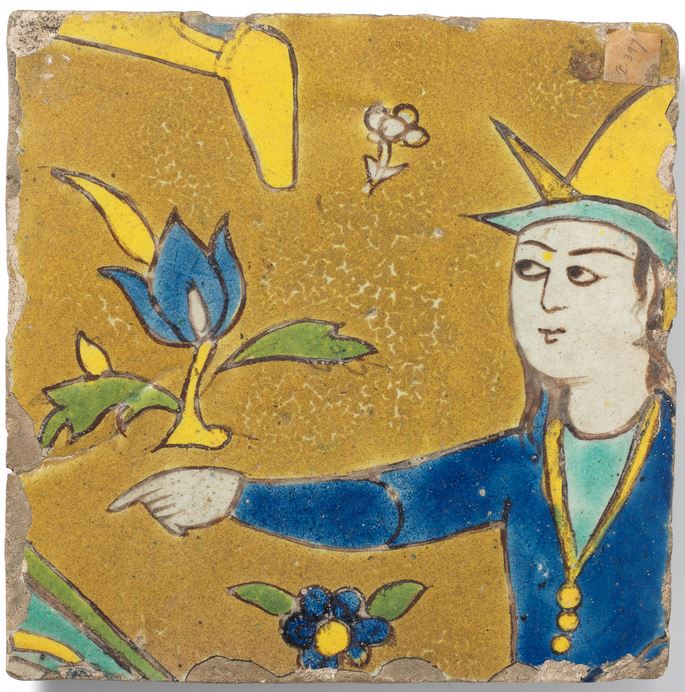
Safavid tile, Bonhams 29.30.22, lot 75, £2,000-3,000
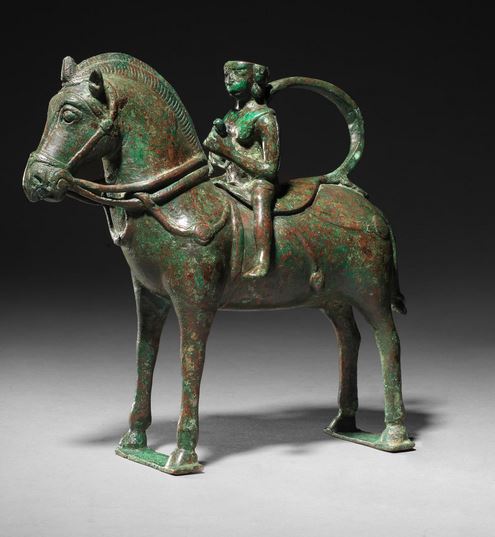
While late Indian paintings are getting some well deserved attention at Sotheby’s, Bonhams seems to be swimming against the current by focusing more than usual on Persian art, especially Medieval ceramics. Their top three lots are from Iran, starting with a silver-inlaid 13th century candlestick offered at £150,000-200,000. The second lot raises the same questions of dating and attribution as Sotheby’s so-called Abbasid rock crystal bowl discussed earlier. The beautiful bronze horse and rider valued £100,000-150,000 is given “early Islamic, Persia 7th/8th centuries”, which could be a possibility, apart from the fact that all comparisons given are either Sassanian, pre-Islamic, or Seljuk, 13th century. This doesn’t take from the inherent aesthetic quality of the piece, but Bonhams also has an annoying tendency to leave out provenance from their catalogue, which is risky with this type of already problematic pieces. The market will decide.
Bronze horse and rider, Bonhams, 29.03.22 lot 18, £120,000-150,000
That being said, it wouldn’t be a Bonhams auction without late Indian art, especially Sikh, that plays in a very specific demographic and have been doing well in previous sales. A particularly interesting lot is the album of 60 paintings depicting Sikh rulers, monuments and people, most likely produced in Lahore in the 1840’s. The patron of this volume is not known (probably a British official given the English annotations on some pages), but its preservation state is quite rare and valuable. The main item of this section is a lovely emerald and diamond-set gold pendant from the collection of Maharani Jindan Kaur (1817-63), wife of Maharajah Ranjit Singh (1780-1839), valued £60,000-80,000. Here lies the strength of Bonhams, its capacity to source exciting pieces with clear historical background and clear provenance.
An imperial Mughal spinel, Rosebery’s 01.04.22, lot 126 – £60,000-80.000
For the same estimate, Rosebery’s is offering an imperial Mughal spinel, inscribed with the title of Shah Jahan and dated 1[0]39AH (1629-30AD), as well as other prestigious Indian jewellery from the late 18th and 19th century. Here as well, Indian painting is in the spotlight, as well as Chinese Qur’an with a selection of 14 ajzaʼ from different manuscripts. Alice Bailey, head of department, will speak about her auction better than I can, so go check the latest ART Informant episode!
After two years of pandemic, I am very excited for this Spring Islamic week, and look forward seeing all the incredible selections. If you’re in London between the 28th and the 30th March, get in touch and come say hi!
A large annotated drawing showing the currents of energy in a horse, Rajasthan, 19th c. Bonhams 29.03.22, lot 235, £2,000-3,000
Sotheby’s 31st May 2011.
For reminder, the Great Indian Fruit Batfrom the Impey Album sold last year at Sotheby’s for £644,200 incl. premium.











 Isabelle Imbert