Category: Short (Hi)Story

  • Auction Catalogues and Reattribution: a Difficult Exercise

    Auction Catalogues and Reattribution: a Difficult Exercise

    All Islamic Art Historians working on large set of material data will tell you the same, spending hours going through auction catalogues to find the forgotten gem is part of the job. Writing my doctoral dissertation of Indian and Persian flower paintings produced between the 16th and the 18th centuries, I dissected countless of catalogues from the 60’s to recent days, hoping to find the long-lost twin of Mansur’s Tulip (which I didn’t). What I found, however, was a lot of questionable attributions, dating, and deeply cut corners.

    This is not the case for all auction catalogues and some houses take very seriously their responsibility to publish accurate analysis of Islamic artefacts, especially for the most prestigious auction lots, but it is common practice to put objects in artificial categories and call it a day. These categories are usually based on one distinctive feature, whether it is a chronological marker such as a ruling dynasty (i.e. Safavid Iran), a city or production centre, loosely attached to chronological range (i.e. Iznik or Kashan), or more rarely another artefact (i.e. The St Petersburg Muraqqa’). Integral part of the catalogue entries, these categories provide an immediate reference to the seasoned reader, but they also constitute a selling argument.

    Some productions are indeed more valued than others, depending on market trends. Earlier this year, I had the opportunity to produce an expertise for a client who was interested in acquiring an archaeological artefact that raised the difficulty of re-attribution.

    Abbasid, Early Islamic, Sasanian: Close Call…

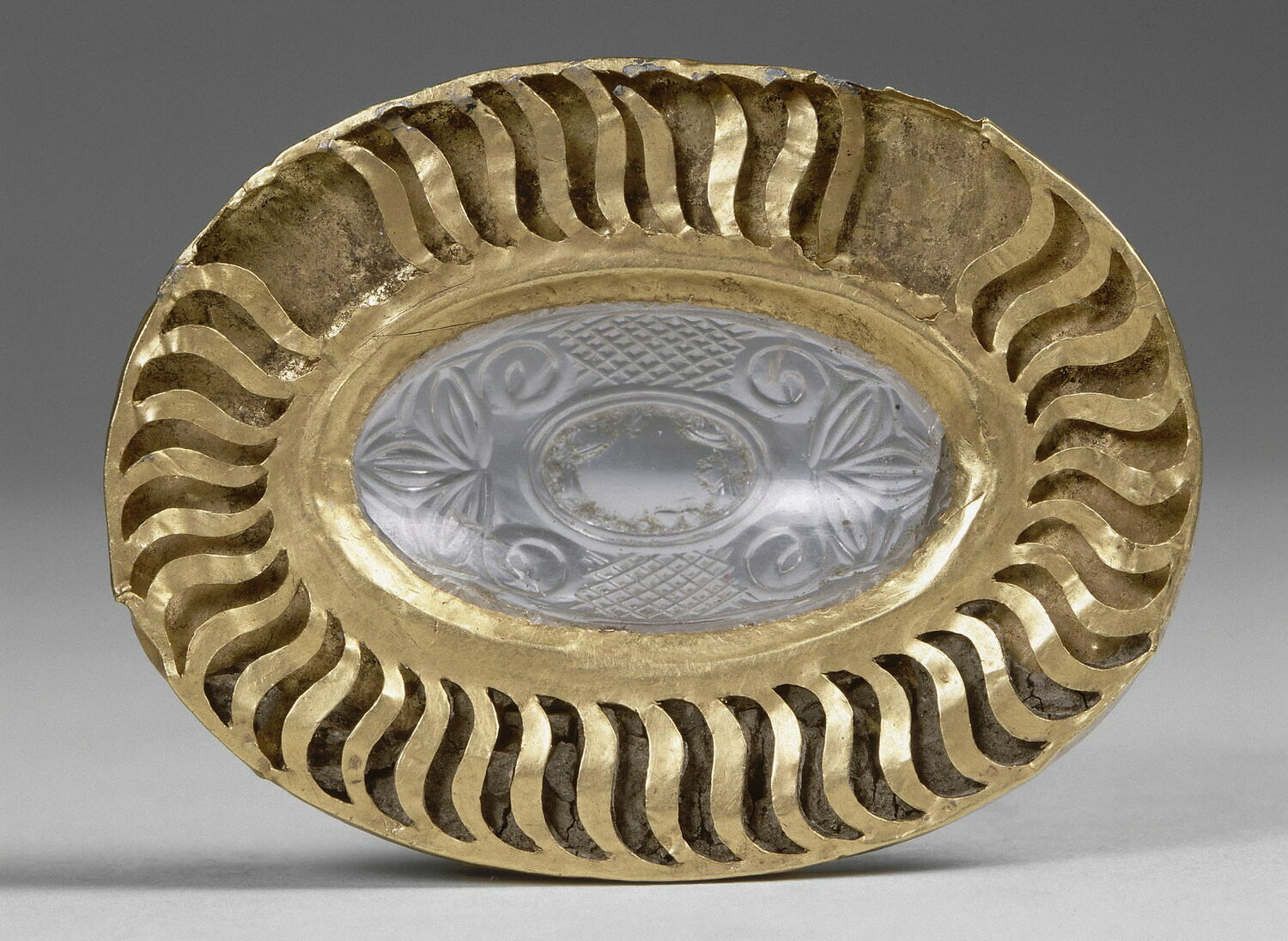
    The objects was an elliptical dish on low foot, flared belly and flattened rim, carved in a single piece of rock crystal. The outside body was cut in a symmetrical composition based on two repeating patterns of a palmette of three main double leaves and two smalls at the base, flanked by long looping stamen and a centric pattern repeating on the long sides. The centre of the dish was marked by a double line forming a medallion. The rim was cross-hatched apart from both ends, highlighted by a symmetrical pattern based on repeating lines.

    The object had been sold previously as Abbasid (750-1258). Based on the pictures I first received, it was my immediate opinion that the piece was not Abbasid, as its shape and ornementation had no equivalent in known objects and architectural decoration from this period. The other clue was the proximity of this piece with two others kept in the Louvre, discovered in the archaeological settlements of Susa.
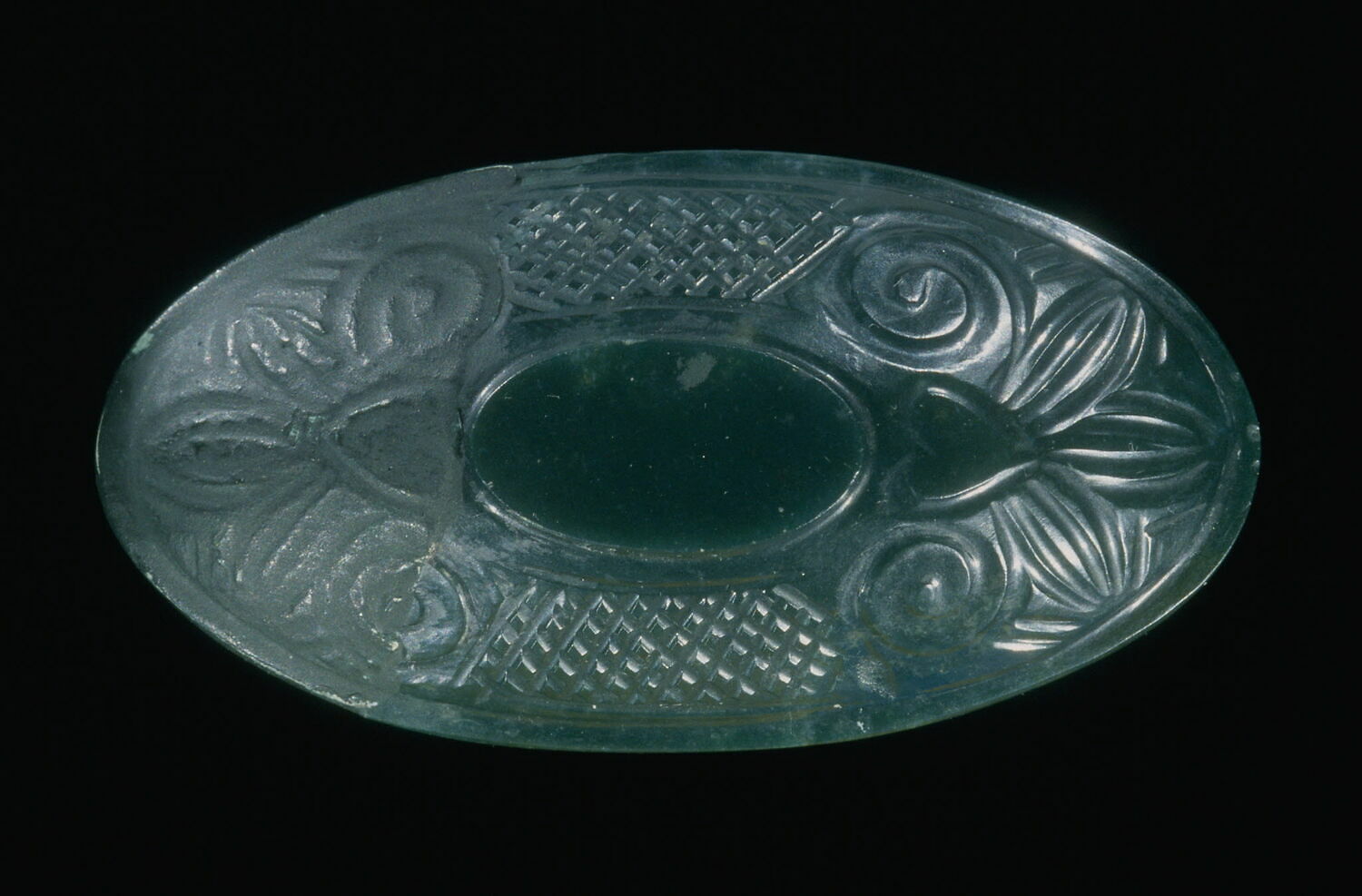
    Archaeological excavations of Susa, spanning from 1851 till 1979 and led by several teams of mostly French nationality, had focused first and foremost on Ancient and Imperial periods up to the Achaemenid dynasty, destroying upper layers in the process. For this reason, the line between late Sasanian and Early Islamic settlements is today blurry and it is virtually impossible to date precisely artefacts that do not bear any distinctive features (such as Arabic inscriptions).

    Stucco relief fragment, Ctesiphon, Iraq, Sasanian, 6th c. MET (32.150.10)

    Individual patterns and the overall shape of the piece led me to suspect the piece had nothing to do with Abbasid productions, even in Susa, but could be linked to late Sasanian productions. For instance, the three-leaves palmettes that occupy each sides of the dish, find numerous equivalences in Sassanian repertoire. Palmettes are extremely common in late Antiquity and in Islamic arts, but the structure of these patterns is specific enough to be used as a point of comparison: three leaves doubled in their centre, two additional leaves at the base in the shape of a crude heart, flanked by symmetrical loops. It appears in stucco decoration found in Ctesiphon, the Sasanian capital, as well as Susa in the late Sasanian/ Early Islamic layers.

    The same way, the elliptical shape of the dish is a commonplace of late Sasanian art.1 Either elliptical or boat-shaped, with or without a foot, these dishes are associate to wine-drinking and can be ornamented lavishly.

    Walters Art Museum, Baltimore (57.625)

    Though archaeological layers haven’t been preserved, Sasanian occupation of Susa is well documented in primary sources2, revealing that the city was conquered in the 3rd century and rebuilt into a vibrant economic trade centre with Mesopotamia and Fārs. The artefacts found on site, including the two Louvre dishes, suggest that rich merchants were installed in the city. It then declined under the last Sasanian rulers but continued to inhabited under the Umayyad and Abbasid, before being progressively abandoned.

    …Or Easy Way Out?

    Attributions to particular productions and chronological eras tend to be passed down from dealer to dealer, as if the first publication was the unalterable authority. Because the object had been published in a previous auction catalogue as Abbasid, the attribution was acted, and going against it without any new archaeological evidence would be a challenge. Intellectual honesty aside, reattributing the piece to what I think is its correct production context, or at least questioning the status quo, have a significant impact of the valuation.
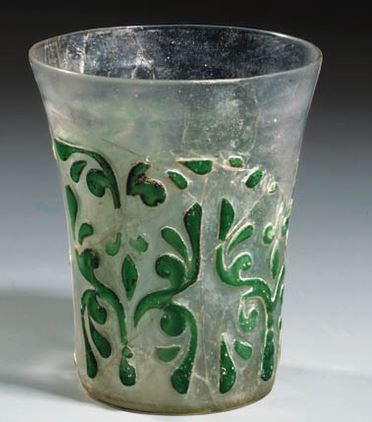
    Glass fragmentary beaker, attributed to Samarra, 9-10 c. Christie’s 11/04/2000, lot 288

    Sasanian and post-Sasanian3 are rare on the market and do not easily find buyer, apart from silver wine-boats with exceptional decoration. The productions are not particularly well studied and raise questions of dating and authenticity. In comparison, glass or rock-crystal objects identified as Abbasid have a lot more chances to reach high prices, sometimes despite questionable attributions. In consequence, it is a safer bet for auction houses and art dealers to put an object as Abbasid. The dynasty lasted more than 500 years and covered a massive territory, so even if doubts remain, attributions do not raise too many eyebrows.

    In truth, attributions to Sasanian, post-Sasanian, Omayyad or Abbasid remain speculative. Certainty is rare in early Islamic arts history, but rethinking the importance of attributing unmarked object and opening the door to doubt would constitute a healthier alternative to catalogues too prescriptive. These might leave interested buyers or potential sellers disappointed, should new information arrise that would render the original attribution obsolete.
    Whether it was the doubt caused my analysis or the price given by the dealer that changed the buyer’s mind regarding the acquisition, I will not know, but finding the right words to question established historiography was certainly a challenge!

    1. A. S. Melikian-Chirvani, “From the Royal Boat to the Beggar’s bowl”, Islamic Art IV, New York, 1992.
    2. See G. Gropp, “Susa v. The Sasanian Period”, Encyclopædia Iranica, online edition, 2005 and associated bibliography.
    3. The term “Post-Sasanian” is attributed to artefacts that cannot be attributed to either Sasanian or early Islamic productions with absolute certainty. It usually encompasses objects linked to Zoroastrianism but found is Islamic occupation layers on archaeological sites, or to objects that more vaguely look Sasanian but cause sufficient doubts.
  • The Mystery of the Narcissus

    The Mystery of the Narcissus

    On the 10th June 2020, Sotheby’s will be presenting a painting of a narcissus flower signed by the 18th century Persian painting Muhammad Masih. The painting is not dated but the signature seems genuine, written in gold on each side of the base.

    Golden signature of Muhammad Masih, just below a standard form of dedication.

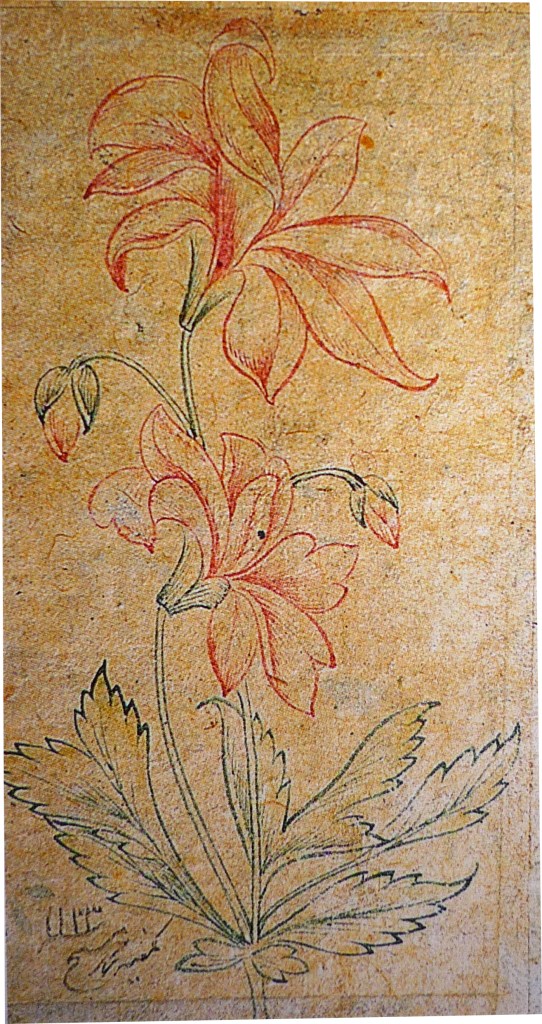
    To say that the painting rings a bell is an understatement. Indeed, two other identical versions are currently known. One is mounted in the Hindo-Irani album, also called Nasir al-Din Shah album, currently scattered between the Golestan Palace in Tehran, the Chester Beatty Library for the most part, and other collections.1 The page bears what I call an “attributive signature” to the famous Indian painter Mansur, who worked in Mughal India for emperors Akbar (1556-1605) and Jahangir (1605-1627).

    The second page is mounted in the St-Petersburg album, previously called Leningrad album, kept for the most part in Russia, with only a few other folios scattered in various public and private collections (including a never seen before page sold last Winter in Paris). The painting is dated 1105 H./ 1693-94 and signed by the Persian painter Muhammad Zaman.

    The Painters

    Nadir al-‘asr Mansur worked in India, first in Akbar Ketabkhana (library), signing paintings in the 1590’s, and at least until 1621 when he was in Kashmir with the emperor Jahangir who wrote:

    The flowers seen in the summer pastures of Kashmir are beyond enumeration. Thos drawn by Master Nadir ul-‘asr Mansur the painter number more than a hundred.2

    Mansur is particularly reknown for his depictions of animals and flowers, but only two flower paintings indisputably bear his signature, a Tulip today in Aligarh University Museum and a copy of an European engraving in the Golestan palace in Tehran. This particular painting of a narcissus is problematic. Though the wording is similar to others genuine signatures, it is not located on the painting but on the below border, which was added later, when the page was mounted in the album. This is a common feature with Mughal album painting but one that is often ignored by specialists.

    The style of the painting differs slightly from Aligarh Tulip and the Golestan “Seven Flowers”, but we can put the variations on the natural evolution of the painter style, as well on the fact that this painting is most probably the copy of an European engraving (more on this below).3

    Muhammad Zaman worked in Safavid Iran between 1086 H./1675 or earlier and 1106 H./ 1695. The life of Muhammad Zaman has caused a lot of controversy among specialists, some stating he travelled to India, others to Europe where he converted to Christianism (which has been proven untrue).
    He is particularly known for his copies of European engravings, and according to his dated works, he seems to have favored flower paintings in the late stages of his career. This particular narcissus, signed and dated, was probably offered to the king Shah Soliman 1st (1666-1694). The style is genuine and corresponds to other flower paintings signed by the artist, mounted in the St-Petersburg album or elsewhere.

    Muhammad Masih career is even less clear than the other two artists, about whom a lot still remain unknown. Some state that Muhammad Masih was an Indian painter emigrated in Iran during the 18th century, but this has never been proven.4His work is not particularly well studied, but he seemed to have worked at the end of the 17th century and during the 18th century, as demonstrated by several paintings and drawings scattered in various collection, including a small flower dated 1123 H./ 1711-12, mounted in an album kept in the Muze-ye Honarhā-ye Moʻāser in Ispahan.

    Flower signed Muhammad Masih, 1123 H./ 1712

    Origin of the Design

    Muhammad Masih painting was initially sold at Sotheby’s Paris in 2015. I was busy writting my doctoral dissertation at the time and I completely missed it. Having three pages with an exact same design is however unprecedented.

    At the time, I was not able to identify the exact model of the two paintings I knew, and despite a follow-up research, I still come empty-handed. However, there is no doubt that the orginal design was made in Europe, most likely during the 16th century, for a printed herbarium, or most likely a florilegium, or “book of flowers”, particularly en vogue during the 17th century.

    Contrary to religious and mythological engravings that are pretty well documented, it is unclear how did herbaria and florilegia arrive in India and in Iran, but we know that some European travellers and artists had some books of flowers in their belongings. For this reason, we find many copies of Jan Theodor van de Bry, Florilegium renovatum et auctum, published in Frankfurt in 1641, Pierre Vallet Le Jardin du Roy published in Paris in 1606, Francois L’Anglois Livre de fleurs, Paris, 1620, Adrian Collaert Florilegium, published in 1587, and several others.

    On the left, Indian painting, 18th c., Clive album (VAM IS.48:1/A-1956). On the right, the original by Pierre Vallet, Le jardin du Roy, Paris, 1606. Species depicted: Lilium Martagon

    Making a copy in the 17th century

    Regardless how flower books arrived in the hands of painters, tthis exact model, and many others, were used to create either exact copies, such as our three identical pages, or brand new compositions using several sources.

    To make a copy is quite easy. First the artist used a niddle to make small perforations along the contours of the original design. Then, the model was put face against a blank sheet of paper. The painter then put a bit of charcoal powder on the back of the original page, which went through the holes onto the blank page. The “master copy” could be used several times, as demonstrated by the existence of the three similar narcissus.

    Pounced drawing of a bird. Iran, 17th c. (British Museum, 1988-4-23.26, f. 15b)

    Was Mansur the first one to paint this narcissus? This would explain why Muhammad Zaman chose the subject, as the Indian painter was most probably reknown outside of the Mughal court. Was Muhammad Zaman even aware of the first painting? Probably, though it is unsure how (the first painting probably arrived in Iran later, after Delhi sack by the army of Nader Shah Afshar in 1747).
    The depiction of narcissus is not uncommon in Iran in the 17th century, as the flower takes on several different meaning in poetry and litterature, but the facination with this particular design is more complex than it looks, and a lot more remains to discover.

    1. For the full list of folios, see E. Wright, Muraqqa, 2008, p. 141. The exact number of pages depend on the author. Wright counts 126, Atabai counts 131. B. Atabai, Fihrist-i Muraqqa’at, 1974, p. 178.
    2. Translation from The Jahangirnama: Memoirs of Jahangir, Emperor of India, ed. W.M. Thackston, 1999, p. 333.
    3. Asok Kumar Das openly challenges this attribution in Wonders of Nature: Ustad Mansur at the Mughal Court, 2012, p. 148-149. I remain slightly more nuanced than the author.
    4. This is the initial assertion of Mohammad ‘Ali Karimzade Tabrizi in Ahval va asar-e Naqqashan-e Qadim-e Iran, 1985, vol. 3, pp. 183-4, recounted by Melikian Chirvani in Le Chant du Monde, 2007, p. 408.