This short message to inform readers that this blog will not be updated for the foreseeable future. All previous posts remain available, so if you want to get started in Islamic art History and Market, I recommend the following:
I put a lot of care and effort in writing each post, and I am not willing to compromise on quality just to produce content. So, this is goodbye for now! I am not excluding posting again at some point, but for now, life has other plans for me and I won’t be able to free the time needed to write interesting and insightful texts.
Finally, and most importantly, I wish to thank all the readers who have been following this blog and have contributed, one way or the other, to its success. Take care, stay curious, be happy!
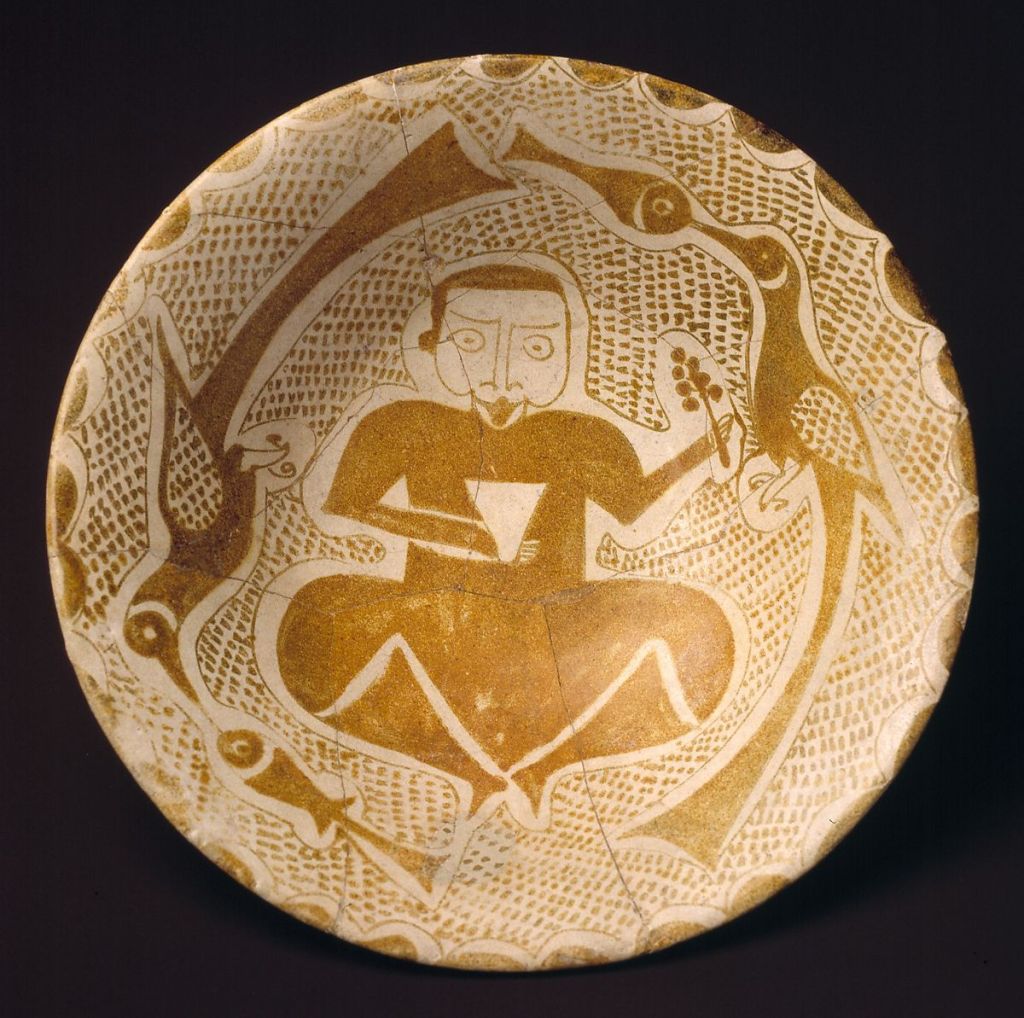
Bowl, Iraq, 10th century MET Museum, NY (1977.126)
Welcome back dear reader of this humble blog, I hope you had a good summer! Autumn is already here, and with that, London Islamic week is arriving quickly.
A short disclaimer before we start: this blog article is coming out very late, is shorter and a rougher than planned. I caught a bad cold last week and have been completely unable to get any work done for several days. Instead of completely abandoning the writing, I decided to publish an “as is” version. Hopefully this will still be informative, and I will review the results later on.
This season, 8 auctions will be held between the Wednesday 25th and the Tuesday 31st October, as follow:
Sotheby’s 18th to 27th October, online: “The Edith & Stuart Cary Welch Collection”, 260 lots
Sotheby’s 25th October, AM: “The Edith & Stuart Cary Welch Collection”, 130 lots
Sotheby’s 25th October, PM: “Art of the Islamic World & India”, 157 lots
Christie’s 26th October, “Art of the Islamic and Indian Worlds including Rugs and Carpets”, 215 lots
Christie’s 27th October, “An Eye Enchanted: Indian Paintings from the Collection of Toby Falk”, 152 lots
Roseberys 30th October: “Antiquities, Islamic & Indian Arts”, 542 lots (including 67 antiquities and 21 contemporary)
Chiswick 31st October, AM: “Property of a European Collector, part VI”, 84 lots
Chiswick 31st October, PM: “Islamic & Indian arts”, 354 lots
Some will have noticed I have left Plakas auctions out of this review, despite them having a sale scheduled on the 24th. Plakas have no named expert, and the authenticity a number of objects presented in the catalogue is highly questionable. They are also plagiarising the work of known experts, namely the complete description of a near complete late 12th c. Abbasid Qur’an sold at Artcurial earlier this year. Plakas is selling one page of this manuscript and just copied and pasted Artcurial text, including the provenance. This is wrong on many levels and actions are being taken as I write, so I will not discuss this further.[efn_note]Thank you to the Artcurial team for confirming this information, including the fact that the provenance of the page sold at Plakas is not the same as the rest of the manuscript.[/efn_note]
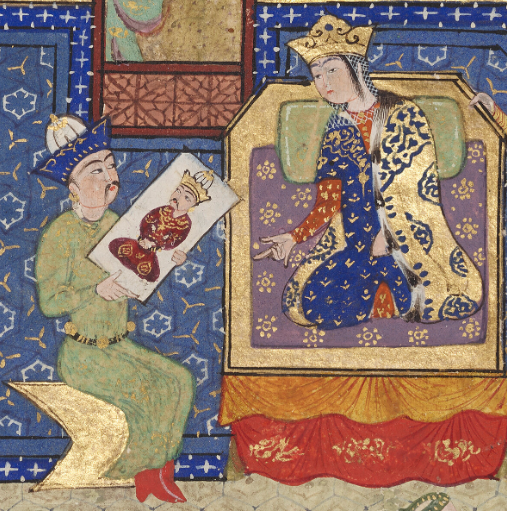
Nushaba recognises Alexander, Persia, 15th c, Christie’s 26/10, lot 57
Because Bonhams delayed their previous auction, they will hold their next one on the 14th November and their online sale from the 11th till the 15th November. Separating themselves from their competitors has worked quite well, achieving the second-highest result since 2010 with the sale of Tipu Sultan’s bedchamber sword. If you want to know more about it, check the Top 20 of the most expensive Islamic art objects ever sold, part 1 and part 2.
Lastly, and before jumping in the auctions, let’s note that this Islamic week is Beatrice Campi’s last at Chiswick auctions. Beatrice built the Islamic and Indian department from scratch 6 years ago and has positioned the house as a solid player on the London market for affordable art. The future is now very uncertain for the department, as finding a replacement for Beatrice is proving to be a struggle, but I wish to congratulate Beatrice on 6 beautiful years, and I cannot wait to see what she’ll do next. In the same vain, Behnaz Atighi Moghaddam, head of sales at Christie’s, has now gone on personal leave, and corridor conversations are questioning the future structure of the Islamic art department.
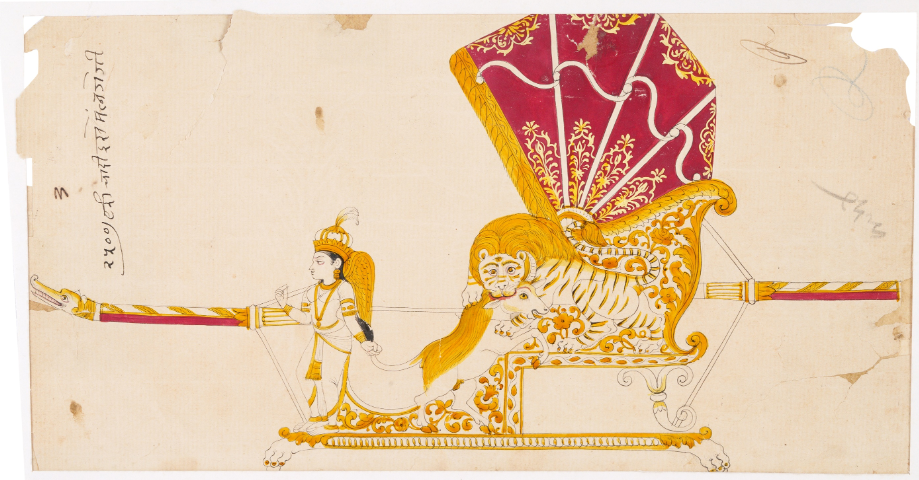
Tinted drawing, Benares, c. 1880, Chiswick 31/10, lot 108
Beautiful Objects and Hefty Prices
Sotheby’s opens this Islamic week with 120 lots, on top of which is an Abbasid astrolabe, maybe made in Baghdad circa 900, valued at £1,500,000-2,500,000. The artefact comes with an Egyptian and European provenance and a well written notice. I have little opinion when it comes to astrolabes but given the high estimate, I am quite interested to follow the sale. This is most likely a museum piece which might interest institutions of the Gulf, so we might see some action.
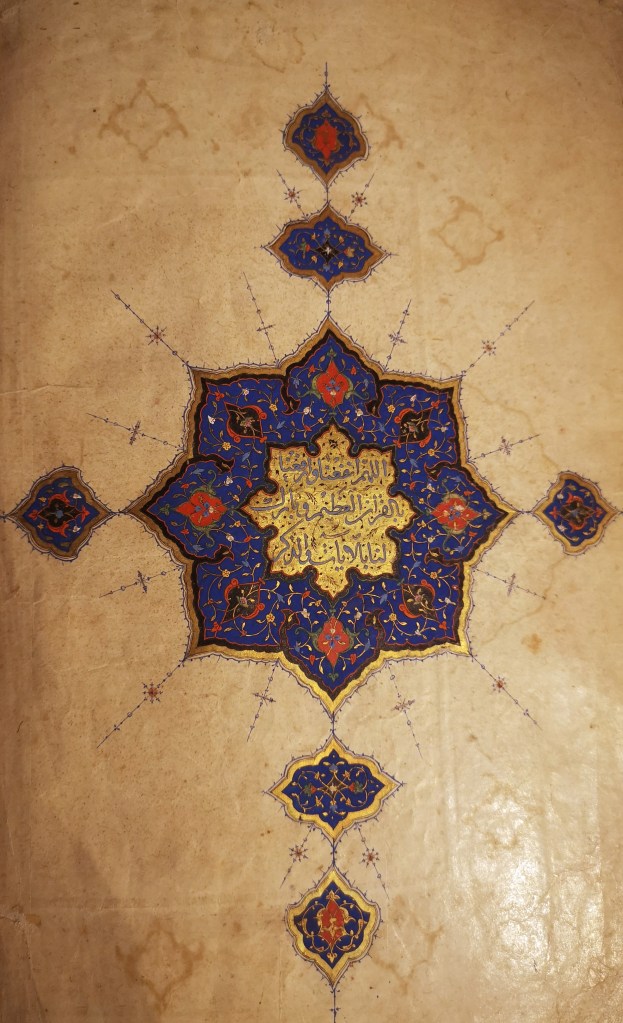
Safavid Qur’an, 983H/ 1575-76, Sotheby’s 25/10, lot 21 (detail)
Christie’s biggest entry is a 16th century Safavid ‘Palmette and Bird’ carpet, valued at £2,000,000-3,000,000, from the collection of baron Edmond de Rothschild, previously published and presented several time at auctions. It was sold most recently at Sotheby’s New York in 2013 for $1,930,500, so 10 years later, this carpet might break records.
Chiswick and Roseberys thankfully maintain their prices. Roseberys highest valued object is a Still Life by the Indian artist F.N. Souza dated 1986, valued £30,000-50,000. Roseberys has slowly but surely been including more contemporary pieces in their Islamic and Indian art catalogues, but having a contemporary painting as the top lot is unusual, so I am curious to see what repercussion this might have on future auctions. The second most expensive lot is the full book collection of Pr JM Rogers, Islamic art historian and pioneer, who passed away in 2002. This includes around 900 books, valued at £15,000-20,000, which will most likely be bought by a museum or a library. Two uncommon top lots!
Chiswick went with a more traditional route by presenting a large Mamluk brass candlestick for £15,000-20,000 in their afternoon auction. According to the description, it was recently bought in France, but I couldn’t retrieve from where (I didn’t look too hard to be fair). The blazon engraved on the body indicates it was produced in the second half of the 15th century, but without further precision.[efn_note]According to M. Meinecke (1972), quoted by Julia Gonnella on Museum with no Frontiers, 47 amirs of the late Burji period used this particular blazon.[/efn_note] Chiswick is also offering the last part of the single-owner collection they have been selling for the past three years, the star lot being a 12th/13th Persian coper-inlaid brass ewer valued at £2,000-3,000. The auction of the five previous parts all did really well, including several white-gloves sales, and we can expect similar results this time around. What an amazing collection!
Safavid gold-damascened iron finial, Roseberys 30/10, lot 374
Additionally, we can only regret the lack of provenance on many lots from all four auction houses. At the risk of sounding like a broken record, at this point in time, undisclosed provenance in catalogue should not an acceptable practice. Auction houses obviously do their due diligence, but the opacity of the market has real consequences. We know artefacts and manuscripts are being looted or stolen from small, unpublished collections to be sold through port-francs, this is nothing new, and the only way to combat this is by being crystal-clear on provenance. Christie’s is selling Persian and Kashmiri manuscripts with no provenance line (lot 90and 91), and an Eastern Kufic Qur’an section from 11th/12th c. Persia with, for provenance, “By repute Private Collection, London, since circa 1990”. How was this even green-lit? In the same fashion, Sotheby’s is offering a beautiful 15th c. Central Asian silk robe, again we no provenance. Stay tuned for more discussion on provenance on the ART Informant podcast.
Building on Success
10th c. Qur’an, Sotheby’s 25/10, lot 11 (detail)
This season feels like a summary of the biggest success in London and Paris these past years. Sotheby’s second highest lot is a 10th century illuminated Qur’an of 247 leaves, including some replaced in the early 20th c., valued at £800,000-1,200,000. The manuscript is extraordinary, described in the catalogue as the earliest surviving Qur’an written in gold on paper, but unfortunately it comes with no provenance. Its presentation in the auction comes after the successful sale of a late 12th c. Abbasid Qur’an at Artcurial, Paris, in May this year, which achieved €406,720 (with premium). Christie’s also builds on that success with an Eastern Kufic section of 42ff from late 11th c. Persia, given at £80,000-120,000.
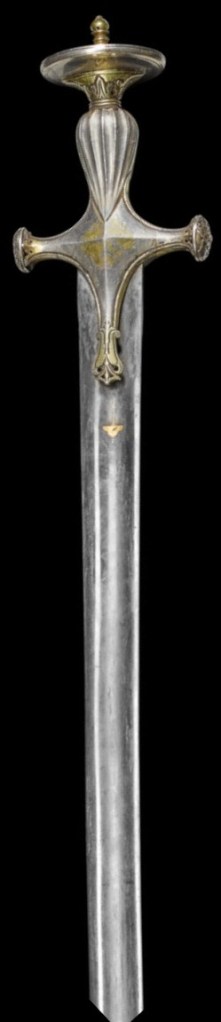
Unsurprisingly, we are seeing lots of historical swords in Sotheby’s and Christie’s catalogues. This comes after the record-breaking sale of Tipu Sultan’s bedchamber sword, sold earlier this year at Bonhams for £14,080,900, and which is today the 2nd most expensive piece of Islamic art ever sold (but you already knew that since you have read my Top22 blogs). Christie’s fully capitalises on that success with their second highest lot, a sword and scabbard from the personal armoury of Tipu Sultan, dated 1224 H./ 1796-97, valued £1,500,000-2,000,000 (same as Bonhams sword). The provenance is impressive: after Tipu Sultan’s demise, the blade went directly to Charles, 1st Marquess and 2nd Earl Cornwallis (d. 1805) and remained in the family until the cost of living crisis hit the UK and they couldn’t afford heating their castle. Joking aside, this sword is objectively more beautiful than the one sold at Bonhams, with a gold-inlaid hilt in the form of a tiger head, which makes the estimate almost conservative. Two other swords and a mustketoon from Tipu Sultan’s collection are also offered for more affordable ranges (lots 101-103), while Sotheby’s presents one gold-overlaid katar dagger with tiger stripe motifs for £60,000-80,000, attributed to Mysore with the mention of Tipu Sultan in the catalogue entry. The craze for Tipu Sultan lives.
Tipu Sultan’s sword, Christie’s 26/10, lot 100
Sotheby’s also offers a composite sword, the blade, most likely 16th century Safavid, bears an dedication to Süleyman the Magnificent (r.1520-66), while the marine-ivory hilt is most likely 18th century. Valued at £100,000-150,000, the historical name might attract buyers, in the same fashion as Awrangzeb’s sword “the army conquest” sold in the previous Islamic week for roughly 5 times its estimate.
For the previous Islamic week, I wrote that the high-end auction houses, particularly Sotheby’s, were expanding their range to objects generally sold on the Parisian art market, or by more affordable houses such as Roseberys and Chiswick. The operation was a success for Sotheby’s, prices achieving surprising heights. To be fair, estimates were high to begin with, with, for instance, a 19th c. Sub-Saharan Qur’an offered for £8,000-12,000, sold £31,750, or an Algerian wooden Arabic practice board valued £3,000-5,000, sold £20,320. Sotheby’s continues their expansion this season with manuscripts from East and West Africa, Dagestan, as well as wooden boards and printed hajj certificates that would normally be considered more as ethnographic curiosities than luxury art pieces. Some of the prices are particularly high. We can, for instance, question the estimate of An illuminated Qur’an from 17th century Algeria, valued £50,000-70,000. While the manuscript is of undoubtable quality and dated volumes from this time and region are rare, North African premodern production has never been a best seller on the London market. These manuscripts are usually favoured by the Parisian market which has more historical ties with the region. This strategy makes sense for Sotheby’s, but it might be detrimental to the Parisian market on the short and long term, we’ll have to wait and see.
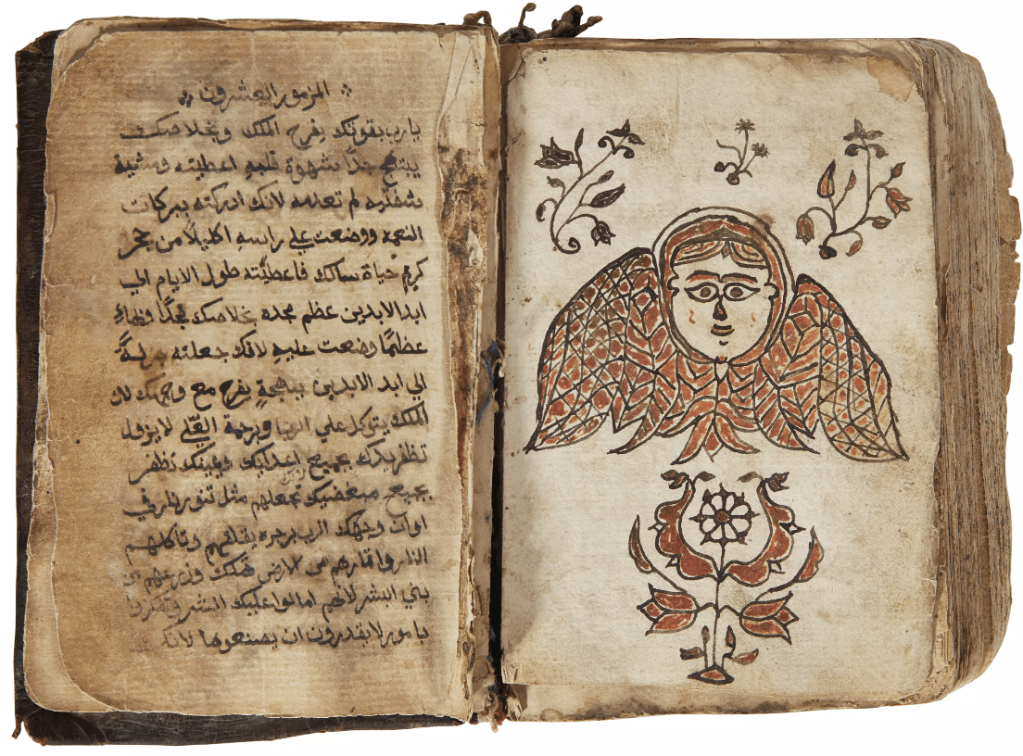
The expansion of the field is once again demonstrated by Roseberys catalogue, which has arguably the most diverse selection (also the largest). It includes several lithographs and early Iranian prints, as well as sub-Saharan manuscripts, Chinese Qur’an sections, and interesting Christian volumes in Syriac and Arabic, including a partial Old Testament from 18th c. Syria or Egypt, previously sold in Paris by Rim Encheres for €800 and offered here for £1,000-1,500.
Biblical manuscript, 17th c., Roseberys 30/10, lot 135
India in the spotlight
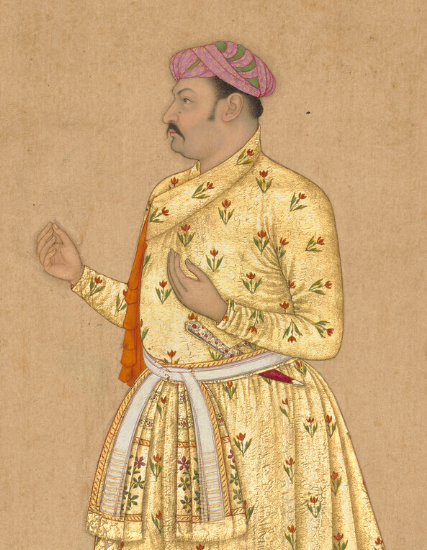
Abu’l Hasan Asaf Khan, c. 1615, Christie’s 26/10, lot 5
The excitement this season comes from the auction of two major art collections: Edith & Stuart Cary Welch Collection sold by Sotheby’s, and Toby Falk’s collection presented by Christie’s, two important scholars of Indian painting in particular. The Welch collection is sold in two parts, live on the 25th October in the morning, and online from the 18th to the 27th. Sotheby’s made the interesting choice to present the collection has a whole under the Islamic and Indian department instead of splitting between departments, maybe following owner instructions, or to capitalise on the Welch name, known by collectors of Islamic and Indian art but not necessarily by others. The live catalogue includes Chinese, Japanese, and of course Indian artworks, while the online catalogue also includes Persian and European works, with generally lower estimates. Toby Falk’s collection is mainly composed of Indian paintings, with some Persian and Ottoman inclusions here and there. The quality of both collections reflect the impeccable taste of their owners, as well as their access to exclusive material via a network of merchants and collectors it would be interesting to investigate.
Amateurs of Indian arts on lower budgets will particularly appreciate Chiswick afternoon catalogue, which includes almost half on Indian objects, from painting to furniture, jewellery, musical instruments, and other. The prevalence of Indian paintings and objects in Islamic and Indian art auction is nothing new, but it is particularly visible this season and we can question how the market will be able to absorb this influx, especially given the two collector sales come on top of Christie’s and Sotheby’s selection in the main sale catalogues.
My Top 5
I did it for the previous Islamic week after someone asked me and really enjoyed picking 5 items among the treasures offered. This top 5 is just what I would buy if I had the funds regardless of market value or trends. In no particular order:
Roseberys, lot 500: A picchvai of Krishna fluting among rising lotus flowers, India, mid-20th century. This is the cutest wall-hanging I have ever seen, that is it.
Sotheby’s, E&SCW Collection, lot 77: Anonymous, “Whose Sleeves? (Tagasode)”, Momoyama-Edo Period, late 16th-early 17th century. Not Islamic but I adore these Japanese painted folding screens. I posted a different one on Instagram last year and I’m excited to see this one!
Christie’s, lot 50: A Hispano-moresque carved and bone-inlaid cabinet, Spain, 16th/17th c. My love for architectural cabinets will live forever.
Chiswick, lot 283: A Safavid tile mosaic with yellow peacock, 17th c. Collecting architectural ceramic goes against my principles, however I really love this production of Safavid architectural mosaic, they are so lively and colourful.
Christie’s, TF collection, lot 9: A peri in a garden, Mughal India, 16th c. The fineness of this depiction is absolutely striking.
A picchvai of Krishna fluting, India, mid-20th c.
Roseberys 30/10/23, lot 500 (detail)
Spring is here, and with it came auction catalogues! London houses have once again presented a great selection of amazing objects, including some things expected, and some really not. The first major surprise came from Bonhams. For the first time in… forever, probably, Bonhams is not participating in the Islamic week, their auction being pushed to the 23rd May. This is most likely due to the Parisian auction held by Bonhams Cornette de Saint Cyr (a.k.a. Bonhams Paris) on the 6th April, with a catalogue of 144 lots. Understandably, it would have been a struggle for the experts to carry two auctions less than a month apart. At the time I am finishing this article, the auction made €229,792.50 (including premium) with 75% of lots sold. Congratulation to the team for these results.
London Islamic week will start on Wednesday 26th April at Sotheby’s, which will present a small but action-packed catalogue of 175 items, including 40 carpets. The 27th, Christie’s will offer 240 lots, including 70 carpets. On Friday 28th, Chiswick and Rosebery’s will hold their auctions at the same time, Chiswick with two catalogues: part 5 of their single-owner sale in the morning with 90 lots, and 335 lots in the afternoon, and Rosebery’s with one catalogue of 528 lots including 56 archaeological artefacts and 33 contemporary art pieces.
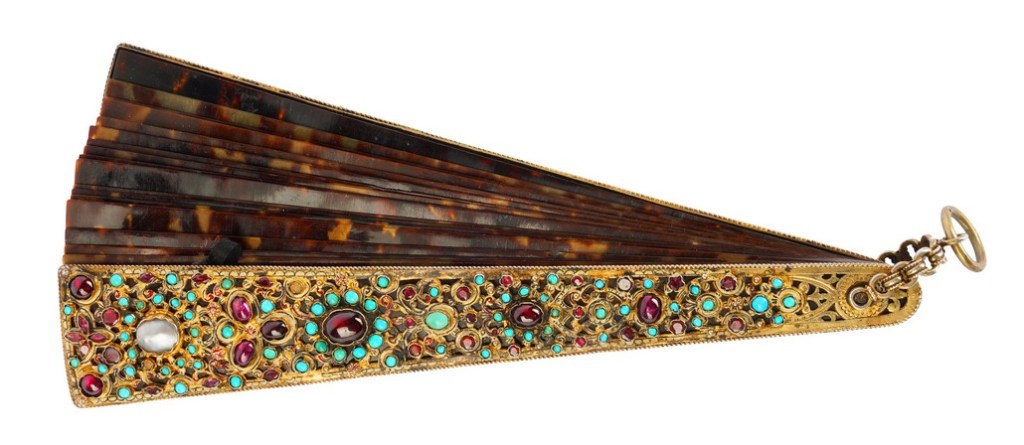
Tortoiseshell fan, Hungary, Ottoman provinces, or Russia, 19th c. Chiswick lot 366, £2,000 – £3,000
Moving the Borders
Qur’an, Roseberys 316
This spring, the inclusion of several artefacts gives an impression that the field of Islamic and Indian art history is expending, shedding light on productions usually considered to be at the edges of the Islamic world. Sotheby’s presents two fragments of Qur’an in bihari script produced in pre-Mughal India: 35 illuminated folios which would have deserved a longer notice for their connexion with folios from other collections such as the Khalili (QUR602) and the Louvre (MAO937), valued at £26,000-35,000, and 5 folios from a different manuscript, decorated with very particular polychrome vegetal illuminations, offered for £15,000-20,000. Christie’s presents two illustrated folios from a Khusro nameh of ‘Attar, attributed to 15th century India (previously attributed to Southern Iran), “Imam ‘Ali fighting a Lion” for £7,000-10,000, “Hurmuz healing Jahan-Afruz” for £5,000-7,000. Rosebery’s shows three manuscript fragments: a juz, three folios, two folios, all for very small prices. Sultanate manuscripts never achieve incredible prices, but the presence of this many in the sales might be the beginning of something.
Collection of prayers, 19th c. Nigeria, Sotheby’s, lot 7, £4,000-6,000
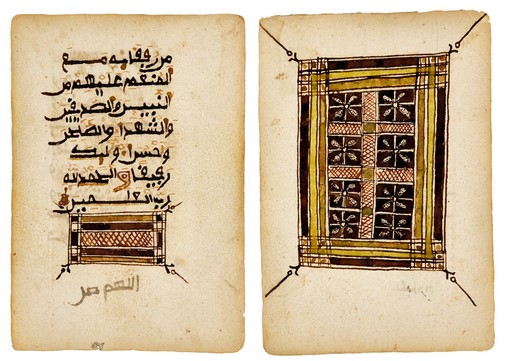
Sub-Saharan manuscripts are also given the spotlight by Sotheby’s and Roseberys. These are usually reserved to mid-range auctions, and it is rare to see them included in top-end catalogues. Islamic art in Sub-Saharan Africa is a fairly new field that is expending slowly, so it is good to see it being given some well-deserved attention. Two beautiful Qur’anic manuscripts with their carry case from Nigeria or Chad are offered at Sotheby’s for £8,000-12,000 (lot 14 and 16), and an illuminated collection of prayers from 19th century Sudan is valued at £4,000-6,000. Additionally, an unusual wooden Qur’an board from Somalia is given at £3,000-6,000. Roseberys offers two Ethiopian Qur’an manuscripts with lavish decoration, as well as compilations of prayers likely copied in 19th century Horn of Africa.
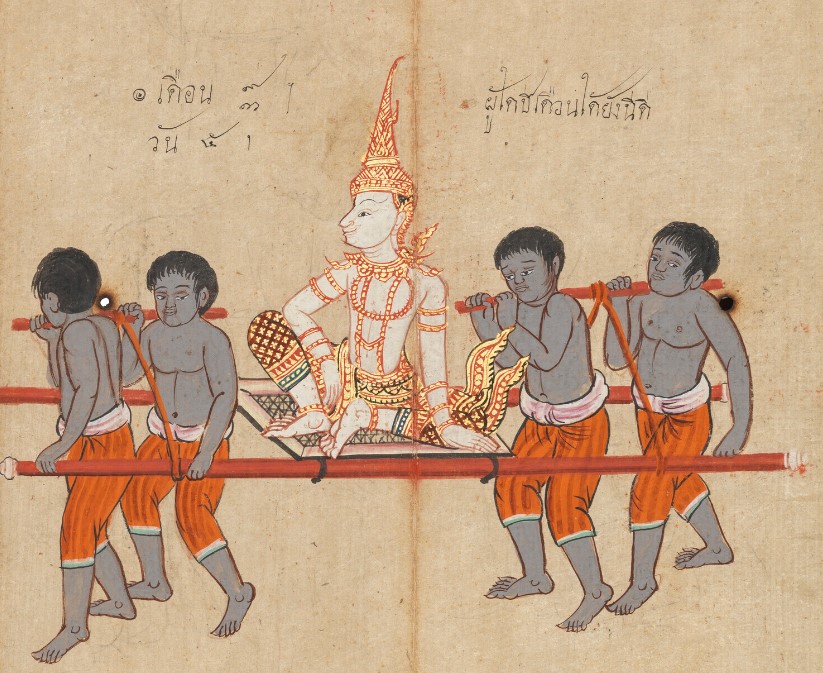
Christie’s is offering a wonderful concertina manuscript from 19th century Burma (today Myanmar) with a rich and intriguing iconography for £1,000-1,500, which would have deserved more explanations, as well as a “Siirt” silver-inlaid bronze candlestick from 14th century Anatolia with Armenian inscriptions that illustrate perfectly the movements of artefacts in and out the borders of the Islamic world. Two Armenian artefacts are also offered at Chiswick, a Qajar brass tray and two crucifixes, and a complete Armenian gospel at Roseberys. 18th century Greek-Ottoman, Syriac, Coptic and Hebrew productions are also represented, all being parts of the large and undefinable Islamic world. Finally, Roseberys will present juz‘ of Chinese Qur’an manuscripts, as they have done for several seasons.
With the increasing difficulty to source new objects for a developing market, expanding the field appears a necessity. The progress of academic research also give light on previously unknown productions, highlighting their aesthetic and historical value. This is a win-win for both parties, and potentially a good investment for buyers, as these objects will most likely gain value in the next years.
A concertina of iconographic motifs, Burma, 19th c. Christie’s, lot 103, £1,000-1,500
Pushing the Chronology
Geographical boundaries are not the only one being pushed this season, it also feels like the chronology is expending. Persian paintings illustrate this well, with a qualitative selection of a large range of historical productions, starting with the 14th century until the 2000s. Two folios of the same Shah Nameh produced in Persia in 741/ 1341 (under the Inju dynasty) are presented, “Faramarz lifts Surkha, son of Afrasiya, from the saddle” offered by Christie’s for £8,000-12,0000, “The fight between Nowzar and Afrasiyab” offered by Roseberys for £6,000-8,000.
For the 15th century, Chiswick is offering an illustrated Shah Nameh page from Western Persia (£300-500), as well as Roseberys, presenting a restored page from an unidentified manuscript (£1,000-1,500), Christie’s an extraordinary full-page painting from Timurid Herat (150,000-200,000). 15th century Persian painting for every budget! The 16th century is represented by a painting from a manuscript Akhlaq-i Muhsini of Husayn Va’iz al-Kashifi (Sotheby’s, £10,000-15,000) and of course, a new page from the Shah nameh of Shah Tahmasp, a folio illustrated by a nocturne combat scene, offered at Sotheby’s for £4,000,000 – 6,000,000, the top lot of the season. In its centre, Bizhan slaying the Turanian leader Nastihan, surrounded by the Iranian army chasing the rest of the raid. As always, the level of details on the painting is astonishing and there is no doubt people will queue to see the page. The previous page sold at Sotheby’s last season achieved £8,061,700, the year before one sold at Christie’s for £4,842,000, I am therefore very curious to see if prices will continue to increase. Usually, fight scenes sell for less than other types of illustrations, but this is the most sumptuous Persian manuscript ever created, so the rule might not apply. If you want to learn more about this extraordinary manuscript, you can listen to the episode of the ART Informant podcast with Dr Firuza Melville.
Signed Mu’in Musavvir 1087/1676 (detail), Christie’s 52, £40-60,000
Two pages signed by Mu’in Musavvir are offered by Christie’s. He’s not the most famous painting of the second half of the 17th century, but his work has been well studied, in particular by Dr Massumeh Farhad, so the pages should sell well (here and there). A beautiful oil painting signed by Muhammad Baqir, one of the stars of the 18th century, who notoriously collaborated to the decoration of the St Petersburg album, and dated 1173/ 1659-60 is also at Christie’s for £150,000-250,000. Zand productions are not the most studied, but this painting seems like a safe bet. Lots of Qajar gol o bolbol and beautiful ladies are offered everywhere (as well as couples in compromising positions and a puzzling “ring of 10 intertwine youths” at Chiswick!), and interestingly, late 19th and early 20th century paintings, such as the portrait of Zahir al-Daula, son-in-law of Nadir al-Din Shah Qajar, dated 1301/ 1884 (Christie’s, £120,000-180,000), and another portrait from the same time, this time of an unknown dignitary (Chiswick, £2,000-3,000). Several Iranian artists are represented at Roseberys, including Maryam Shirinlou (b. 1966) who has been doing solo exhibitions since the 1990s.
The inclusion of Persian painting from different eras is not new on the market, but the offering is particularly consistent and will most hopefully show what will be the trends going forward, especially for later periods.
Shah nameh of Shah Tahmasp, fol. 328r. Sotheby’s lot 41, £4,000,000 – 6,000,000
Trendy Blades
The Army’s Conquest, Sotheby’s lot 94
Arms are clearly having a moment in the sun this spring. They already shone bright last year in Paris, with category white-glove sales at Artcurial and Millon, so we can expect high success in London as well. Christie’s top lot is a 17th century Mughal gem-set dagger with impeccable provenance: it was first in the hands of Lord Robert Clive of Plassey (or his son), and last in the al-Thani collection (Qatar reigning family), which is partly exhibited in the Hotel de la Marine in Paris1; an impressive pedigree! Value at £300,000-500,000, it is remarkable for its atypical proportions and the uniquely large stones that ornate the hilt. To be noted that other Indian lots come from the al-Thani collections (67 to 76), all the highest quality. I am particularly excited to see the 18th century silver and gilded durbar set (£250,000-350,000)
Speaking of pedigree, Sotheby’s present two historical swords: one gilt-mounted sword with ruby eyes and scabbard from Tipu Sultan’s armoury (£200,000-300,000), and the beautifully simple personal sword of Mughal Emperor Aurangzeb (r.1658-1707): ‘The Army’s Conquest’ (£150,000-200,000), Chiswick also includes two Indian blades among the top lots, a 19th c. “Sosun Pattah” ceremonial sword (£4,000-6,000) and an 18th-19th c. jade-hilted “khanjar” with garnet beads (£4,000-6,000). Several other swords and blades are presented by the four houses, so it’ll be interesting to see if the success encountered in Paris in winter 2022 will be duplicated here. Maybe swords are the new manuscripts?
My Top 5
To finish, someone asked me on Instagram what are my 5 favourite items this season, and I thought it would be a fun way to end this article. Here they are, with little explanation and in no particular order:
The page of Shah Tahmasp’s Shah Nameh. Obviously (Sotheby’s, lot 41)
Five pages from a Qur’an produced in Sultanate India. I posted about it on Instagram, they really caught my eye. Only one other page of this manuscript has surfaced so far, presented at Rim Encheres earlier this year [efn_note]Thank you to Rim Mezghani for the reminder[/efn_note]. The illumination design and colours are simply exquisite (Sotheby’s, lot 4)
“Solomon with the Queen of Sheba”, Timurid Herat, mid-15th c. I adore Timurid painted productions (illustrations and illuminations), and this scene, with its profusion of figures, elements and gold, simply makes me happy. Look in particular at the Queen’s expression looking at Solomon, we all deserve someone who looks at us like that (Christie’s, lot 25)
An illustrated Tarikh-i Dilgusha-yi Shamshir Khani, Lahore or Kashmir, 19th century. This text, which is basically an abridged version of Firdosi Shah Nama, was written by Tavakkul Beg in 1063H/ 1653 and encountered a certain popularity in India.2 Kashmiri 19th century paintings are a hit or miss, to say the least, but the 24 illustrations in this manuscript are really nice. (Chiswick, lot 434)
“A lady writer with hookah”, Pahari school, Kanrga or Guler, North India, mid-19th c. Powerful feelings emanate from this scene, art resonates. (Rosebery’s, lot 94).
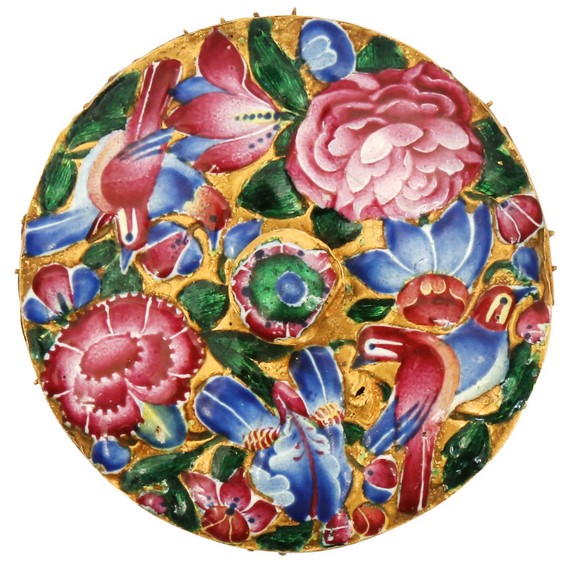
Enamelled gold lid, Persia, 19th c. Chiswick, lot 42, £500-700
The Islamic week just finished in London, and what a week it has been. Starting on a personal note, it’s been a busy one for me, and I am so grateful to have been able to see so many amazing experts, scholars, collectors and enthusiasts, who make the field of Islamic arts genuinely exciting. And of course, having the opportunity to see so many artworks is a privilege I never take for granted.
This blog article will be in two parts. I will give my thoughts on the main topics here, and will deep-dive more on certain items in the next one, keeping both articles easy to read and quick to write.
All prices include premium.
Now, there is a lot to say about the auctions. Bonhams opened the week with a catalogue of 157 lots and sold only 41% for a total of £471,697.50, while the online auction sold 46% of their 249 for £268,605.75. The next day, Sotheby’s sold 56% of their catalogue of 195 lots for a total of £14,224,727. On the Thursday, Christie’s sold 90% of their 264 lots for £15,989,353, a record for Christie’s London in the past 15 years, only surpassed in May 2019 when three lots were sold for more than £3 million each. On the Friday, Chiswick won the whole week by achieving a white-glove sale in their single-owner morning auction, selling 100% of the 89 lots for £141,361. The afternoon auction also did well with 63% sold of their 360 lots for £327,401. Finally, Roseberys sold 66% of their 418 lots (excluding archaeology) for a total of £736,918, an impressive total.
Pitchwai celebrating Nandi, India, 20th c, Roseberys 28/10/22, lot 468, £2,470
The downfall of Bonhams
We need to talk about Bonhams first. I am usually quite critical of auction houses and catalogues that are not up to the standard that we should expect, but this is heartbreaking. Bonhams’ Islamic and Indian art department has been in decline for the past 10 years, and this is their worse Islamic week sale so far (excluding secondary and online auctions).
Bonhams Islamic week results over the last 10 years.
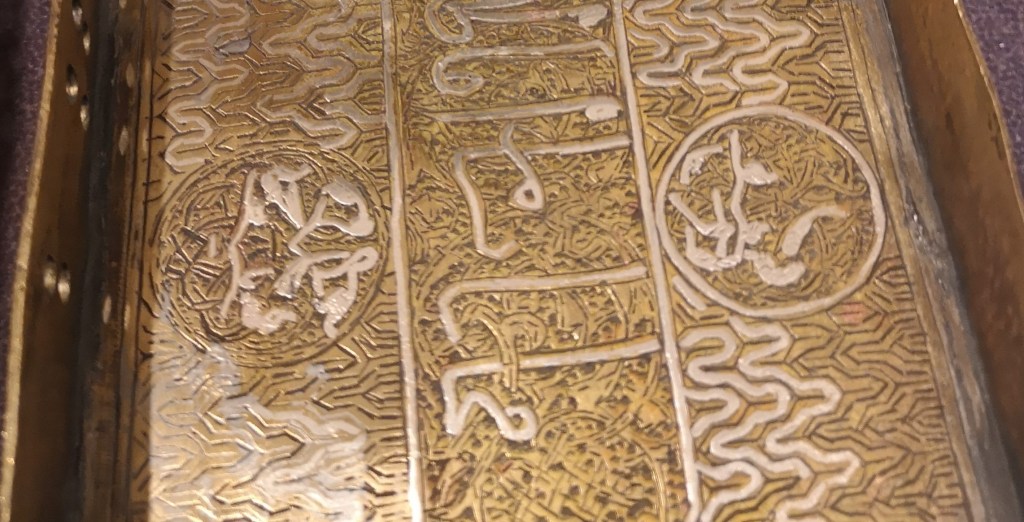
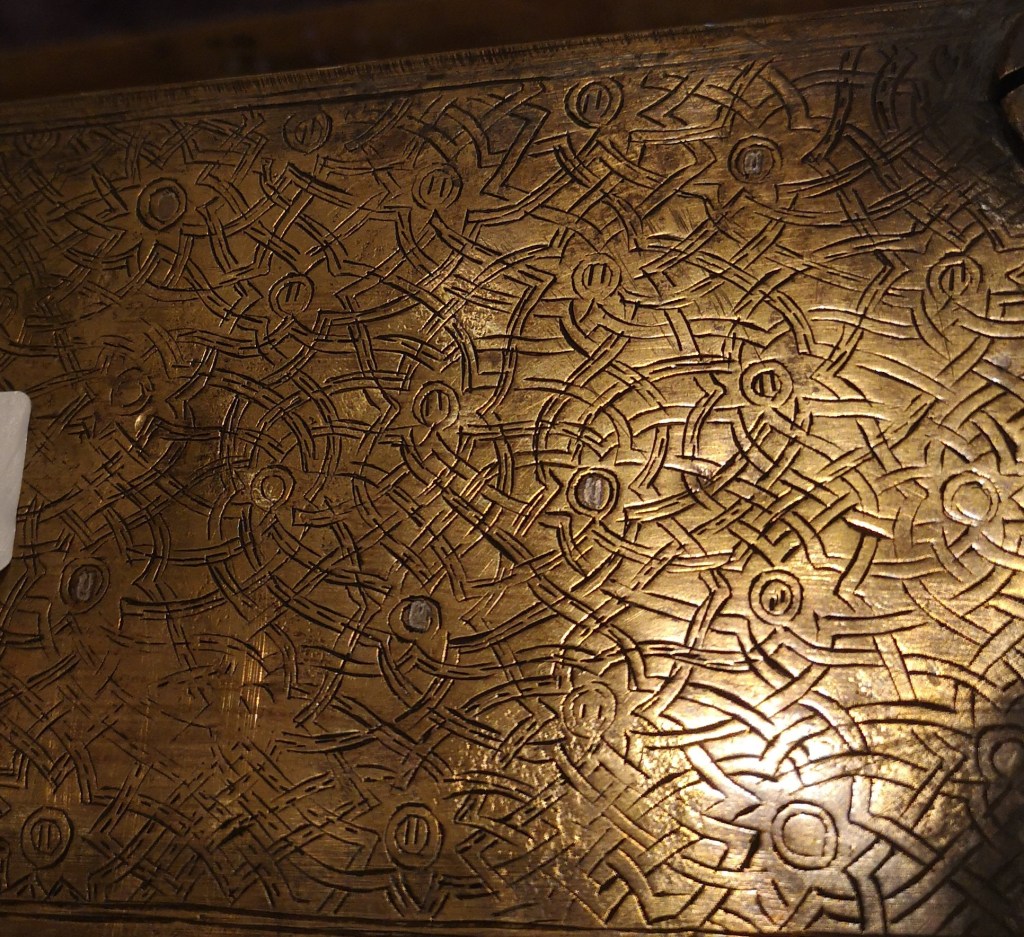
This can be explained by past mistakes, but mainly by a catalogue that felt rushed and incomplete, and lots presented with a number of issues more or less disclosed. I am not going to repeat here what I previously wrote about the importance of providing provenance for the top lots (and ideally not a previous auction catalogue as sole provenance, but that’s beside the point for now), however I’ll add that condition reports should be as precise and thorough as provenance. I will only give one example, as it feels like beating a dead horse, the Mamluk pen-case, the auction top lot valued £90,000-120,000 and remained unsold. Upon close examination, it appears that the silver incrustations were most likely later restorations, the same with the engravings at the bottom of the box. This was not described in the catalogue, and the inlay restorations were barely mentioned in the condition report, while the addition of the engravings at the bottom were omitted. The object looked good in picture and from the far, but the semi-lack of transparency (some later additions were described) and the not so great details up-close discouraged buyers. Now, I am of course not saying that objects should be pristine, obviously, damages and restorations are part of their history, but they should not be concealed shamefully, on the contrary. This is not a problem exclusive to Bonhams, I’ll talk about it more in part 2 of this review.
Detail of Bonhams 25/10/22 lot 36 showing the later restorations of the silver inlaysDetail of Bonhams 25/10/22 lot 36 showing the later engravings below the box
In contrast, Bonhams’ top sale is a small portrait of a Persian dignitary signed by the famous painter Abu’l-Hasan Ghaffari Kashani (d. 1282/1865-6), who worked at the court of Qajar rulers Muhammad Shah and Nasir al-Din Shah period, and signed this piece in 1262 H./ 1845-46. It also came with stellar provenance and a good catalogue entry full of references. Valued at £15,000-20,000, it sold for £40,620.
I think Bonhams is currently struggling to find its place in a complex and rapidly evolving market. It cannot compete with Christie’s and Sotheby’s as it did in the past, and it’s not in the same market division as Chiswick and Roseberys, so it sits oddly in the middle. The effort of the Islamic and Indian art department to expend their selection, notably by adding a Sikh art section, is truly commendable, but they might need to revamp further, while pushing on provenance and transparency to repair their reputation.
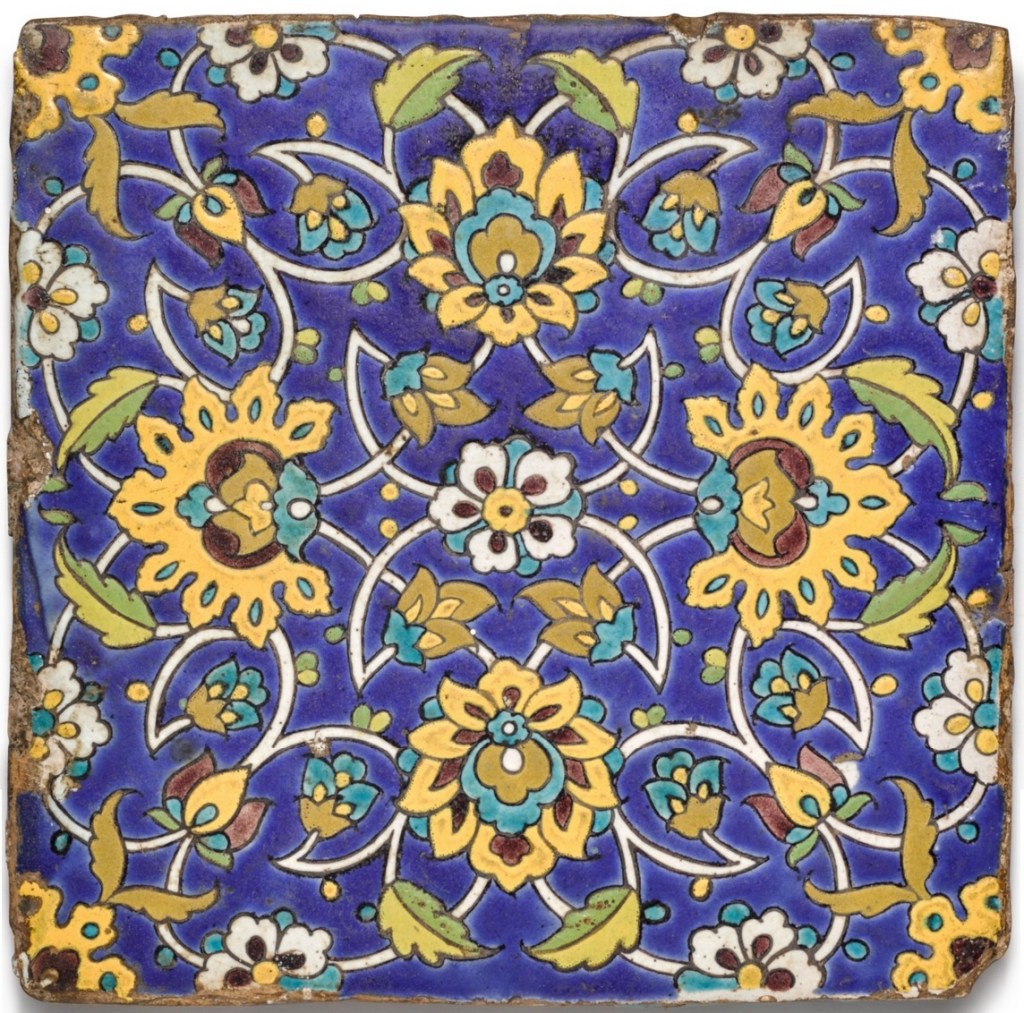
Panel of three Safavid Kubachi tiles, Iran, 17th c., Chiswick 28/10/22, lot 14, £1,125
Expected results, good surprises…
Of course, everybody was waiting to see how much would achieve the page from Shah Tahmasp’s Shahnama, offered by Sotheby’s for £4,000,000-6,000,000. Well, it did not disappoint, reaching £8,061,700, beating the record set with another page sold in 2011 for £7.4 millions as part of the collection of Stuart Cary Welch. Two main biders were competing on the phones, so we’ll have to wait until the buyer reveals themselves, if they do. If you want to learn more about this page, you can still listen to the ART Informant podcast episode with Dr Firuza Melville.
A big surprise was the 11th c. Andalusia oil lamp offered with an estimate of £300,000 – 400,000 and sold for £1,608,000. Maybe because I was captivated by so many gorgeous pieces, I didn’t notice this lamp during the exhibition, I completely walked past it! I regret it now, especially because this type of telescopic lamps are incredibly rare.
I wrote in my previous blog that I would wait to see what the market decide regarding the Mughal pashmina carpet valued £2,500,000-3,500,000. It was sold for £5,442,000, also breaking the record on carpet auctions.
Mughal pashmina carpet, India, c. 1650, Christie’s 27/10/22, lot 200, £5,442,000
More surprisingly were the £1,002,000 achieved by an 8th c. Kufic Qur’an section of 162 folios, sold against an estimate of £350,000-450,000. I wrote a few years ago that Kufic Qur’ans popularity was decreasing, and I admit that I was wrong. I don’t understand why this manuscript did so well, I can only hope the new owner will not disbound it to sell the pages separately. Sotheby’s also did well, selling the monumental Qur’an page for £819,000 (£650,000 hammer, same as Millon’s page sold last June).
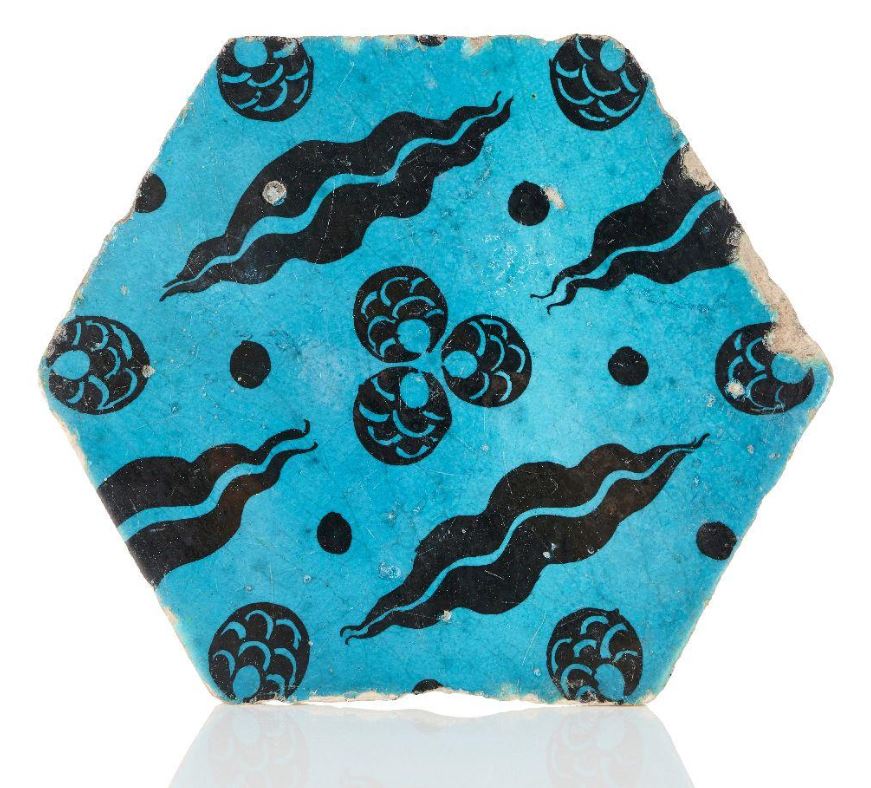
Unsurprisingly, Turkish Iznik ceramics did very well. Christie’s sold a delightful 16th century jug with the most amazing lavender colour for £906,000, against an estimate of £120,000-180,000. Roseberys exploded the percentage value of their hexagonal Cintimani tile from 16th c. Ottoman Syria, selling it £114,400, 186.5% from the high estimate of £4,000.
Finally, let’s mention Chiswick, which also had an excellent day on Friday, starting with the very first lot, a lovely cast openwork bronze incense burner in the shape of a lion from 12th c. Khorassan, sold for £11,250. This was included in the fourth part of their single-owner sale, this one achieving a rare 100% of lots sold. In the afternoon, a portrait of a prince from 18th c. Deccan reached £17,500.
Cintimani tile, Syria, 16th century, Roseberys 28/10/22, lot 85, £114,000
… And bad news
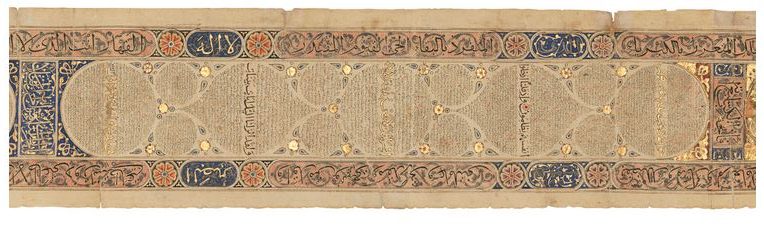
After the scandal of Timurid Qur’an, sold in 2020 for £7.016.250, that turned out to have been stolen from Afghanistan in 2019, another huge controversy is coming to Christie’s. The extraordinary 14th century Il-khanid Qur’an scroll, offered for £250,000-350,000 and sold for £1,602,000, has started to make some noise in Turkey, where some write that it was allegedly stolen. It was apparently offered for sale in 2010, but was withdrawn and removed from the online and print catalogue after it was discovered as allegedly stolen. Christie’s put it back for auction this October, 12 years later, most likely because the legal status of the piece changed (supposedly), but Turkish authorities are currently investigating. You can read about this on halk.com.tr and on karar.com.
The catalogue entry only mentions “Djafar Ghazi, Munich” as a provenance, which is thin. Jafar Ghazi was a famous Iranian collector and businessman who acquired a large amount of manuscripts. His collection was dispersed after his passing in 2007. To my knowledge, there is no record on how he acquired this Qur’an, and we can only assume it came to the UK as part of the dispersion, but I imagine it moved legally between Germany and the UK. This case could potentially be bad for Christie’s reputation, which was already not at its highest, but we’ll have to wait for the investigation to finish. More to come, I’m afraid.
Qur’an scroll, 754H/ 1353-54 (detail), Christie’s 27/10/22, lot 28, £1,602,000












 Isabelle Imbert