Tag: art history

  • After the Storm, Another Storm?

    After the Storm, Another Storm?

    The effect of the Pandemic on the London Islamic week of Spring 2021

    The year 2020 has been challenging for the world and everybody on the planet has felt the impact on the pandemic. Not being out of the woods yet, the beginning of this year seems more hopeful with the promise of a vaccine in most countries, but we’ll more likely see long-term effects of this crisis, starting with the London Islamic week of Spring 2021.

    For the Islamic arts market, and the art market in general, 2020 has forced a rapid shift, proving the capability of auction houses to adapt, but not without consequences.

    All prices below include premium.
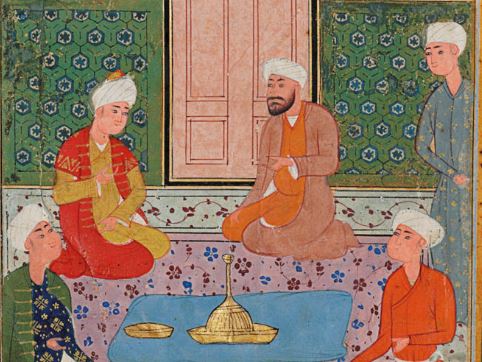
    Bayazid Bastami and Khizravayh b. Shaykh Ahmad, Iran, c. 1570. Christie’s 01.04.21, lot 17, £4-6.000

    A rapid shift to avoid the worst

    From a purely financial perspective, the worst was avoided. For pre-modern Islamic and Indian arts, Sotheby’s took the biggest hit, achieving overall £10,526,614, a 31.6% decrease compared to last year. Christie’s maintained its base revenue with £21,927,125, a 0.41% decrease from 2019, but excluding the exceptional sale (as in “one time event”) of the al-Thani collection, held in New York in July 2019 and that made $109,031,875.
    Bonhams sustained a 32% growth by maintaining its 4 annual sales, two live and two online, while Chiswick auctions registered a 5.75% decrease while adding additional online auctions.

    In France, Millon et Associés also endured the pandemic with a 37.2% decrease in revenue, also due to the fact that 2019 was an exceptionally good year for this house that managed to sell a page of the Padshanama.
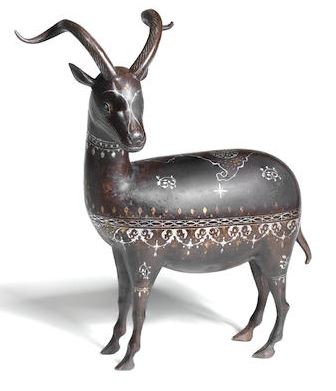
    Ram, Qajar Irna, 19th c. Bonhams 30.03.21 lot 35, £1.5-2000

    Sotheby’s heavy decline can be attributed to two things. First, a disappointing spring auction where most of the star items didn’t sell, such as the blue and black Kashan ewer from the Edward Binney III collection. Overall the sale made £3.6 millions, Sotheby’s London lower result since October 2017. Secondly, the sale of artefacts from the L.A. Mayer Museum in Jerusalem, aborted due to the controversy surrounding deaccessionning, was a blow for the house that was already behind his main competitor.

    Travel restrictions, forced closure of non-essential businesses and the overall insecurity about the immediate future could have turned most buyers away, but the move to online auctions, already initiated in the previous years, allowed a smooth transition. Online catalogues, online bidding and 360° exhibition tours are already a tool for major houses, but the pandemic has accelerated the process. We can expect to see printed catalogues disappear completely in the next few years, Christie’s having already announced its plan to decrease by half the number of catalogues sent around the world.1

    Zodiac bassin, Iran 13th c. Sotheby’s lot 79, £ 1-1.5M

    A Cloudy Present: London Islamic week of Spring 2021

    The biggest London auction houses, Christie’s, Sotheby’s and Bonhams have just published their catalogue and their content seem to reflect both the effects of the pandemic and the increasing challenges of the Islamic arts market. Firstly, the catalogues are a lot smaller than usual: 141 lots for Bonhams presented on the 30th March, 183 lots including 45 carpets for Sotheby’s on the 31st March and 157 lots including 57 carpets at Christie’s on the 1st April. In comparison, Christie’s had 205 lots in 2020 and 302 in 2019. The pandemic has made it more difficult for experts to travel and source objects, but more generally, it is getting harder to source never sold before items.

    That being said, both Christie’s and Sotheby’s have managed to source unpublished star lots. The 13th century Khorassan basin with silver-inlaid astrological figures is nothing less but extraordinary. The silver decoration is mostly intact, which is rare given the fragility of silver incrustations, while the size (50 cm diameter) and the quality of the figurative decor make the high valuation, £1.000.000-1.500.000, completely justified. For the first time since 2010, Christie’s most expensive lot is a 19th century Qajar painting2, known to have been part of the collection of late artist Frederic Clay Bartlett (1873-1953). The massive group portrait, valued £1.000.000-1.500.000, is described in extensive details by Dr Layla S Diba, great scholar of Qajar Iran. The painting is presented as a “rediscovery”, but it was never lost, it was part of the permanent and exposed collections of Bonnet House Museum and Gardens. About its sale, Patrick Shavloske, CEO, commented:

    But the time has come for the Qajar painting to move to a new home that is better positioned to give the artwork the care and honour it so richly deserves. Proceeds from the Qajar painting sale will be used by the museum to conserve its paintings by Frederic Clay Bartlett and Evelyn Fortune Bartlett as well as the historic Bonnet House itself, also an artful creation of the Bartletts.3

    Unidentified Qajar prince, Christie’s 1st April 21, lot 31

    Museums deaccessionning part of their collections to compensate the lost of revenues caused by the pandemic have sparked a large debate, and though the sale of L.A. Mayer Museum at Sotheby’s ultimately failed, this auction is not getting the same traction, most likely because it is limited to one artefact.

    Both Sotheby’s and Christie’s have managed to source interesting manuscripts. Christie’s is presenting a Qur’an with a colophon bearing the name of the famous 13th century calligrapher Yaqut al-Musta’simi, valued £300.000-500.000. The manuscript was illuminated in 17th century Safavid Iran, but the writing looks genuine to a non-specialist of Ilkhanid calligraphy such as myself. We can regret the fact that Christie’s didn’t get the opinion, nor even quote Dr Nourane Ben Azzouna, specialist of Yaqut al-Musta’simi, to confirm if the manuscript is genuine.4 A genuine manuscript signed by one of the greatest masters of calligraphy is an event that would have required further investigations.

    A surprising view in Christie’s catalogue is the page wrongly attributed to the St Petersburg Muraqqa’, sold at Sotheby’s in 2018 for £25.000 and discussed on this blog. This time, the page is valued at £7.000-10.000, a huge drop from the initial sale price.

    Sotheby’s is presenting a very interesting Qur’an dated 920/ 1514, signed by the calligrapher and dedicated to the Chief of Justice of Jerusalem and Nablus, only 2 years before the conquest of Jerusalem by the Ottoman armies. The arts of the book from the extreme end of the Mamluk dynasty have not been studied in much details yet, so this complete manuscript constitutes an interesting testimony of the period.

    Some lots, however, clearly reflect the difficulties that both Sotheby’s and Christie’s had constituting exciting catalogues. For instance, Christie’s presents a page from the Nasir al-din Shah album valued £3.000-5.000. Though this page might be attached to an album produced for the sovereign of the Qajar dynasty, Nasir al-Din around 1888, the page is not from the Nasir al-din Shah album, very famous muraqqa’ initially gathered in Mughal India and passed to Iran after Delhi sac by the army of the Afshar king Nasir al-din Shah in 1747. Words matter, though I do not think buyers will be duped.
    Same goes with a Mamluk Qur’an page on pink paper offered by Sotheby’s for £6.000-8.000. The page is dated in the catalogue circa 728/ 1327 on the basis of a different page sold in 2008, also undated but previously published by the art dealer Philip C Duschnes as originating from a Qur’an written by Ahmad b. ‘Abdullah b. al-Mansur Hashemi al-‘Abbasi, completed 7 Sha’ban 728. This convoluted datation is problematic, especially given that I am not completely convinced the page from 2008 comes from the same manuscript as the two pages from 2011 and 2021. My doubts are based on the different quality level of the kufic script in the headers and some details in the thuluth script. Beside the fact that the colophon remains unpublished to this day, the datation of the page can be questioned on the basis of the illumination style, closer to the productions from the second half of the 14th century than the late 1320’s.4
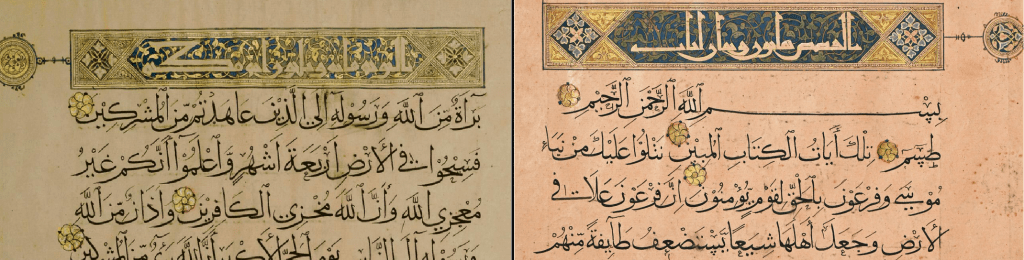
    On the left, the page sold in 2008; On the right, Sotheby’s 31.03.21 lot 5.

    Sotheby’s, Christie’s and Bonhams catalogues contain a majority of later artefacts, mainly 18th and 19th centuries, which reflect the difficulties the houses have encountered sourcing Medieval and Pre-Modern objects. This might be why some attributions to the Safavid era seem a bit far-fetched.
    For £100.000-150.000, Christie’s is offering an album page showing the rest on the flight into Egypt, given to the famous Safavid painting Muhammad Zaman and dated 1076/ 1665-66. I have several problems with this page beside the commonplace of the inscription, ya saheb al-Zaman, often linked to the painter without much afterthoughts, so here come the bullet points:

    • Though Biblical themes and copies from European prints have been a constant in Muhammad Zaman career, the style of this particular painting doesn’t fit the painter’s, it lacks the roundness of his forms and the volumes created with strong shades.
    • The painting is on vellum, which is a highly singular for Muhammad Zaman and Safavid painters in general (though they have experienced with various media).
    • The painting is signed but unfinished, which is unprecedented in Muhammad Zaman catalogue
    • The date 1076/1665-66 seems to be too early in the artist’s career. Though Muhammad Zaman biography is still open to debate, the core of his work is dated from the 1670s to 1690s, with a seemingly confirmed date of death in 1700.
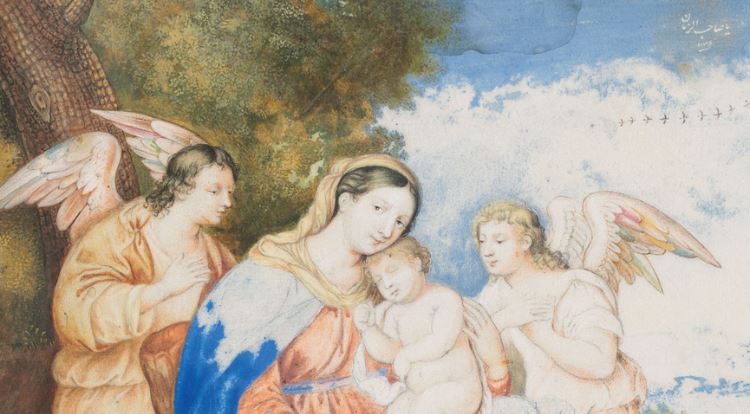
    Christie’s 1.04.21 lot 20, attributed to Muhammad Zaman, £100-150.000

    Despite a smaller catalogue, Bonham’s has managed to remain coherent with their usual focus on later Indian art, particularly Punjabi and Sikh. Their star lot is a 19th century portrait of Raja Lal Singh by the Austrian painter Augustus Theodor Schoefft, valued £150.000-250.000. Among the most prestigious artefacts feature a gorgeous Chand-Tikka from the collection of Maharani Jindan Kaur (1817-63) valued £90.000-120.000 and a large manuscript of Janamsakhi from late 18th century Punjab, given for £25.000-35.000.

    The main object of curiosity in Bonham’s catalogue is an oil on canvas full-length portrait of an “African soldier“, given to Safavid Iran circa 1680-90, valued £100.000-150.000. The notice has been written by Dr Eleanor Sims, scholar of Safavid painting and who has published on a series of 21 full-length portraits on canvas she dates from the 1680s.6 I have personally never been convinced these 21 paintings were produced in the 17th century under Safavid rulers, I think they were made later, maybe during the 18th century during the reigns of Zand or Afshar dynasties. This is an unpopular opinion and no doubt some will disagree, but given what we know about painting production, artistic fashion and stylistic evolution of Pre-Modern Persian painting (16th-19th c. roughly), there is no good explanation for this production of full scale oil paintings, coming from nowhere and disappearing as it came before becoming highly popular under the Qajar dynasty in the 19th century.
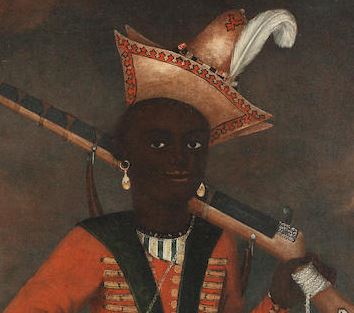
    “African soldier” Bonhams 30.03.21 lot 28, £100-150.000

    Regarding the “African soldier”, I am obviously not convinced neither. Despite the accurate depiction of weapons described by Dr Sims, I do not believe this man to be a soldier, as the garb does not fit the representation of actual Safavid soldiers, and I do not believe he is from the 17th century as evoked above.

    Dr Sims worked with Christie’s in 2019 to attribute the paintings of a 15th century manuscript to the famous painter Behzad, in a demonstration that convinced no one since the manuscript remained unsold. Given this track record and the questions surrounding this portrait, it will be particularly interesting to see what price it will achieve.

    This Islamic week definitely carries the weight of the pandemic, and though the three catalogues also contain some interesting items, we can wonder if the pressure for spectacular lots haven’t forced the experts to cut some corners. Travel restrictions in 2020 haven’t particularly blocked buyers, but the quality of the catalogues might.

    Shah Abbas seated on a terrace, signed Mehdi al-Imami, Iran, 20th c. Bonhams 30.03.21, lot 16, £2.000-3.000
    Shah Abbas seated on a terrace, signed Mehdi al-Imami, Iran, 20th c. Bonhams 30.03.21, lot 16, £2-3.000
    1. “Le bilan 2020 du marché de l’art”, L’objet d’Art, 575 (Feb 2021), p. 76.
    2. Last time was the Portrait of a Nobleman signed Isma’il Jalayir, estimated £500.000-800.000 and sold £601.250. Christie’s 13.04.2010, lot 150.
    3. “A rediscovered Qajar painting from Bonnet House Museum Gardens leads Christie’s auction”, artdaily
    4. She has published many times on the topic of attributions to this calligrapher. See her latest book, Aux origines du classissisme. Calligraphes et bibliophiles au temps des dynasties mongoles (Brill, 2018), pp. 48-132 in particular.
    5. Thank you to Dr Adeline Laclau for her expertise on this page.
    6. Eleanor Sims, “Five Seventeenth-Century Persian Oil Paintings”, Persian and Mughal Art, London: 1976, pp. 223-32; “The “Exotic” Image: Oil-Painting in Iran in the Later 17th and the Early 18th Centuries”, in The Phenomenon of ‘Foreign’ in Oriental Art, Wiesbaden: 2006, pp. 135-40; “Six Seventeenth-century Oil Paintings from Safavid Persia”, in God is Beautiful and Loves Beauty: The Object in Islamic Art and Culture, New Haven: 2013, pp. 343, 346-47.
  • The Future of the Islamic Art Market could be Now

    The Future of the Islamic Art Market could be Now

    Click here to jump to the latest update (22nd Nov.)

    The challenges the world faces this year are of unprecedented magnitude, and with them, the fragile equilibrium of world economy has been thrown off balance completely. For museum and galleries, the blow is particularly hard, as most intitutions were already struggling keeping their doors open and their ceilling from leaking.

    Kashan turquoise-glazed pottery figurine of a camel and rider, 13thc. L.A. Mayer Museum auction, Sotheby’s

    To Deaccession or Not To

    In countries were main museums are public institutions, the gradual decrease of governement fundings have forced museums to look for funds elsewhere. In 2018-2019, the British Museum received £13.1 million grant-in-aid, the lowest since 2015, and particularly significant when put next to the year total expanditure, £96.2 million. This translated, among others, by an acquisition budget going from £1.1 million to £0.8.million. Last year, British Museum public revenues was £39.4 million, also the lowest since 2015, but we can expect 2020 to be particularly disastruous.1

    For galleries and private museums, the pandemic and inevitable economical crash that is predicted for 2021 are even more worrying, and it will take some time to recover from the loss of public revenues. Around the world, cultural institutions and associations are forced to look inside for solutions. In April, the American Association of Art Museum Directors (AAMD) passed a series of resolutions to relax the rules of deaccessinioning restricted funds:

    The resolutions state that AAMD will refrain from censuring or sanctioning any museum—or censuring, suspending or expelling any museum director—that decides to use restricted endowment funds, trusts, or donations for general operating expenses. The resolution also addresses how a museum might use the proceeds from deaccessioned art to pay for expenses associated with the direct care of collections.2

    Could the MET sell this Qur’an folio, Iran 12th c. (1996.238.2)

    This means that between April 2020 and April 2022, American museums can sell parts of their collections to replace lost income and finance their operations.
    In the UK, the powerful Royal Academy of Arts (RA) has been letting a similar idea float, though the debate has been particularly focused on the Taddei Tondo, a marble sculpture of Michelangelo, already threatened of sale in the late 70’s.3 No decision has been made yet regarding the tondo future, and it is unlikely that the piece will end up in an auction, but the financial crisis of cultural institutions, especially the smaller ones, might force hands.

    Selling or exchanging pieces of collections to fund new acquisitions is not a new practice, American museums have been doing it for years in a controlled setting4, but the new guideline from the AAMD extends the justification for selling art pieces towards operational means.

    The L.A. Mayer Museum auction presented by Sotheby’s

    What it means for Islamic Arts

    So far, Islamic arts had not been publicly impacted by deaccessioning, though the practice is common behind closed doors and emphasised by controversial sales such as the Timurid Qur’an on Chinese paper witht a more than opaque provenance, sold in June 2020.
    However, in a market working in a quickly closing loop and given the current context, it was only a matter of time before parts of an Islamic arts collection be presented in a historical auction.
    The time should have been on the 27th October 2020 and the auction at Sotheby’s of 190 lots from the collections of the L.A. Mayer Museum of Islamic Arts in Jerusalem. The aim of the auction has been clearly stated by the museum director Nadim Sheiban:

    We were afraid we could lose the museum and be forced to close the doors. […] If we didn’t act now, we would have to shut down in five to seven years. We decided to act and not wait for the collapse of the museum.5

    The star of the auction: an Aq-qoyunlu silver-inlaid helmet, 15th c.,  £400.000-600.000

    The catalogue included lots from all over Islamic lands but none from Israel and Palestine, as the legislation regarding native artefacts leaving the country is particularly strict. The auction, planning to reach around £6 million, would have given financial security to the L.A. Mayer Museum for the years to come, but would also constitute a definite slippery slope for private museums of Islamic arts around the world.

    In an unexpected turn of events, the auction was postponed last minute on Monday night. While Sotheby’s website states that the delay is only until November, there is no guarantee the sale will ever occur, as criticisms came from the Israeli government officials and the public. The Hermann de Stern Foundation, that owns the L.A. Mayer Museum collection, still seems keen on moving forward with the sale but might struggle reaching an agreement:

    The foundation’s management hopes that the postponement will make it possible to reach agreements that will also be acceptable to the Culture Ministry in the coming weeks.6

    What now?

    If the sale does go ahead, it will set a new precedent for the market of Islamic arts, as it will open the door for other museums to sell parts of their collections, either to acquire new items or just to keep the light on.

    We can also question the motives for selling Islamic artefacts. The conflict between Israel and Palestine and the tensions in the Holy City between Jewish and Muslims come to mind in the case of the L.A. Mayer Museum auction and make the intervention of the pan-Israeli governement more surprising, but Islamic arts are political and ideological tools in more than one region. The Indian governement of Kovind and Modi might use this opportunity to accentuate their efforts to rewrite (not to say errase) India’s Muslim history, but even in Europe where far-right anti-Mulims parties are gaining more influence every day, progressiveley emptying Islamic arts collections could be a way to deny a shared past.


    This bleak picture highlights the fact that selling Islamic arts bears a lot of weight, and publicly deaccessionning collections is not anodyne. Auction arts should use caution when selling museum pieces, but in this less than certain economical context, caution might already be gone in the wind. It will be interesting to see if the L.A. Mayer Museum auction goes ahead in November, and what the near future holds for Islamic arts.

    Update: Auction delayed again

    On Wednesday 19th December, the High Court of Justice has suspended the sale for two additional weeks, time for the L.A. Museum, Sotheby’s and the Culture Ministry to negotiate over holding a more limited auction with less high profile items, though these remain to be defined.7

    A painting that could become controversial? Wedding of Dara Shokuh, Awadh, c. 1740, National Museum, New Dehli (58.58/38)
    1. British Museum governance.
    2. AAMD Board of Trustees Approves Resolution to Provide Additional Financial Flexibility to Art Museums During Pandemic Crisis 15 April 2020.
    3. Royal Academy of Arts considers selling Michelangelo marble to plug financial hole—and not for the first time 25 Sept 2020.
    4. The Permanent Collection May Not Be So Permanent, The New York Times, 26 Jan 2011. The Indiana Museum of Art lists all the deaccessioned pieces since the 1930’s.
    5. Jerusalem’s Islamic art museum says it has to auction off part of its collection, The Times of Israel, 24 Sept 2020.
    6. Auction for Jerusalem museum’s treasures postponed at last minute, The Guardian, 26 Oct. 2020.
    7. High Court Delays Controversial Sale of Rare Islamic Artifacts by Israeli Museum, Haaretz, 19th Nov. 2020.
  • The Mystery of the Narcissus

    The Mystery of the Narcissus

    On the 10th June 2020, Sotheby’s will be presenting a painting of a narcissus flower signed by the 18th century Persian painting Muhammad Masih. The painting is not dated but the signature seems genuine, written in gold on each side of the base.

    Golden signature of Muhammad Masih, just below a standard form of dedication.

    To say that the painting rings a bell is an understatement. Indeed, two other identical versions are currently known. One is mounted in the Hindo-Irani album, also called Nasir al-Din Shah album, currently scattered between the Golestan Palace in Tehran, the Chester Beatty Library for the most part, and other collections.1 The page bears what I call an “attributive signature” to the famous Indian painter Mansur, who worked in Mughal India for emperors Akbar (1556-1605) and Jahangir (1605-1627).

    The second page is mounted in the St-Petersburg album, previously called Leningrad album, kept for the most part in Russia, with only a few other folios scattered in various public and private collections (including a never seen before page sold last Winter in Paris). The painting is dated 1105 H./ 1693-94 and signed by the Persian painter Muhammad Zaman.

    The Painters

    Nadir al-‘asr Mansur worked in India, first in Akbar Ketabkhana (library), signing paintings in the 1590’s, and at least until 1621 when he was in Kashmir with the emperor Jahangir who wrote:

    The flowers seen in the summer pastures of Kashmir are beyond enumeration. Thos drawn by Master Nadir ul-‘asr Mansur the painter number more than a hundred.2

    Mansur is particularly reknown for his depictions of animals and flowers, but only two flower paintings indisputably bear his signature, a Tulip today in Aligarh University Museum and a copy of an European engraving in the Golestan palace in Tehran. This particular painting of a narcissus is problematic. Though the wording is similar to others genuine signatures, it is not located on the painting but on the below border, which was added later, when the page was mounted in the album. This is a common feature with Mughal album painting but one that is often ignored by specialists.

    The style of the painting differs slightly from Aligarh Tulip and the Golestan “Seven Flowers”, but we can put the variations on the natural evolution of the painter style, as well on the fact that this painting is most probably the copy of an European engraving (more on this below).3

    Muhammad Zaman worked in Safavid Iran between 1086 H./1675 or earlier and 1106 H./ 1695. The life of Muhammad Zaman has caused a lot of controversy among specialists, some stating he travelled to India, others to Europe where he converted to Christianism (which has been proven untrue).
    He is particularly known for his copies of European engravings, and according to his dated works, he seems to have favored flower paintings in the late stages of his career. This particular narcissus, signed and dated, was probably offered to the king Shah Soliman 1st (1666-1694). The style is genuine and corresponds to other flower paintings signed by the artist, mounted in the St-Petersburg album or elsewhere.

    Muhammad Masih career is even less clear than the other two artists, about whom a lot still remain unknown. Some state that Muhammad Masih was an Indian painter emigrated in Iran during the 18th century, but this has never been proven.4His work is not particularly well studied, but he seemed to have worked at the end of the 17th century and during the 18th century, as demonstrated by several paintings and drawings scattered in various collection, including a small flower dated 1123 H./ 1711-12, mounted in an album kept in the Muze-ye Honarhā-ye Moʻāser in Ispahan.

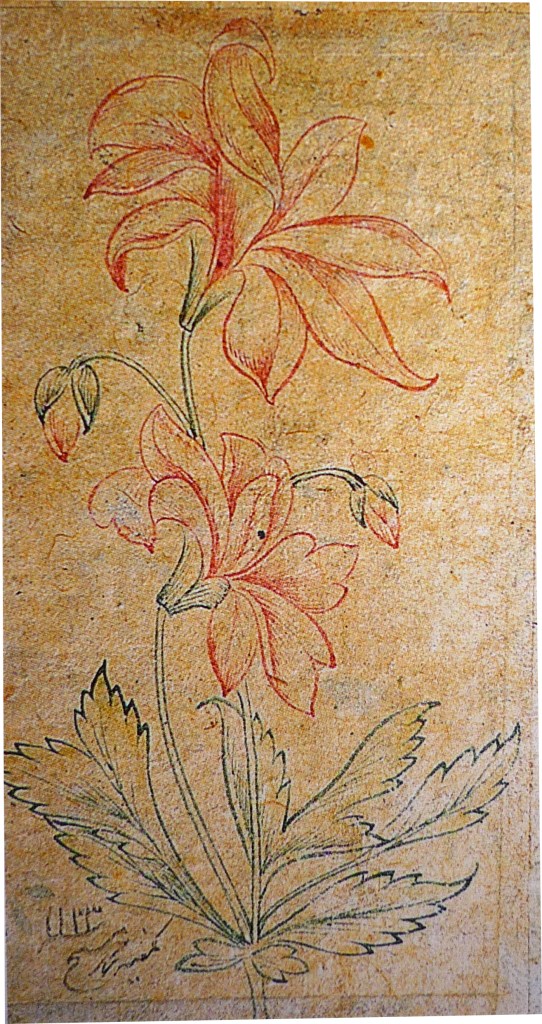
    Flower signed Muhammad Masih, 1123 H./ 1712

    Origin of the Design

    Muhammad Masih painting was initially sold at Sotheby’s Paris in 2015. I was busy writting my doctoral dissertation at the time and I completely missed it. Having three pages with an exact same design is however unprecedented.

    At the time, I was not able to identify the exact model of the two paintings I knew, and despite a follow-up research, I still come empty-handed. However, there is no doubt that the orginal design was made in Europe, most likely during the 16th century, for a printed herbarium, or most likely a florilegium, or “book of flowers”, particularly en vogue during the 17th century.

    Contrary to religious and mythological engravings that are pretty well documented, it is unclear how did herbaria and florilegia arrive in India and in Iran, but we know that some European travellers and artists had some books of flowers in their belongings. For this reason, we find many copies of Jan Theodor van de Bry, Florilegium renovatum et auctum, published in Frankfurt in 1641, Pierre Vallet Le Jardin du Roy published in Paris in 1606, Francois L’Anglois Livre de fleurs, Paris, 1620, Adrian Collaert Florilegium, published in 1587, and several others.

    On the left, Indian painting, 18th c., Clive album (VAM IS.48:1/A-1956). On the right, the original by Pierre Vallet, Le jardin du Roy, Paris, 1606. Species depicted: Lilium Martagon

    Making a copy in the 17th century

    Regardless how flower books arrived in the hands of painters, tthis exact model, and many others, were used to create either exact copies, such as our three identical pages, or brand new compositions using several sources.

    To make a copy is quite easy. First the artist used a niddle to make small perforations along the contours of the original design. Then, the model was put face against a blank sheet of paper. The painter then put a bit of charcoal powder on the back of the original page, which went through the holes onto the blank page. The “master copy” could be used several times, as demonstrated by the existence of the three similar narcissus.

    Pounced drawing of a bird. Iran, 17th c. (British Museum, 1988-4-23.26, f. 15b)

    Was Mansur the first one to paint this narcissus? This would explain why Muhammad Zaman chose the subject, as the Indian painter was most probably reknown outside of the Mughal court. Was Muhammad Zaman even aware of the first painting? Probably, though it is unsure how (the first painting probably arrived in Iran later, after Delhi sack by the army of Nader Shah Afshar in 1747).
    The depiction of narcissus is not uncommon in Iran in the 17th century, as the flower takes on several different meaning in poetry and litterature, but the facination with this particular design is more complex than it looks, and a lot more remains to discover.

    1. For the full list of folios, see E. Wright, Muraqqa, 2008, p. 141. The exact number of pages depend on the author. Wright counts 126, Atabai counts 131. B. Atabai, Fihrist-i Muraqqa’at, 1974, p. 178.
    2. Translation from The Jahangirnama: Memoirs of Jahangir, Emperor of India, ed. W.M. Thackston, 1999, p. 333.
    3. Asok Kumar Das openly challenges this attribution in Wonders of Nature: Ustad Mansur at the Mughal Court, 2012, p. 148-149. I remain slightly more nuanced than the author.
    4. This is the initial assertion of Mohammad ‘Ali Karimzade Tabrizi in Ahval va asar-e Naqqashan-e Qadim-e Iran, 1985, vol. 3, pp. 183-4, recounted by Melikian Chirvani in Le Chant du Monde, 2007, p. 408.
  • Happy New Year 2019!

    Happy New Year 2019!

    This is with some disbelief that I wish you all a very happy new year 2019. Disbelief that 2018 is already passed and that we are already turning the page. What a year it has been!

    For me, 2018 meant the starting point of my freelance activities, and of course the creation of this website. Coming at the end of a two years break after getting my PhD, 2018 seemed like the right time for returning to what I know and love: writing about Islamic Arts.

    I did not think that I would be able to find people ready to share their passion with me this quickly but sometime the stars just align the right way. For this I wish to thank, among others, Millon & Associés and lot-art.com for giving me opportunities to collaborate on several occasions, but also the numerous collectors, merchants, art historians and enthusiasts who encouraged the launch of my activities.

    If you are ready these lines, thank you.

    I do not know yet what 2019 will precisely be made of, but I am excited to discover it. My biggest project will be to rework and publish my doctoral dissertation. Though it was recognized as a work of high quality by the eminent scholars who composed my jury, it will still need some in-depth work to be actualized and synthesized in a (readable) book.
    As well, I wish to develop my writing activities further with new projects and hopefully I’ll be able to communicate more on that soon.

    So I wish you all a very happy new year, I hope it will be full of joys and discoveries for you and your loved ones, and I hope to see you back on this blog very soon!

    Women celebrating holi, detail of a painting from the Gentil collection. Lucknow or Faizabad, 18th c. BNF (OD44fol, fol. 44)