Tag: art

  • The Future of the Islamic Art Market could be Now

    The Future of the Islamic Art Market could be Now

    Click here to jump to the latest update (22nd Nov.)

    The challenges the world faces this year are of unprecedented magnitude, and with them, the fragile equilibrium of world economy has been thrown off balance completely. For museum and galleries, the blow is particularly hard, as most intitutions were already struggling keeping their doors open and their ceilling from leaking.

    Kashan turquoise-glazed pottery figurine of a camel and rider, 13thc. L.A. Mayer Museum auction, Sotheby’s

    To Deaccession or Not To

    In countries were main museums are public institutions, the gradual decrease of governement fundings have forced museums to look for funds elsewhere. In 2018-2019, the British Museum received £13.1 million grant-in-aid, the lowest since 2015, and particularly significant when put next to the year total expanditure, £96.2 million. This translated, among others, by an acquisition budget going from £1.1 million to £0.8.million. Last year, British Museum public revenues was £39.4 million, also the lowest since 2015, but we can expect 2020 to be particularly disastruous.1

    For galleries and private museums, the pandemic and inevitable economical crash that is predicted for 2021 are even more worrying, and it will take some time to recover from the loss of public revenues. Around the world, cultural institutions and associations are forced to look inside for solutions. In April, the American Association of Art Museum Directors (AAMD) passed a series of resolutions to relax the rules of deaccessinioning restricted funds:

    The resolutions state that AAMD will refrain from censuring or sanctioning any museum—or censuring, suspending or expelling any museum director—that decides to use restricted endowment funds, trusts, or donations for general operating expenses. The resolution also addresses how a museum might use the proceeds from deaccessioned art to pay for expenses associated with the direct care of collections.2

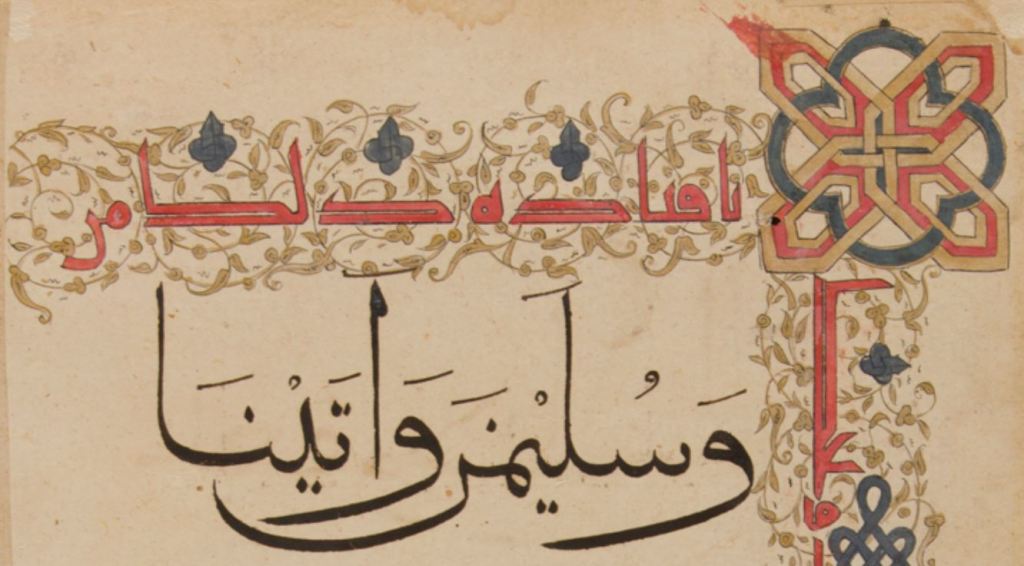
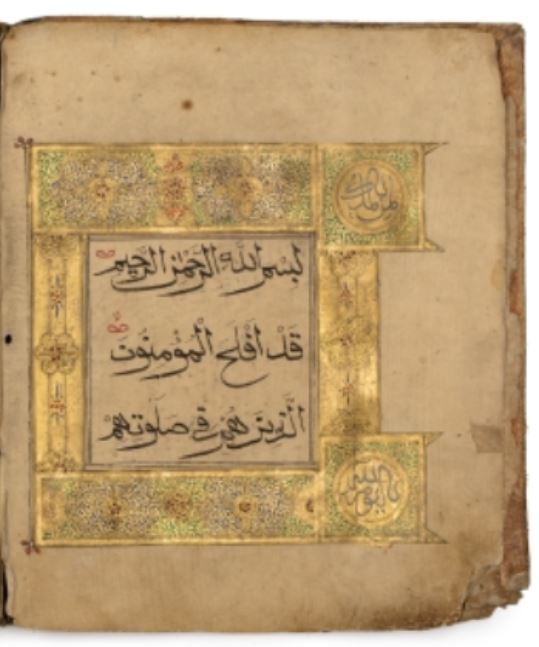
    Could the MET sell this Qur’an folio, Iran 12th c. (1996.238.2)

    This means that between April 2020 and April 2022, American museums can sell parts of their collections to replace lost income and finance their operations.
    In the UK, the powerful Royal Academy of Arts (RA) has been letting a similar idea float, though the debate has been particularly focused on the Taddei Tondo, a marble sculpture of Michelangelo, already threatened of sale in the late 70’s.3 No decision has been made yet regarding the tondo future, and it is unlikely that the piece will end up in an auction, but the financial crisis of cultural institutions, especially the smaller ones, might force hands.

    Selling or exchanging pieces of collections to fund new acquisitions is not a new practice, American museums have been doing it for years in a controlled setting4, but the new guideline from the AAMD extends the justification for selling art pieces towards operational means.
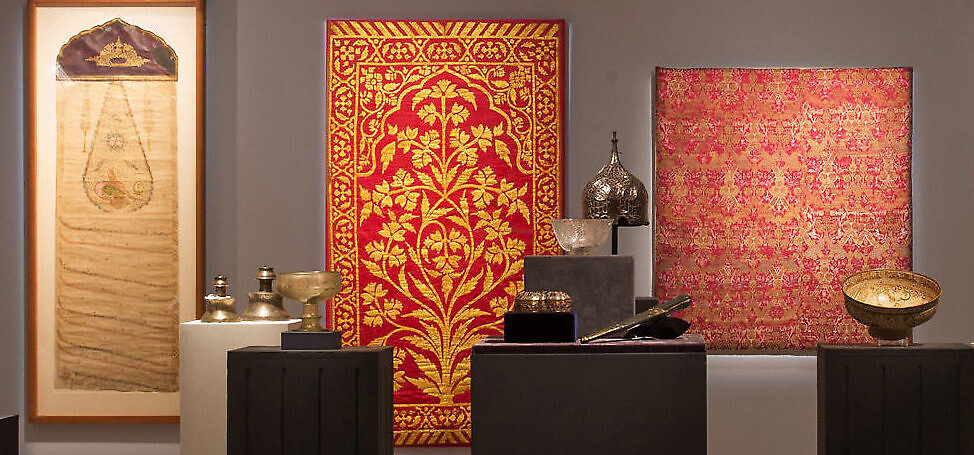
    The L.A. Mayer Museum auction presented by Sotheby’s

    What it means for Islamic Arts

    So far, Islamic arts had not been publicly impacted by deaccessioning, though the practice is common behind closed doors and emphasised by controversial sales such as the Timurid Qur’an on Chinese paper witht a more than opaque provenance, sold in June 2020.
    However, in a market working in a quickly closing loop and given the current context, it was only a matter of time before parts of an Islamic arts collection be presented in a historical auction.
    The time should have been on the 27th October 2020 and the auction at Sotheby’s of 190 lots from the collections of the L.A. Mayer Museum of Islamic Arts in Jerusalem. The aim of the auction has been clearly stated by the museum director Nadim Sheiban:

    We were afraid we could lose the museum and be forced to close the doors. […] If we didn’t act now, we would have to shut down in five to seven years. We decided to act and not wait for the collapse of the museum.5

    The star of the auction: an Aq-qoyunlu silver-inlaid helmet, 15th c.,  £400.000-600.000

    The catalogue included lots from all over Islamic lands but none from Israel and Palestine, as the legislation regarding native artefacts leaving the country is particularly strict. The auction, planning to reach around £6 million, would have given financial security to the L.A. Mayer Museum for the years to come, but would also constitute a definite slippery slope for private museums of Islamic arts around the world.

    In an unexpected turn of events, the auction was postponed last minute on Monday night. While Sotheby’s website states that the delay is only until November, there is no guarantee the sale will ever occur, as criticisms came from the Israeli government officials and the public. The Hermann de Stern Foundation, that owns the L.A. Mayer Museum collection, still seems keen on moving forward with the sale but might struggle reaching an agreement:

    The foundation’s management hopes that the postponement will make it possible to reach agreements that will also be acceptable to the Culture Ministry in the coming weeks.6

    What now?

    If the sale does go ahead, it will set a new precedent for the market of Islamic arts, as it will open the door for other museums to sell parts of their collections, either to acquire new items or just to keep the light on.

    We can also question the motives for selling Islamic artefacts. The conflict between Israel and Palestine and the tensions in the Holy City between Jewish and Muslims come to mind in the case of the L.A. Mayer Museum auction and make the intervention of the pan-Israeli governement more surprising, but Islamic arts are political and ideological tools in more than one region. The Indian governement of Kovind and Modi might use this opportunity to accentuate their efforts to rewrite (not to say errase) India’s Muslim history, but even in Europe where far-right anti-Mulims parties are gaining more influence every day, progressiveley emptying Islamic arts collections could be a way to deny a shared past.


    This bleak picture highlights the fact that selling Islamic arts bears a lot of weight, and publicly deaccessionning collections is not anodyne. Auction arts should use caution when selling museum pieces, but in this less than certain economical context, caution might already be gone in the wind. It will be interesting to see if the L.A. Mayer Museum auction goes ahead in November, and what the near future holds for Islamic arts.

    Update: Auction delayed again

    On Wednesday 19th December, the High Court of Justice has suspended the sale for two additional weeks, time for the L.A. Museum, Sotheby’s and the Culture Ministry to negotiate over holding a more limited auction with less high profile items, though these remain to be defined.7
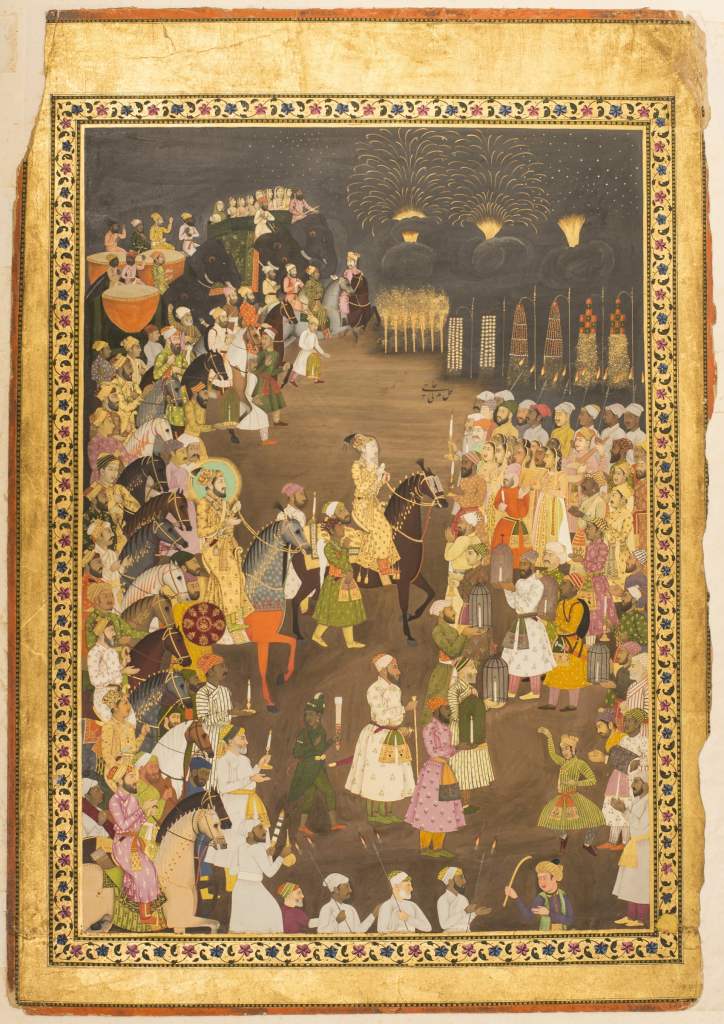
    A painting that could become controversial? Wedding of Dara Shokuh, Awadh, c. 1740, National Museum, New Dehli (58.58/38)
    1. British Museum governance.
    2. AAMD Board of Trustees Approves Resolution to Provide Additional Financial Flexibility to Art Museums During Pandemic Crisis 15 April 2020.
    3. Royal Academy of Arts considers selling Michelangelo marble to plug financial hole—and not for the first time 25 Sept 2020.
    4. The Permanent Collection May Not Be So Permanent, The New York Times, 26 Jan 2011. The Indiana Museum of Art lists all the deaccessioned pieces since the 1930’s.
    5. Jerusalem’s Islamic art museum says it has to auction off part of its collection, The Times of Israel, 24 Sept 2020.
    6. Auction for Jerusalem museum’s treasures postponed at last minute, The Guardian, 26 Oct. 2020.
    7. High Court Delays Controversial Sale of Rare Islamic Artifacts by Israeli Museum, Haaretz, 19th Nov. 2020.
  • The Mystery of the Narcissus

    The Mystery of the Narcissus

    On the 10th June 2020, Sotheby’s will be presenting a painting of a narcissus flower signed by the 18th century Persian painting Muhammad Masih. The painting is not dated but the signature seems genuine, written in gold on each side of the base.

    Golden signature of Muhammad Masih, just below a standard form of dedication.

    To say that the painting rings a bell is an understatement. Indeed, two other identical versions are currently known. One is mounted in the Hindo-Irani album, also called Nasir al-Din Shah album, currently scattered between the Golestan Palace in Tehran, the Chester Beatty Library for the most part, and other collections.1 The page bears what I call an “attributive signature” to the famous Indian painter Mansur, who worked in Mughal India for emperors Akbar (1556-1605) and Jahangir (1605-1627).

    The second page is mounted in the St-Petersburg album, previously called Leningrad album, kept for the most part in Russia, with only a few other folios scattered in various public and private collections (including a never seen before page sold last Winter in Paris). The painting is dated 1105 H./ 1693-94 and signed by the Persian painter Muhammad Zaman.

    The Painters

    Nadir al-‘asr Mansur worked in India, first in Akbar Ketabkhana (library), signing paintings in the 1590’s, and at least until 1621 when he was in Kashmir with the emperor Jahangir who wrote:

    The flowers seen in the summer pastures of Kashmir are beyond enumeration. Thos drawn by Master Nadir ul-‘asr Mansur the painter number more than a hundred.2

    Mansur is particularly reknown for his depictions of animals and flowers, but only two flower paintings indisputably bear his signature, a Tulip today in Aligarh University Museum and a copy of an European engraving in the Golestan palace in Tehran. This particular painting of a narcissus is problematic. Though the wording is similar to others genuine signatures, it is not located on the painting but on the below border, which was added later, when the page was mounted in the album. This is a common feature with Mughal album painting but one that is often ignored by specialists.

    The style of the painting differs slightly from Aligarh Tulip and the Golestan “Seven Flowers”, but we can put the variations on the natural evolution of the painter style, as well on the fact that this painting is most probably the copy of an European engraving (more on this below).3

    Muhammad Zaman worked in Safavid Iran between 1086 H./1675 or earlier and 1106 H./ 1695. The life of Muhammad Zaman has caused a lot of controversy among specialists, some stating he travelled to India, others to Europe where he converted to Christianism (which has been proven untrue).
    He is particularly known for his copies of European engravings, and according to his dated works, he seems to have favored flower paintings in the late stages of his career. This particular narcissus, signed and dated, was probably offered to the king Shah Soliman 1st (1666-1694). The style is genuine and corresponds to other flower paintings signed by the artist, mounted in the St-Petersburg album or elsewhere.

    Muhammad Masih career is even less clear than the other two artists, about whom a lot still remain unknown. Some state that Muhammad Masih was an Indian painter emigrated in Iran during the 18th century, but this has never been proven.4His work is not particularly well studied, but he seemed to have worked at the end of the 17th century and during the 18th century, as demonstrated by several paintings and drawings scattered in various collection, including a small flower dated 1123 H./ 1711-12, mounted in an album kept in the Muze-ye Honarhā-ye Moʻāser in Ispahan.

    Flower signed Muhammad Masih, 1123 H./ 1712

    Origin of the Design

    Muhammad Masih painting was initially sold at Sotheby’s Paris in 2015. I was busy writting my doctoral dissertation at the time and I completely missed it. Having three pages with an exact same design is however unprecedented.

    At the time, I was not able to identify the exact model of the two paintings I knew, and despite a follow-up research, I still come empty-handed. However, there is no doubt that the orginal design was made in Europe, most likely during the 16th century, for a printed herbarium, or most likely a florilegium, or “book of flowers”, particularly en vogue during the 17th century.

    Contrary to religious and mythological engravings that are pretty well documented, it is unclear how did herbaria and florilegia arrive in India and in Iran, but we know that some European travellers and artists had some books of flowers in their belongings. For this reason, we find many copies of Jan Theodor van de Bry, Florilegium renovatum et auctum, published in Frankfurt in 1641, Pierre Vallet Le Jardin du Roy published in Paris in 1606, Francois L’Anglois Livre de fleurs, Paris, 1620, Adrian Collaert Florilegium, published in 1587, and several others.

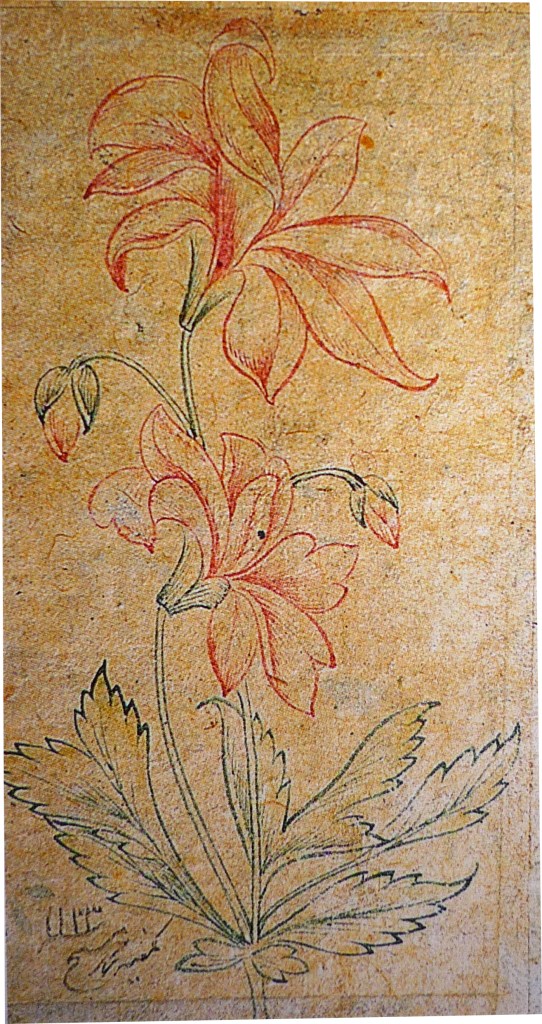
    On the left, Indian painting, 18th c., Clive album (VAM IS.48:1/A-1956). On the right, the original by Pierre Vallet, Le jardin du Roy, Paris, 1606. Species depicted: Lilium Martagon

    Making a copy in the 17th century

    Regardless how flower books arrived in the hands of painters, tthis exact model, and many others, were used to create either exact copies, such as our three identical pages, or brand new compositions using several sources.

    To make a copy is quite easy. First the artist used a niddle to make small perforations along the contours of the original design. Then, the model was put face against a blank sheet of paper. The painter then put a bit of charcoal powder on the back of the original page, which went through the holes onto the blank page. The “master copy” could be used several times, as demonstrated by the existence of the three similar narcissus.

    Pounced drawing of a bird. Iran, 17th c. (British Museum, 1988-4-23.26, f. 15b)

    Was Mansur the first one to paint this narcissus? This would explain why Muhammad Zaman chose the subject, as the Indian painter was most probably reknown outside of the Mughal court. Was Muhammad Zaman even aware of the first painting? Probably, though it is unsure how (the first painting probably arrived in Iran later, after Delhi sack by the army of Nader Shah Afshar in 1747).
    The depiction of narcissus is not uncommon in Iran in the 17th century, as the flower takes on several different meaning in poetry and litterature, but the facination with this particular design is more complex than it looks, and a lot more remains to discover.

    1. For the full list of folios, see E. Wright, Muraqqa, 2008, p. 141. The exact number of pages depend on the author. Wright counts 126, Atabai counts 131. B. Atabai, Fihrist-i Muraqqa’at, 1974, p. 178.
    2. Translation from The Jahangirnama: Memoirs of Jahangir, Emperor of India, ed. W.M. Thackston, 1999, p. 333.
    3. Asok Kumar Das openly challenges this attribution in Wonders of Nature: Ustad Mansur at the Mughal Court, 2012, p. 148-149. I remain slightly more nuanced than the author.
    4. This is the initial assertion of Mohammad ‘Ali Karimzade Tabrizi in Ahval va asar-e Naqqashan-e Qadim-e Iran, 1985, vol. 3, pp. 183-4, recounted by Melikian Chirvani in Le Chant du Monde, 2007, p. 408.
  • Happy New Year 2019!

    Happy New Year 2019!

    This is with some disbelief that I wish you all a very happy new year 2019. Disbelief that 2018 is already passed and that we are already turning the page. What a year it has been!

    For me, 2018 meant the starting point of my freelance activities, and of course the creation of this website. Coming at the end of a two years break after getting my PhD, 2018 seemed like the right time for returning to what I know and love: writing about Islamic Arts.

    I did not think that I would be able to find people ready to share their passion with me this quickly but sometime the stars just align the right way. For this I wish to thank, among others, Millon & Associés and lot-art.com for giving me opportunities to collaborate on several occasions, but also the numerous collectors, merchants, art historians and enthusiasts who encouraged the launch of my activities.

    If you are ready these lines, thank you.

    I do not know yet what 2019 will precisely be made of, but I am excited to discover it. My biggest project will be to rework and publish my doctoral dissertation. Though it was recognized as a work of high quality by the eminent scholars who composed my jury, it will still need some in-depth work to be actualized and synthesized in a (readable) book.
    As well, I wish to develop my writing activities further with new projects and hopefully I’ll be able to communicate more on that soon.

    So I wish you all a very happy new year, I hope it will be full of joys and discoveries for you and your loved ones, and I hope to see you back on this blog very soon!

    Women celebrating holi, detail of a painting from the Gentil collection. Lucknow or Faizabad, 18th c. BNF (OD44fol, fol. 44)
  • The Autumn continues in Paris

    The Autumn continues in Paris

    It is always difficult to predict the fluctuations of the art market, as tendencies can vary over a few months. In the case of the Islamic arts market, the excercise is even more difficult due to its diversified nature: all medium, a chronology of 14 centuries, more than half the world with no less than a douzen dedicated auctions a year. However, prices resulting from this heterogeneity also depend on the global economy and political context, even more than other markets like contemporary art or modern masters that see less variations in short periods of time.

    This Autumn, two major auctions were held in Paris: Ader Nordmann on the 27th November, Millon et Associés on the 3rd December. Both were really interesting to monitor, as they were the direct continuity of the London Islamic Week. I have commented in my previous article the results achieved by Bonham’s, Sotheby’s and Christie’s and whether some of them could be the start of new trends. Though London and Paris markets are very different in term of lots presented, valuations and overall prices, some tendencies tend to be confirmed. Others, not so much!

    All prices quoted below include VAT.

    Safavid Qur’an, 17th c., sold 5,120€

    Both auctions had a very different selection, reflected in the results. Ader Nordmann presented 326 lots, including 49 lots of archeological artifacts and an amazing gathering of 53 drawings of André Maire. Overall, 65.3% of lots were sold for a total amount of 79,111€. Millon auctioned 402 lots and sold 47.5% for a total of 1,099,397€. This result places Millon directly behind London (for reminder Sotheby’s made almost £8 millions, Christie’s £5 millions and Bonham’s £2.5 millions). Millon has still a bit of a way to go to dethrone London houses but the result is still very impressive for a French auction house and congratulations are in order for this achievement.  

    So how to explain this result, but also the important difference between Millon and Ader? Let’s take a look closer.
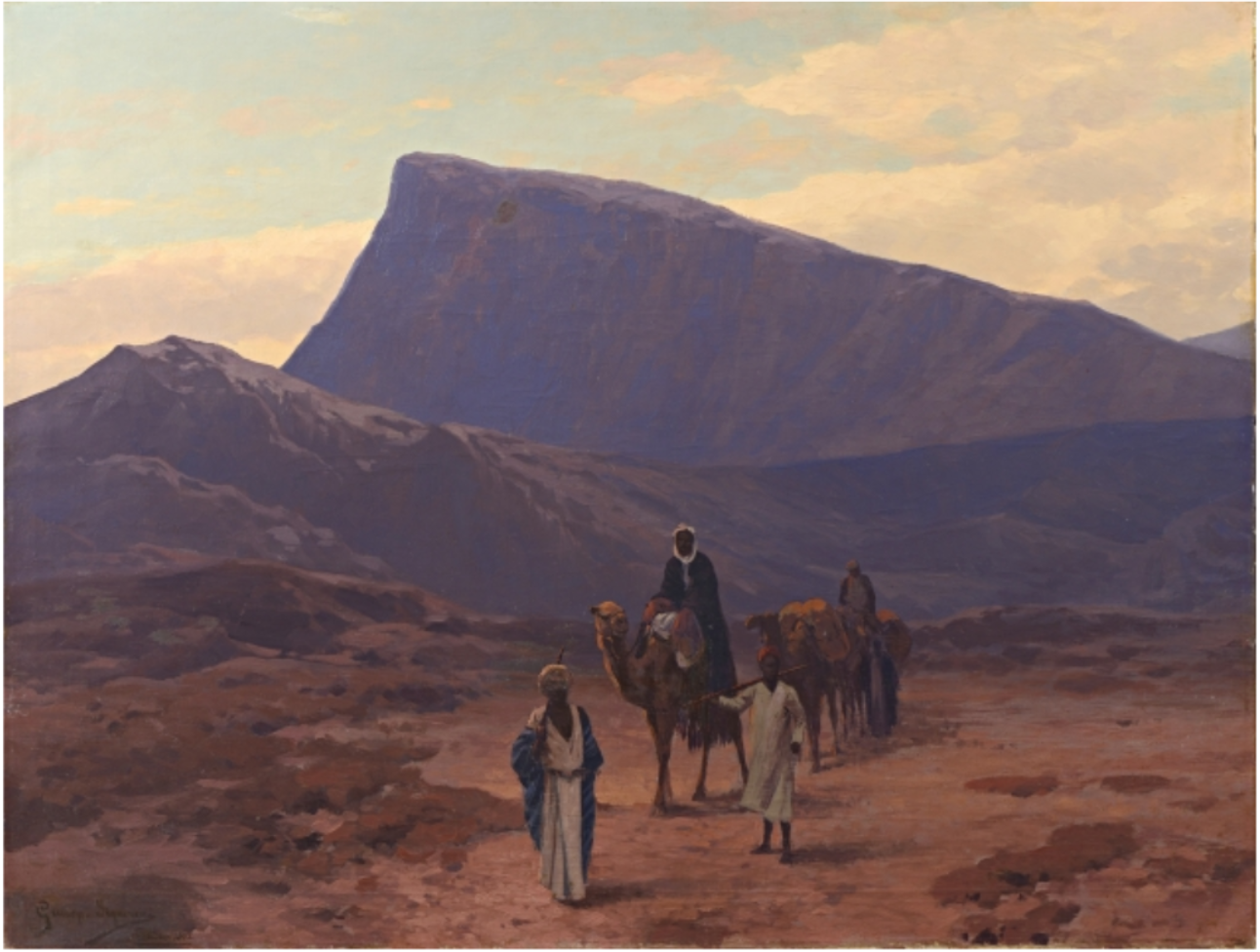
    As per tradition, Millon opened with 119 lots of Orientalist and Modern paintings and 15 lots of books, photographs and lithographs. This section did pretty well with some very impressive results, including a painting of Etienne Dinet (1861 – 1929) showing men praying (37,5 x 29cm), valued 6,000-8,000€ and sold 37,700€, as well as a colorful view of Rabat (64,5 x 99 cm) by Edy-Legrand (1892-1970), valued 6,000-8,000€ and sold 23,400€. Unsurprisingly, my personal favorite remained unsold, as Orientalist painting buyers are usually more attracted by signature and date and this view of the Atlas plateau (probably) is not signed. 

    Despite some restorations, the painting still holds a very interesting monumentality and sense of sublime that are not so common in Orientalist painting

    Ader presented 17 lots of Orientalist paintings, 26 lots of books and hajj certificates, but more importantly 53 drawings of André Maire (1898-1984), a French artist who fought in the two World Wars before leaving for Africa and then Asia where he spent 10 years. He left an immense production of drawings, as demonstrated by Ader selection of views of Egypt, India, Cambogia, Vietnam etc. All the lots were valued 400-600€ and I was expecting higher results. Most of them were sold between 700 and 2,000€, the highest price being achieved by a representation of Buddha and Ganesh.

    Drawing of André Maire are particularly interesting for the proportions of figure and the contrast between humans and environment. 

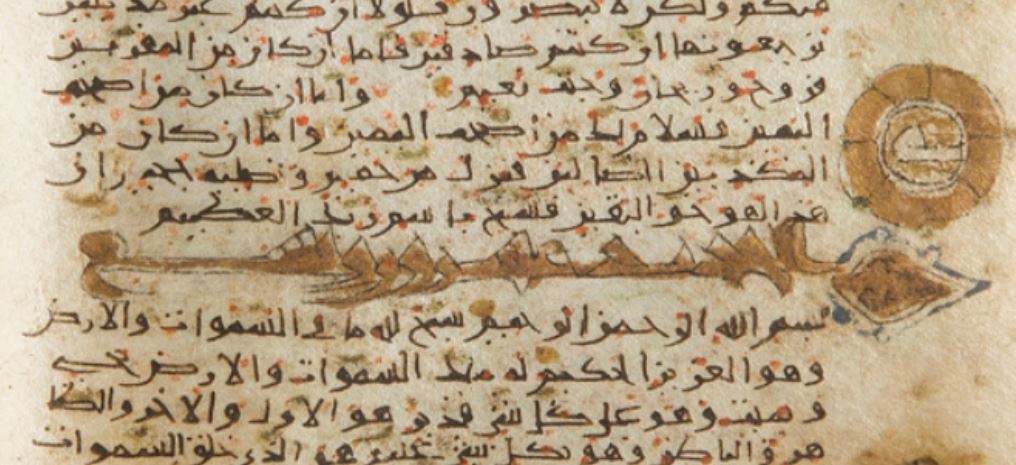
    The big surprise was the prices achieved in both auctions by Medieval North Africa and al-Andalus objects. For reminder, the last London Islamic week had left most of these lots unsold and I was expected similar results in Paris. Ader presented only one lot, a 12th-13th c. travel Qur’an (only 8.9×6.8cm). Valued at only 1,000-1,500€ due to a poor state of preservation, it reached an unexpected 37,120€, thus breaking the auction record. Millon presented five lots from 10th to 16th c. and five Modern revivals. The large Almohad water jar with an elegant tooled decoration took everybody by surprise by going at 54,600€ (against an estimation at 6,000-8,000€). The two Umayyad carbed marble capitals valued at 10,000-15,000€ reached 21,450€ and all the other lots went within their range. 

    To explain the success of North African and Andalusian items in Paris compared to London is not easy, but the most obvious explanation would be that buyers in Paris are not looking for the same kind of objects than London’s. The long lasting relationship between France and North Africa, and by historical extension south of Spain, has played a central role in the diffusion of art, in the constitution of private collections, but also in the elaboration of tast. The latter is demonstrated by the interest for Orientalist paintings, mainly focused on North Africa and Egypt, as well as the selection of books offered for auction, for instance Ader. The existence of documentation is, of course, a reassurance for buyers, as seen by the fact that Ader small Qur’an and Millon water jar both documented the provenance.

    Detail of Ader small Qur’an showing an interesting “proto-maghribi” script, golden surah title and reading mark

    What really made a difference for Millon lies in the manuscript section. 57 lots were presented and though some were left unsold, buyers displayed a rare enthousiasm for others. I was wondering prior to the Islamic week if isolated Qur’anic leaves on parchimen would still sell but after seeing the results, I had no doubt that the leaf with golden Kufic script and red diacritical dots would do well, and it did. The result went way above the range of 8,000-12,000€ with a total of 71,500€, a price comparable to those achieved by the Blue Qur’an bifolio sold by Christie’s in October, given the difference of valuation.

    If this Qur’an golden leaf was a given success, it was not the case for others whose results came as a complete surprise. A North African treatise of Maliki justice copied before 1692 (date of the waqf) was sold 39,000€, another one on sufism in Lybia copied around 1707 went at 13,000€. In other category, a Chinese Qur’an in 30 volumes from the 18th-19th c. and another 18th c. Chinese Qur’anic juz exceeded its range of 800-1,500€ by going at 5,850€. Usually these two kinds of manuscripts never break records, so I am wandering if we are seeing here a new trend developing in French auctions, or is it just a happy coincidence. Another Modern large Qur’an copied in the Arabic Peninsula in 1865 was sold at 52,000€ but this price is explained by the renown of its patron, the Sheikh Qasem b. Muhammad b. Thani (r. 1878-1913), second sheikh of the al-Thani family, considered like the funder of Qatar.

    A 18th c. Chinese Qur’an page, characterized by its golden illumination and script

    Qajar manuscripts and paintings are mostly stable without breaking any records. Two honorable mentions were sold at Ader, a Divan of Sa’adi from the beginning of the 19th c. including 10 paintings of high quality, for 9,216€, and an interesting litograph copy of the Shah Nama dated 1846, sold 12,800€.

    Finally, the category of Indian paintings was uneventful but both selections were not particularly remarkable. Parisian buyers don’t seem to be looking for secondary Indian paintings, while all Mughal high profile pieces are sent directly to London or to private merchants (see for instance Simon Ray current catalogue).

    In conclusion, the large difference of results between the two auction houses came mainly from their selection and what appears to be a shift on the Parisian market towards more high end art events. It will be interesting to see what the spring auctions will offer, and before that what the Carnet de Voyage auction will do in January. Will buyers be still interested in low value items? Time will tell.

    My favorite piece from the Millon auction, sold 3,380€. Click here to read the full catalogue entry written by yours trully