Tag: blog

  • Islamic Arts and Orientalism at Millon

    Islamic Arts and Orientalism at Millon

    This spring is definitely a busy time for Islamic arts, the auction catalogues flow in the mail box!

    On the 3rd of May will be presented at Drouot Paris the Millon & Associés auction. I had the opportunity to work on one of the biggest item, a 17th century Mughal Shah Name linked to Jahangir’s reign and decorated with very interesting paintings and drawings. The full notice in English is available here.

    The rest of the catalogue is equally rich, with a full first half dedicated to Orientalist paintings, as it is the tradition in Millon’s auctions. European paintings from the 19th and early 20th centuries depicting North Africa and the Middle East are not my field of expertise and I generally base my appreciation on their aesthetic appeal more than the overall production context. My three favorite among the 94 Orientalist lots are not the most expensive, far from it, but would compliment each other very well in a collector’s interior (not mine unfortunately!).
    12

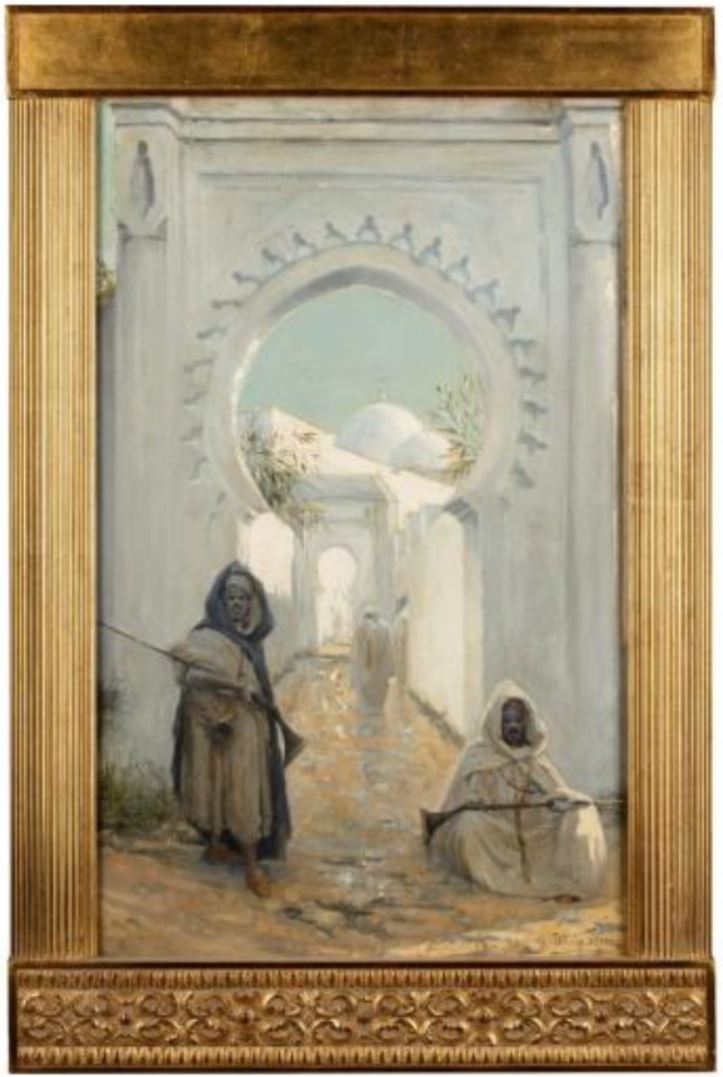
    The Guardians of Henri Van Melle (1859-1930) are particularly interesting for their use of white and blue shades. The foreground show two men with darker clothes and dark skin on which shine the traditional Berber tattooed marks, both highlighted by the white and luminous architecture. Even though the pictorial technique of Van Melle is not particularly innovative, his understanding of light, shades and coloring gives a real interest to this painting, estimated 2500/3000€.

    My second Orientalist favorite is a Moroccan night scene by Lucien Levy-Dhurner (1565-1953). I found the opposition of this painting and The Guardians fascinating, even though they are separated in the catalogue by more than 20 pages. While Van Melle worked on light, Levy-Dhurner worked on shadow but both being composed of different medium on blue shades. As well, both painters chose to depict a characteristic Moroccan architecture and a reduced number of figures. This is a common feature in Orientalist painting, that artists attached themselves to represent more of an idea than a specific subject, and these two paintings compliment each other perfectly in that sense. Levy-Dhurner painting is estimated 4000-6000€.

    56

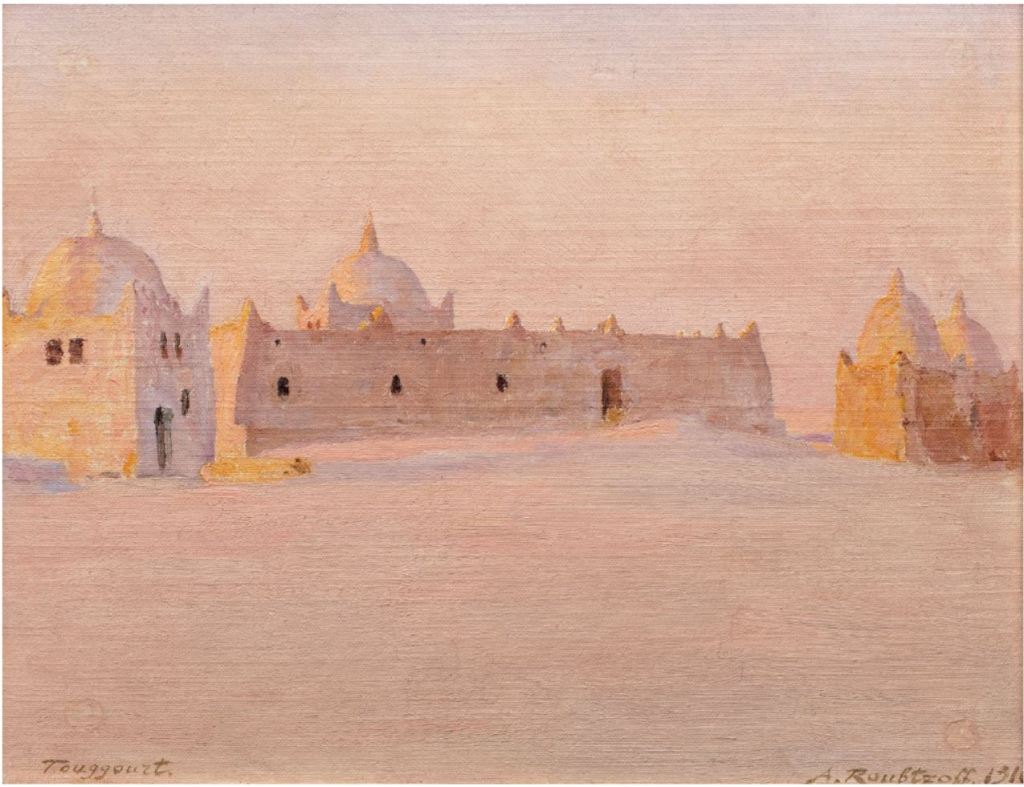
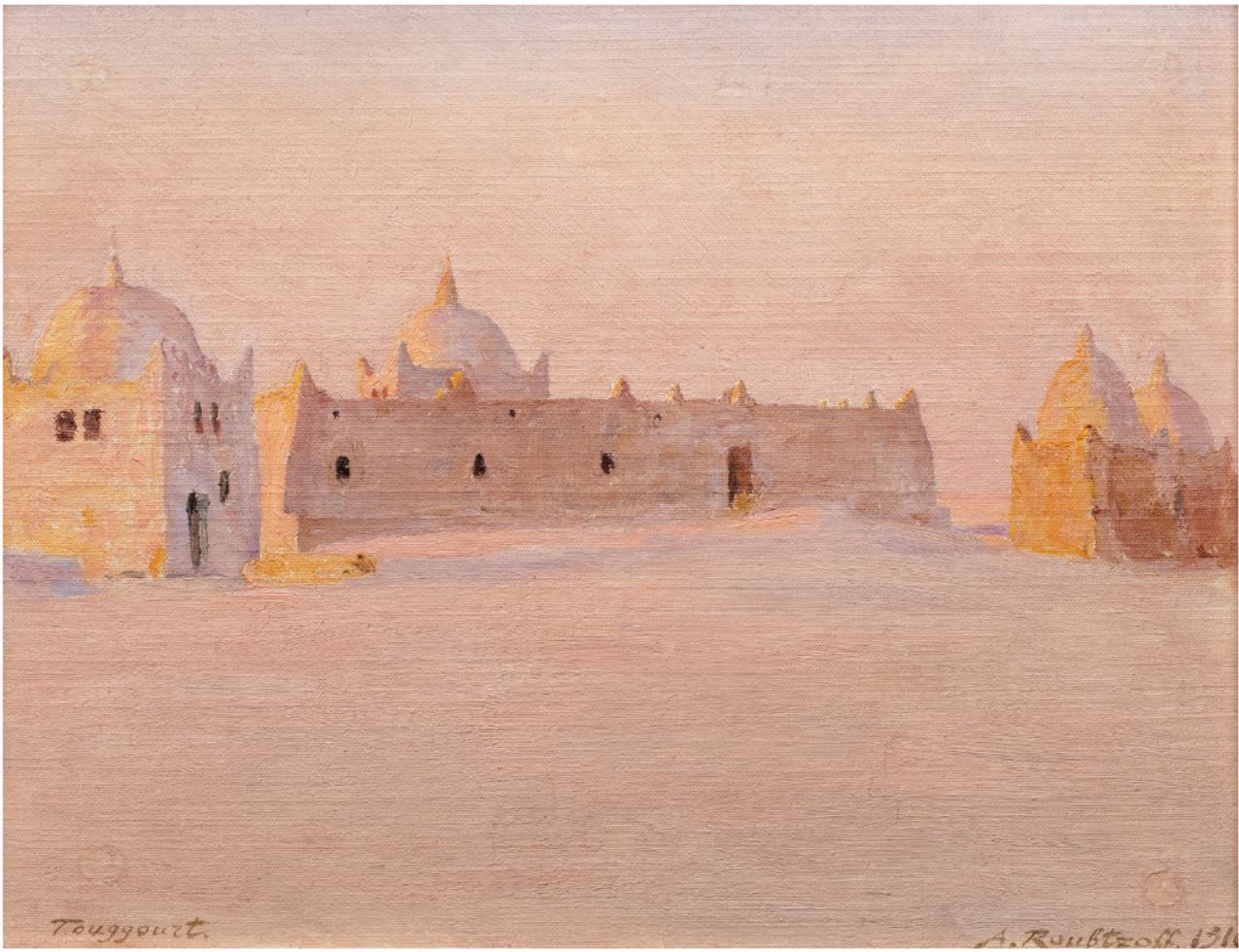
    Finally, and in the same spirit, my last Orientalist coup de coeur is a view of the Beni Djellab tomb in Algeria by Alexandre Roubtzoff (1884- 1949), dated 1916. This elegant oil painting on cardboard depicts beautifully the desert architecture and shows an harmonious play on pink and orange shades. No human figure necessary here, just the calm poetry of the sunrise reflection on the sand dunes. This last painting is the most expensive of my tiny selection with an estimation of 5000/7000€, it is also the most appealing one.
    81

    The other half of the auction catalogue offers a diversity of items, ceramics, weapons, manuscripts, jewelry and textiles, with many interesting pieces. One of them in particular intrigued me. The shape of this powder-blue ewer is similar to Persian and Deccani (India) tableware. However, it was not produced in the Islamic world but in China, around 1720-1730, probably for the Middle-Eastern market.

    Beside its aesthetic qualities embodied by the vibrant blue color and the original decoration of flowers and spider webs (a must on Chinese ceramics!), which earned it the estimation of 3000/5000€, I find this piece, and generally this production, particularly interesting for its historical value and the methodological questions it raises.

    This particular ewer was produced in China for the Islamic market so, is it Islamic art or Chinese art? Is it even either, knowing that its shape was probably given to Chinese potters by European trade companies, already trading on a global level during the 18th century?

    The search of authenticity by collectors of Islamic arts is legitimate and they could question the “truth” of this kind of items. After all, Islamic ceramics are not limited to shapes and uses, they encompass techniques, decorations and meanings. For instance, we can easily assume that the composition of this ewer differs from Islamic potteries, as Chinese potters have the ability to produce porcelain by adding kaolin to the paste, a material absent from the Islamic lands which mostly use siliceous pastes (80% of silicium in opposition to clay based paste mostly used in the Christian west before the 17th century).

    In my opinion, the value of this kind of items lies precisely in their complexity. This ewer represents a very particular point in time, the moment when trade companies took control of the global market, both in Asia by setting up production workshops and in Europe by introducing on the art market fake Indian and Chinese productions coming from these workshops and presented as authentic products of exotic interest. In fact, shapes and decorative repertoire were created by the companies for these specific markets and were a mix of different artistic traditions, like this ewer showing a Persian shape and a Chinese decoration. This item is a pure product of artistic exchanges during the pre-modern era and a nice one with that!

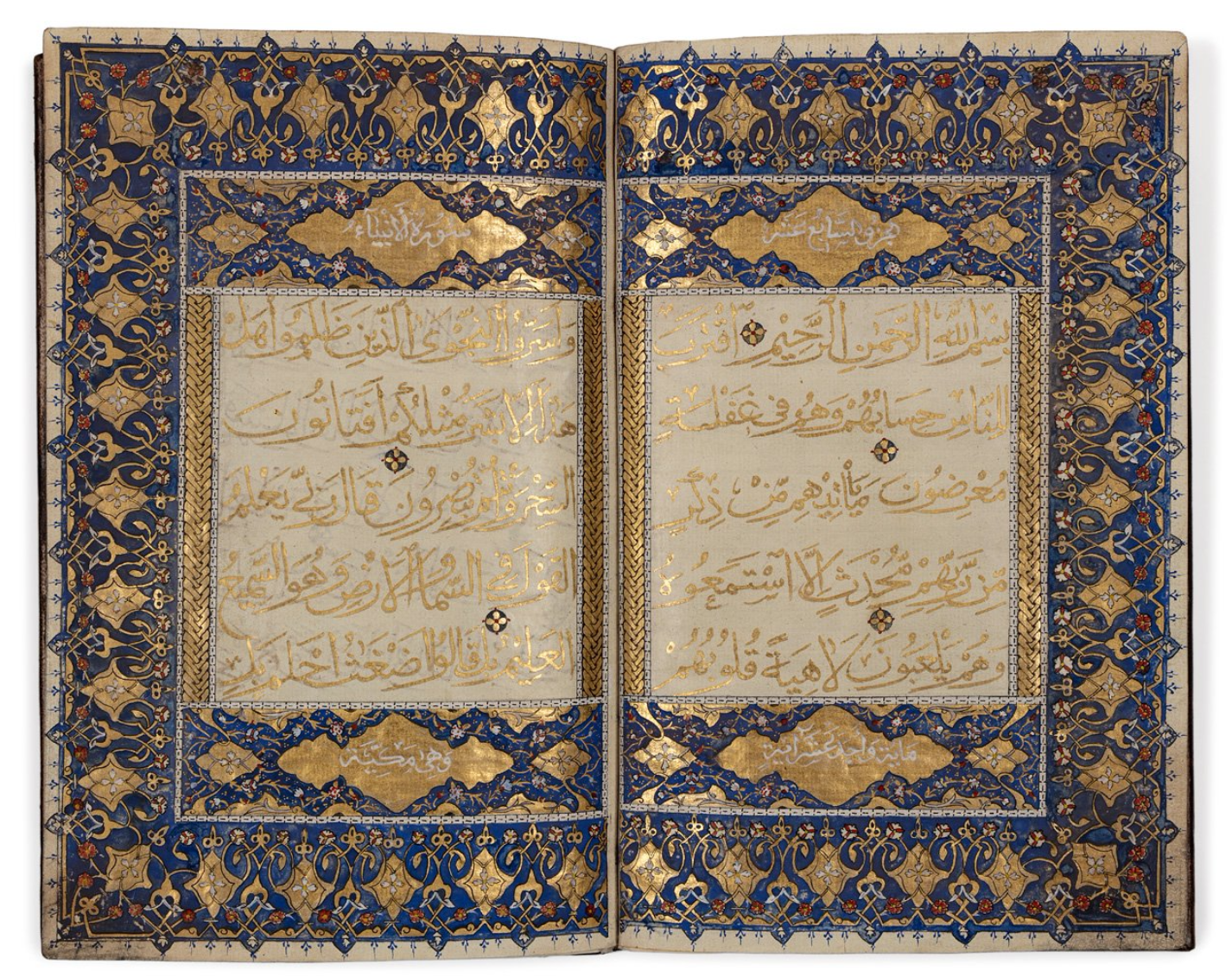
    I posted my last favorite item on Instagram, it is a real beauty and again, with great historical interest. Go check it out!
    Capture

    I look forward seeing the results of this auction, first to see if my work payed off but also because the prices achieved on this sale will certainly have an impact of the Parisian auctions for the rest of the year. Again, stay tuned!

  • This Spring London Islamic week is here

    This Spring London Islamic week is here

    April, what an exciting month. Spring is here, Manchester baby geese are being born (and their mother are attacking passer-by), and the Islamic week is held in London!

    Every six months, experts, specialists and Islamic Arts enthusiasts gather on King Street and New Bond Street to examine, judge and discuss the new and old wonders offered to the highest bidder. What are the stars this year? Are new trends rising? Let’s take a look!

    Bonhams open on the Tuesday with 368 lots. Most of them are manuscripts and isolated paintings from the 16th to the early 20th century, with the exception of the now classic 8th-9th centuries Qur’an pages. Bonhams pre-16th century generally lacks originality but balances it with some very interesting pre-modern and modern pieces. Among them, two in particular caught my eye:

    This book of prayers was written in Arabic in Ottoman Turkey by Abdul-Qadir al-Hisari

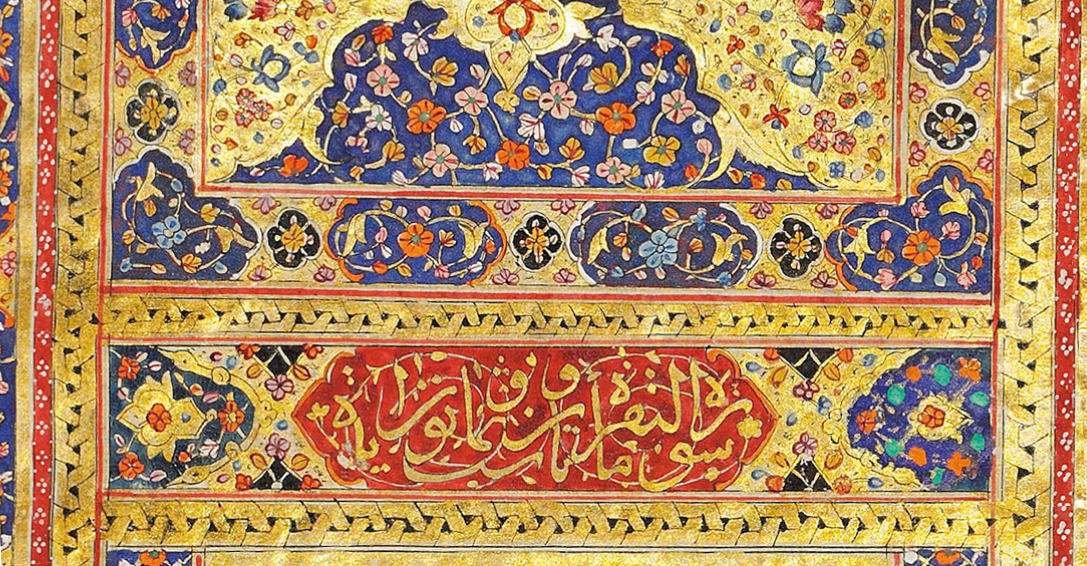
    in 1180 H/1766-67. It contains the names of God and the Prophet, as well as Hilyehs of the four Caliphs. The calligraphy is of good quality but the manuscript stands out by the unusual diagrams, including the sword of the Imam ‘Ali and Noah’s Ark. Estimation £2000-£3000.

    Bo_24.04.18_276

    The Goa production of Christian figures in ivory is nothing new but the St John the Baptist presented in lot 276 is particularly elegant. This production ranges from the 15th to the 19th century and its quality is uneven. However, the experts at Bonhams were not blind to this figure inherent charm and gave it a higher estimation than usual: £4000-6000.

    Sotheby’s auction is full of promises. 105 of the 206 entries are manuscripts, some of them quite amazing. Among them, it is worth mentioning a gorgeous Ottoman erotic manuscript dated 1232/1817, probably produced for a unidentified patron depicted in several paintings (lot 105, £250,000-£232,000). The study of Ottoman arts of the book is still underrepresented, mainly because it has been considered for decades as a sous genre of Safavid and post-Safavid Persian painting. Evidence is that Ottoman painting is everything but a sous genre and for everything who still has doubts about the inherent quality of it, just take a look at this manuscript.

    So_25.04.18_105

    My personal favorite is a bilingual print of the Qur’an made in Hamburg in 1694. This item is not particularly interesting for its aesthetic features, though the Arabic script is interesting, but its historical and historiographical value is higher than the little £1,000-£1,500 estimation it was given. This print is one of the oldest edition of the Qur’an in the Christian West. It is due to the theologian Abraham Hinckelmann (1652-95) who had already printed a monolingual edition of the Qur’an in 1693 but insured the diffusion of the text by adding a Latin translation.

    So_25.04.18_23

    Finally, Christie’s King Street opens its sale on the 26th by nine Qur’anic folios unrecorded folios. It is always exciting when a new item appears on the market, and these small and antique fragments – 11.1×12.7cm, datable 8th century – are particularly important for Qur’anic studies. It wouldn’t be a surprise that a museum jump on this occasion and preempt the lot.

    The selection of Western Islamic art offered after this is interesting and of high quality, especially the golden Fatimid gold armlet miraculously preserved.

    I am always a little bit flustered by collection of ceramics, especially architectural, from the end of the 19th century. The collection of Lockwood de Forest shines by its coherence but brings the question of this acquisition – the same way does the Timurid tiles collection of Mnavzagan Pridonoff presented at Sothebys (lots 106-110). Even tough the catalogue partly specifies the amount of money spent by de Forest, we are left to wonder if his reputation as a collector of architectural ceramic and the price he was ready to put on a tile didn’t speed the destitution of historical monuments. Bearing that in mind, what should we do with such collections? They constitute an important part of Islamic Arts historiography but, as well as so many more Western gathering of artistic artifacts, the ethic behind them is debatable.

    The focus has switched these past years from Medieval productions to Pre-modern, namely Safavid, post-Safavid and Ottoman. Indian Islamic Art is still very 17th Mughal focused but the light brought recently to post-Mughal art by academics and the increasing rarity of Mughal pieces could bring the emphasis to change.

    The taste for later pieces is demonstrated in the Christie’s catalogue by the wide range of Qajar and Ottoman items. No less than 28 entries from 18th and 19th centuries Iran, including heavily decorated Qur’ans, oil paintings, lacquered boxes and enameled jewelry.

    Lot 86, 1200/1786, £8000-£12,000

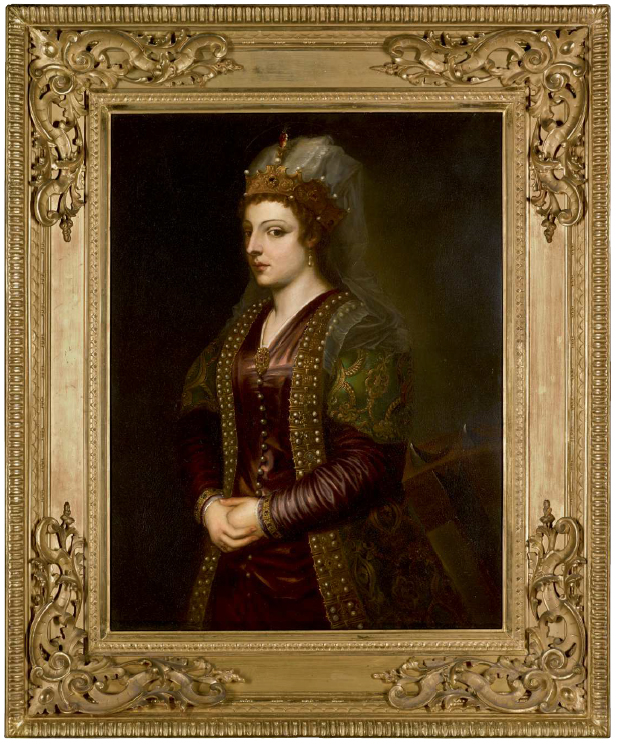
    Fun fact, both Sotheby’s and Christie’s are presenting a version of Titian’s portrait of Caterina Cornano, Saint Catherine of Alexandria (Galleria degli Uffizi). Both paintings are similar in size but Christie’s dated the execution from the 18th century, while Sotheby’s painting seems to be more recent. Christie’s version is more refined, especially the use of shadows and the pose of the figure. One has been given an estimation from £8,000 to £12,000, the other only £5,000-£7,000, the message is clear. As well, it seems that Sotheby’s mistakenly identified the portrait as one of Roxelana, wife of Sultan Süleyman, also depicted by Titian around 1550 and given the name of La Sultana Rossa (Ringling Museum). Someone didn’t do their homework !

    It will be interesting to read the results of these tree auctions and see what has been the rising stars or complete flops of the Spring Islamic week. Stay tuned !