Time flies when you’re having fun… And when you’re stuck at home, apparently. 2021 went like a dream in sweatpants, or like a bad sequel to 2020, which was already not that great.
Luckily, 2021 has also been the year of new encounters, collaborations and initiatives, and overall has been a busy year. Two highlights of the year were my participation to the symposium “Eighteenth-century Persianate Albums Made in India: Audiences – Artists – Patrons and Collectors” in Berlin, during which I had the opportunity to talk about floral margins in 18th century Indian albums. The proceedings will be published this year or the next. The second highlight was the launch of the ART Informant podcast at the end of the year, of which three episodes are already out. I debated whether to start this project for a while, as this format did not exist in the fields of Islamic art history, conservation and market. In the end, I am glad I got passed my doubts, as the feedback of the audience and guests have been particularly positive. For this, I thank you all.
What to look for in 2022
In 2022, I want to continue growing the ART Informant community and reach out to a larger audience. There are a lot of fantastic scholars, curators, conservators, collectors, experts and merchants I want to invite, let’s hope they’ll all say yes. The content I offer via the website and the podcast represent a significant investment, and even though I do this with passion, the realities of the world remind themselves to me. For this reason, I am introducing a Paypal donation button on the site. If you like the content I offer and want to support the site and the podcast, please consider donating. Your donations will help me in growing the platforms and eventually offer more diversified content.
[paypal-donation]
I will attend London spring Islamic week, should covid let me. Last time I was able to attend was in 2019, so I’m particularly excited to meet experts and collectors, and to offer new content on the website and the podcast related to the event.
Hopefully, I will publish two papers, or at least get them accepted for publication. Because I’ve been short on time since I got my PhD in December 2015, I haven’t been able to publish my doctoral dissertation. This is still a project, but to do so I will need uninterrupted time, which your donations might be able to get me. In the meantime, I spread information in shorter bursts, such as the paper I published in The Journal of Islamic Manuscripts last year, on “Patronage and Productions of Paintings and Albums in 18th-Century Awadh“.
On a more personal note, I am aiming to finish my Diploma in Art Law offered by the Institute of Art and Law in London. I would also come back to teaching art history, which I miss dearly, and will start to look for opportunities to do so.
Rendezvous in December 2022 to see if all the above have been accomplished!
I wish you all a fantastic year, hoping the journey will be filled with success, joy and surprises.
I admit it, this title might be a bit dramatic, but it is still an accurate depiction of the upcoming Islamic week, as, yes, there are bats.
This year, Bonhams opens on the 25th October with a large catalogue of 342 lots, more than double since last Spring auction; Roseberys presents on the next day with a head-turning catalogue of 557 lots, though not all are Islamic. Going through the selection is not easy, as there is such a thing as too much of a good thing, especially when the internal organisation of the catalogue makes no sense and the online navigation only allows keyword searches. That being said, a large part of Oliver Hoare’s collection is offered for sale and kept as a cohesive whole within the catalogue.1 Sotheby’s holds two auctions on the 27th, in the morning with 29 Company School paintings, in the afternoon with 184 lots, including three going over the million. Christie’s presents a single catalogue of 207 lots on the 28th. Only one item goes over one million, and the catalogue gives the impression that the auction house has struggled to get a high-quality selection. There are still some pretty amazing and unpublished artefacts, so all is not lost. Finally, Chiswick closes the week on the 29th with two catalogues, a single-owner sale of 162 lots in the morning entirely dedicated to 19th and early 20th Qajar Iran, and a larger catalogue of 236 lots in the afternoon.
All previous auction results include premium. You can click on any image below to get to the corresponding catalogue entry.
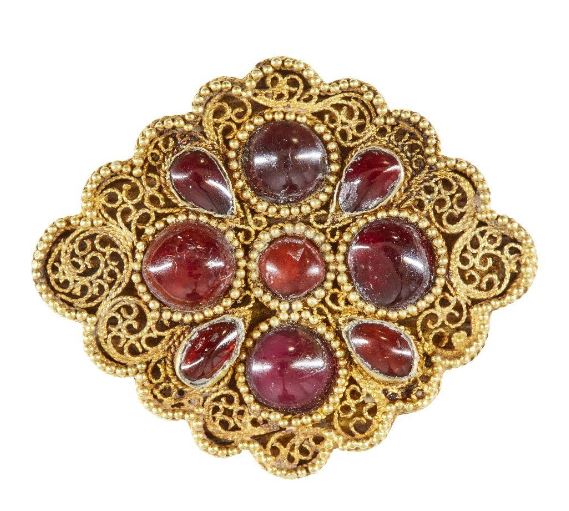
Garnet set gold elements, Roseberys, lot 314, £6-800
The commodity of Indian art
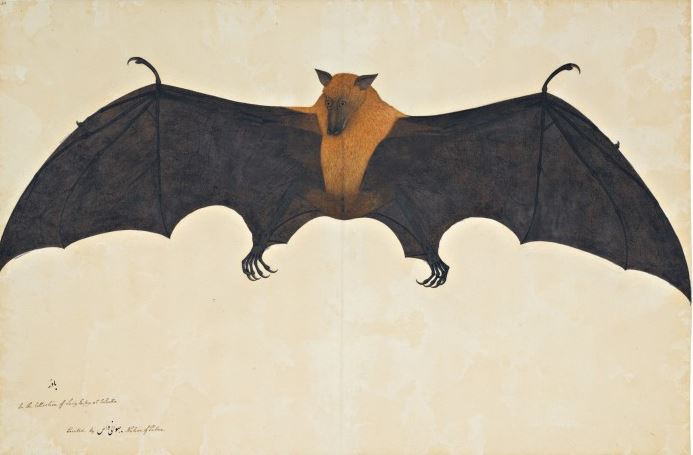
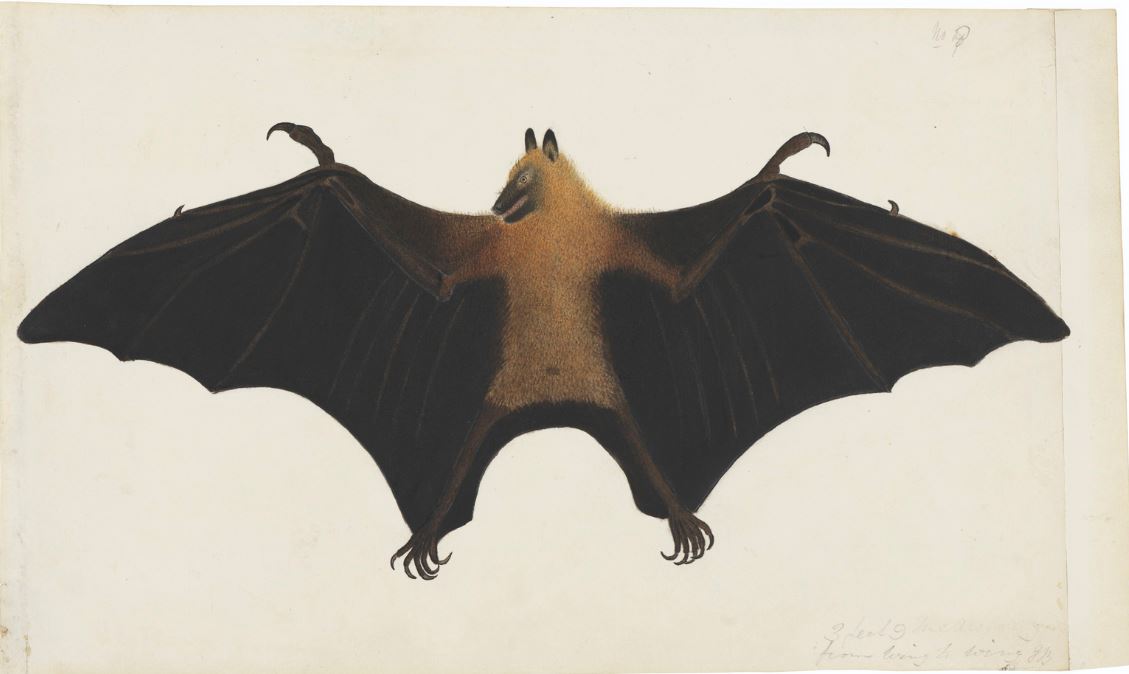
Let’s start with the bats. Sotheby’s first auction is exclusively made of Company School paintings, coming from the collection of the New-York gallery Carlton Rochell. Prices go from £8.000-12.000 to an astonishing £300.000-400.000 for a Great Indian Fruit Bat signed Bhawani Das, produced for Sir and Lady Impey. Elijah Impey was Chief Justice of Bengal from 1774 to 1787 and settled in Calcutta with his wife Mary, where they took a particular interest in hiring local artists to depict Indian natural history. They are today the most famous patrons of “Company School” painting, reflected here in the price of Sotheby’s bat. The flying fox was already famous on the market, having most recently been sold for £458.500 at Bonhams in 2014, before that for £168.500 at Christie’s in 2008 as part of the Niall Hobhouse Collection sale.
Company School bat, Sotheby’s lot 14, £300-400.000 Company School bat, Christie’s lot 55, £20-30.000
The second flying fox, presented at Christie’s for £20.000-30.000, appears a bit pale in comparison to the first one. Unsigned, it lacks the endearing realism that characterises Sotheby’s bat. As well, the catalogue only mentions one previous provenance and nothing prior to 2018.
Company School paintings haven’t moved crowds in a few years, and estimations rarely exceed £40.000. Sotheby’s is taking a risk by presenting a catalogue exclusively composed of Company School paintings, hence the clever marketing, betting on a foreword of William Dalrymple, famous author and curator of the exhibition Forgotten Masters: Indian Painting for the East India Company, held at The Wallace Collection in 2019-2020. It will be interested to see if the announcement effect bring new buyers, but we can at least expect the Flying Fox to do well.
Sotheby’s details the provenance of most of the paintings, which is always laudable, but was not particularly difficult in this case, the majority having been sold in the past 10 years on the London market, either in public auctions or in galleries such as Simon Ray and Francesca Galloway. Stuck in the close loop of increasing values, this leads to suspect that Sotheby’s Bat and Crimson Horned Pheasant are not collected for their artistic merits, but instead the safety their investment represents. It would be naive to think this is not the case for other, even any, high-value artefacts, but this is particularly obvious in this case.
What is also obvious in this auction, is the unofficial agreement between Sotheby’s and Carlton Rochell. Browsing through the afternoon auction catalogue, many Indian paintings rang a bell. With reason, as they were published not long ago in Carlton Rochell’s 2020 and 2021 catalogue, for instance lots 141, 146 and 147 (as I’m finishing this article, Carlton Rochell’s website has been down for two days, and I didn’t get the chance to download the catalogues to compare with Sotheby’s any further. The site was working on the 5th October when I started writing. As we say in French, mystère et boule de gomme).
Indian glasses?
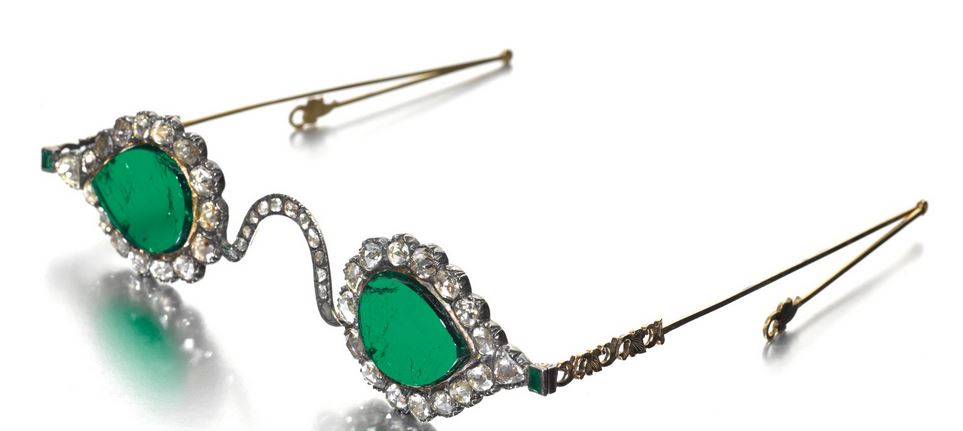
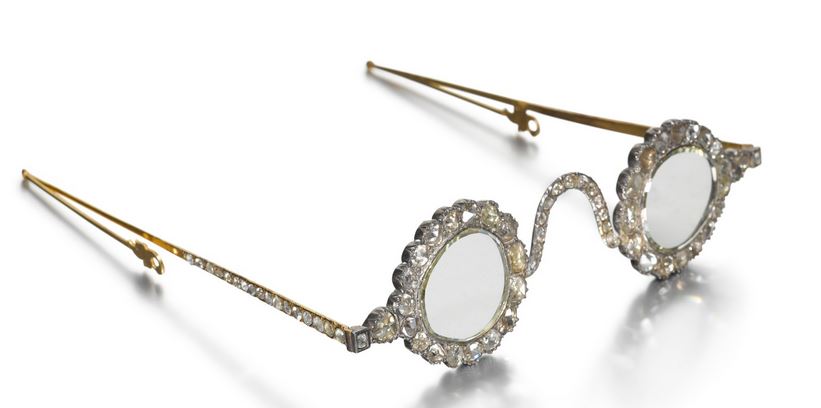
Moving from bats to elephants (the ones in the room), Sotheby’s presents two pairs of 19th century spectacles set with emerald and diamond lenses, each valued at £1.500-2.500.000. I am not a lapidary specialist, so my opinion is solely based on the catalogue, and let’s say I’m confused by these objects. The emeralds originate from a mine in Colombia discovered in 1560, and it is stated in the text that large quantities of emeralds were subsequently acquired by the Mughals. This seems to contradict the fact that emerald deposits can be found in Afghanistan and India. The diamonds “most probably” came from Golconda, but this is not confirmed. Aside from the stone’s origins, the main issue is that the frames are described as European. Indian stone-setting techniques are mentioned in the text, but it is specified that “they incorporate a European ‘open claw’ design”. Examples of figurative paintings showing Pince-nez glasses are also given, such as a portrait of Aurangzeb2, but these spectacles are not pince-nez. The valuation is probably justified by the stones, but the catalogue is extremely misleading, as these beautiful spectacles might very well not be Indian at all. Golconda diamonds and Colombian emeralds on a European frame raise a lot of questions, but I let the reader forms their own opinion.
Emerald spectacles, Sotheby’s lot 213Diamond spectacles, Sotheby’s lot 214
Metalwork in the Place of Honour
The debatable spectacles are not Sotheby’s high-value lots, the first place goes to a gold and silver inlaid brass candlestick attributed to Mosul circa 1275, offered for £2-3.000.000. Previously sold in Paris in 2003 for a price I was unfortunately not able to retrieve, it was exhibited in the MET from 2017 to 2021. The inscriptions do not give any information on the production context, but the subtle iconography suggests a court commission.
Mosul brass candlestick Sotheby’s lot 170, £2-3.000.000
The same way, Christie’s second-biggest lot is an elegant brass ewer attributed to the Khorassan region c. 1200-1210, valued at £ 300-500.000. Bonhams presents a few early bronzes, including a horse-shaped censer. The piece had previously been presented by Christie’s in 2006 as Byzantine and sold for €20.050, but is rebranded here as Umayyad and valued at £100-120.000. The line between Byzantine and Umayyad is often so thin, deciding on one over the other becomes a marketing question. Early Islamic usually sells better than late Byzantine, but it also involves more risks. Clearly, Bonhams feels confident enough to give a 6 figures’ valuation.
Umayyad bronze burner, Bonham’s lot 23, £100-120.000
Not to be outdone, Roseberys and Chiswick offer a large selection of metalworks. Roseberys presents 12 lots composed of gold elements set with garnets and two similar rings, attributed to 12th century Iran and valued between £2-300 and £2-4.000 (lots 309-320). My guess would be that the gold elements come from two different ensembles, but the 10 pieces would deserve to remain together. From what I could see (again, navigation is really uneasy), their most expensive metal artefact is a 12th century Seljuq bronze incense burner in the shape of a bird, valued £20-30.000. It is close to another burner in the MET, though Roseberys’ is better preserved.
My personal favourite presented at Chiswick is an engraved brass casket attributed to 12th century Sicily with later modifications, offered for £4-6.000. The complex history of the Sicily kingdom makes attributions particularly tricky, and art market professionals tend to stay away from the region, complex to brand and sell. It will then be particularly interesting to see if buyers are willing to invest.
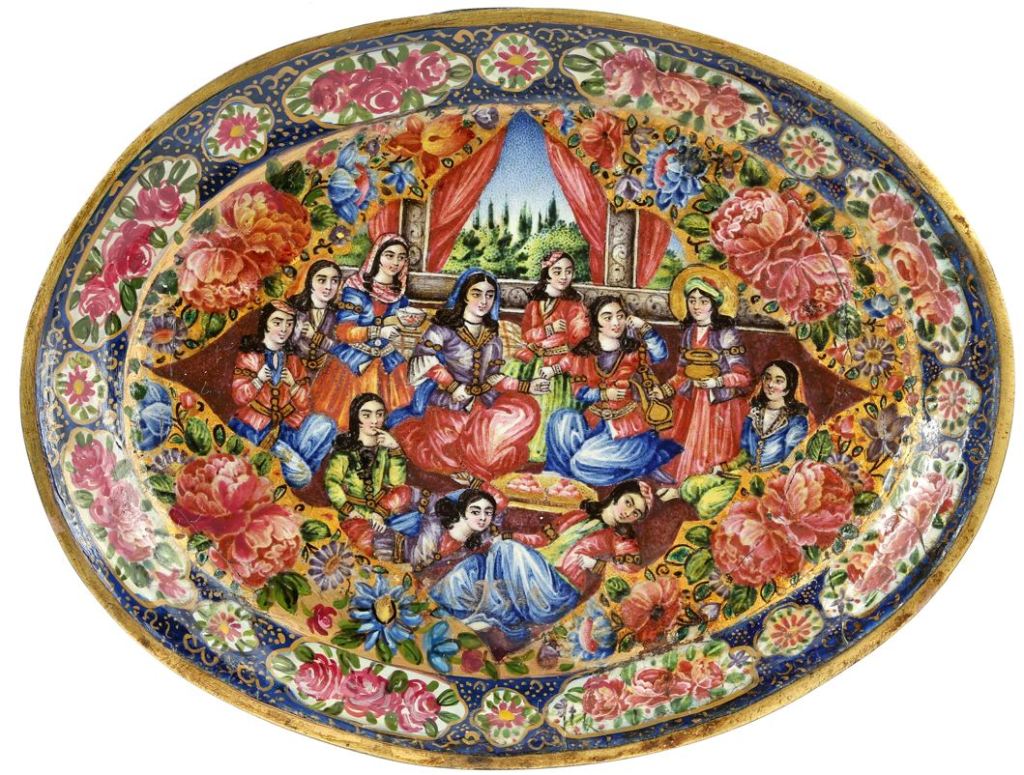
Qajar enamelled copper, Chiswick, lot 201, £6-800
Historical Figures, Historical Manuscripts
Chiswick main attraction in their afternoon auction is a group of 11 ivory figures depicting the Maharaja Ranjit Singh and his court, probably produced in Delhi in the first half of the 19th century. The central figure is identifiable, which is quite rare for this type of artefacts, but not unique in the case of Maharaja Ranjit Singh, as demonstrated by another ivory figure in the Victoria and Albert museum. The identification and the overall quality of the ensemble easily justifies the valuation at £25-30.000. To be noted that a second group of ivory figures is presented by Chiswick in the same auction, 13 anonymous palanquin bearers and attendants, valued only £6-800.
The same way, Bonhams most valuable artefact is a gold-koftgari steel repeating flintlock from the personal armoury of Tipu Sultan, signed by Sayyid Dawud and dated 1785-86. The provenance is no less prestigious, the weapon was acquired by Major Thomas Hart of the East India Company, following the siege of Seringapatam, and kept in the family until March 2019. I would not be surprised if a museum decided to acquire this piece, while Bonhams continues to establish their authority on historical artefacts.
Portrait of Sultan Orhan, Christie’s lot 76, £800-1.200.000
Christie’s is betting big on historical figures this season, with their highest valued lot being six portraits of Ottoman sultans produced in Venice around 1600 for the Grand Vizier Sokollu Mehmed Pasha. The ensemble is very interesting, both for its historical value, but also for the inherent dynamism and quality of each portrait. It seems risky to put European paintings as showrunner of an Islamic art auction, but I believe these will do well.
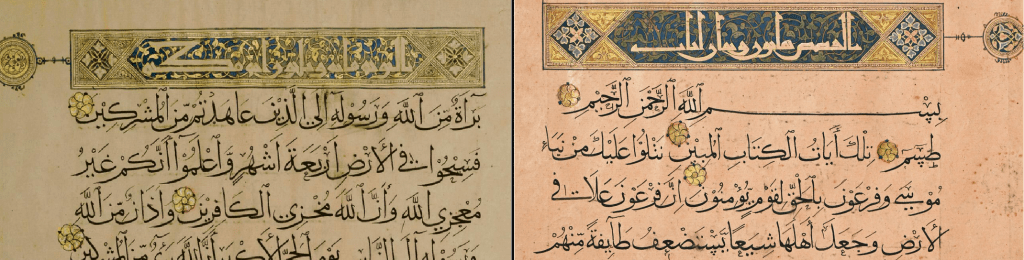
My favourite item of this entire Islamic Week is a Qur’an produced in Sultanate India, both signed and dated 838/1435, which is extremely rare. Offered by Christie’s for £30-50.000, the valuation doesn’t seem to fit the quality of the manuscript. That being said, Sultanate manuscripts rarely fly, so it will be interesting to see what this one will achieve. The gorgeous illuminations are characteristic of Sultanate Qur’ans, an odd mix of Egyptian and Persian influences, interpreted through then Indian lens.3
To finish, and speaking of rare, Sotheby’s present a complete Chinese Qur’an in 30 volumes, signed and dated 1103/1691. This is a huge event, and I hope the specialists of the field will have the opportunity to rush to London to see it before it is sold. Chinese Qur’ans are almost always dismembered, juz being sold separately, while dates and signatures are art history unicorns. The manuscript is sold without provenance, which is highly problematic, and I sincerely hope Christie’s will open their archive to scholars (which they usually do).
So much more could be said about this Islamic week, but I’ll stop there before rewriting all the catalogues. What do you think about Bonhams, Roseberys, Sotheby’s, Christie’s and Chiswick selections? Please share in the comments below!
Complete Chinese Qur’an, Sotheby’s, lot 119, £40-60.000
Oliver Hoare (1945-2018) was an influential Islamic art dealer, to whom we owe the creation of the first Islamic art department at Christie’s. More info on his Wikipedia page.
Museum für Islamische Kunst, Berlin, inv. I4594 fol.5.
The lot essay finally quotes Pr Brac de la Perriere’s work, one of the few specialists of Sultanate India and who has been mostly ignored in previous auctions. It was about time!
The effect of the Pandemic on the London Islamic week of Spring 2021
The year 2020 has been challenging for the world and everybody on the planet has felt the impact on the pandemic. Not being out of the woods yet, the beginning of this year seems more hopeful with the promise of a vaccine in most countries, but we’ll more likely see long-term effects of this crisis, starting with the London Islamic week of Spring 2021.
For the Islamic arts market, and the art market in general, 2020 has forced a rapid shift, proving the capability of auction houses to adapt, but not without consequences.
All prices below include premium.
Bayazid Bastami and Khizravayh b. Shaykh Ahmad, Iran, c. 1570. Christie’s 01.04.21, lot 17, £4-6.000
A rapid shift to avoid the worst
From a purely financial perspective, the worst was avoided. For pre-modern Islamic and Indian arts, Sotheby’s took the biggest hit, achieving overall £10,526,614, a 31.6% decrease compared to last year. Christie’s maintained its base revenue with £21,927,125, a 0.41% decrease from 2019, but excluding the exceptional sale (as in “one time event”) of the al-Thani collection, held in New York in July 2019 and that made $109,031,875. Bonhams sustained a 32% growth by maintaining its 4 annual sales, two live and two online, while Chiswick auctions registered a 5.75% decrease while adding additional online auctions.
In France, Millon et Associés also endured the pandemic with a 37.2% decrease in revenue, also due to the fact that 2019 was an exceptionally good year for this house that managed to sell a page of the Padshanama.
Ram, Qajar Irna, 19th c. Bonhams 30.03.21 lot 35, £1.5-2000
Sotheby’s heavy decline can be attributed to two things. First, a disappointing spring auction where most of the star items didn’t sell, such as the blue and black Kashan ewer from the Edward Binney III collection. Overall the sale made £3.6 millions, Sotheby’s London lower result since October 2017. Secondly, the sale of artefacts from the L.A. Mayer Museum in Jerusalem, aborted due to the controversy surrounding deaccessionning, was a blow for the house that was already behind his main competitor.
Travel restrictions, forced closure of non-essential businesses and the overall insecurity about the immediate future could have turned most buyers away, but the move to online auctions, already initiated in the previous years, allowed a smooth transition. Online catalogues, online bidding and 360° exhibition tours are already a tool for major houses, but the pandemic has accelerated the process. We can expect to see printed catalogues disappear completely in the next few years, Christie’s having already announced its plan to decrease by half the number of catalogues sent around the world.1
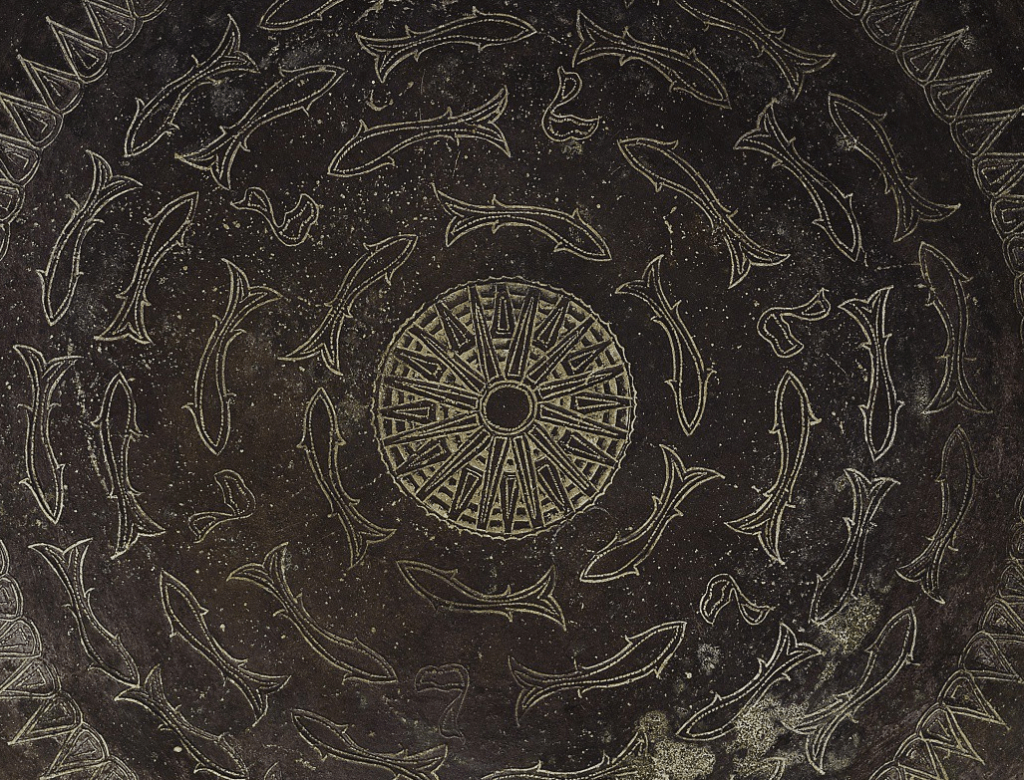
Zodiac bassin, Iran 13th c. Sotheby’s lot 79, £ 1-1.5M
A Cloudy Present: London Islamic week of Spring 2021
The biggest London auction houses, Christie’s, Sotheby’s and Bonhams have just published their catalogue and their content seem to reflect both the effects of the pandemic and the increasing challenges of the Islamic arts market. Firstly, the catalogues are a lot smaller than usual: 141 lots for Bonhams presented on the 30th March, 183 lots including 45 carpets for Sotheby’s on the 31st March and 157 lots including 57 carpets at Christie’s on the 1st April. In comparison, Christie’s had 205 lots in 2020 and 302 in 2019. The pandemic has made it more difficult for experts to travel and source objects, but more generally, it is getting harder to source never sold before items.
That being said, both Christie’s and Sotheby’s have managed to source unpublished star lots. The 13th century Khorassan basin with silver-inlaid astrological figures is nothing less but extraordinary. The silver decoration is mostly intact, which is rare given the fragility of silver incrustations, while the size (50 cm diameter) and the quality of the figurative decor make the high valuation, £1.000.000-1.500.000, completely justified. For the first time since 2010, Christie’s most expensive lot is a 19th century Qajar painting2, known to have been part of the collection of late artist Frederic Clay Bartlett (1873-1953). The massive group portrait, valued £1.000.000-1.500.000, is described in extensive details by Dr Layla S Diba, great scholar of Qajar Iran. The painting is presented as a “rediscovery”, but it was never lost, it was part of the permanent and exposed collections of Bonnet House Museum and Gardens. About its sale, Patrick Shavloske, CEO, commented:
But the time has come for the Qajar painting to move to a new home that is better positioned to give the artwork the care and honour it so richly deserves. Proceeds from the Qajar painting sale will be used by the museum to conserve its paintings by Frederic Clay Bartlett and Evelyn Fortune Bartlett as well as the historic Bonnet House itself, also an artful creation of the Bartletts.3
Unidentified Qajar prince, Christie’s 1st April 21, lot 31
Museums deaccessionning part of their collections to compensate the lost of revenues caused by the pandemic have sparked a large debate, and though the sale of L.A. Mayer Museum at Sotheby’s ultimately failed, this auction is not getting the same traction, most likely because it is limited to one artefact.
Both Sotheby’s and Christie’s have managed to source interesting manuscripts. Christie’s is presenting a Qur’an with a colophon bearing the name of the famous 13th century calligrapher Yaqut al-Musta’simi, valued £300.000-500.000. The manuscript was illuminated in 17th century Safavid Iran, but the writing looks genuine to a non-specialist of Ilkhanid calligraphy such as myself. We can regret the fact that Christie’s didn’t get the opinion, nor even quote Dr Nourane Ben Azzouna, specialist of Yaqut al-Musta’simi, to confirm if the manuscript is genuine.4 A genuine manuscript signed by one of the greatest masters of calligraphy is an event that would have required further investigations.
Sotheby’s is presenting a very interesting Qur’an dated 920/ 1514, signed by the calligrapher and dedicated to the Chief of Justice of Jerusalem and Nablus, only 2 years before the conquest of Jerusalem by the Ottoman armies. The arts of the book from the extreme end of the Mamluk dynasty have not been studied in much details yet, so this complete manuscript constitutes an interesting testimony of the period.
Some lots, however, clearly reflect the difficulties that both Sotheby’s and Christie’s had constituting exciting catalogues. For instance, Christie’s presents a “page from the Nasir al-din Shah album“ valued £3.000-5.000. Though this page might be attached to an album produced for the sovereign of the Qajar dynasty, Nasir al-Din around 1888, the page is not from the Nasir al-din Shah album, very famous muraqqa’ initially gathered in Mughal India and passed to Iran after Delhi sac by the army of the Afshar king Nasir al-din Shah in 1747. Words matter, though I do not think buyers will be duped. Same goes with a Mamluk Qur’an page on pink paper offered by Sotheby’s for £6.000-8.000. The page is dated in the catalogue circa 728/ 1327 on the basis of a different page sold in 2008, also undated but previously published by the art dealer Philip C Duschnes as originating from a Qur’an written by Ahmad b. ‘Abdullah b. al-Mansur Hashemi al-‘Abbasi, completed 7 Sha’ban 728. This convoluted datation is problematic, especially given that I am not completely convinced the page from 2008 comes from the same manuscript as the two pages from 2011 and 2021. My doubts are based on the different quality level of the kufic script in the headers and some details in the thuluth script. Beside the fact that the colophon remains unpublished to this day, the datation of the page can be questioned on the basis of the illumination style, closer to the productions from the second half of the 14th century than the late 1320’s.4
On the left, the page sold in 2008; On the right, Sotheby’s 31.03.21 lot 5.
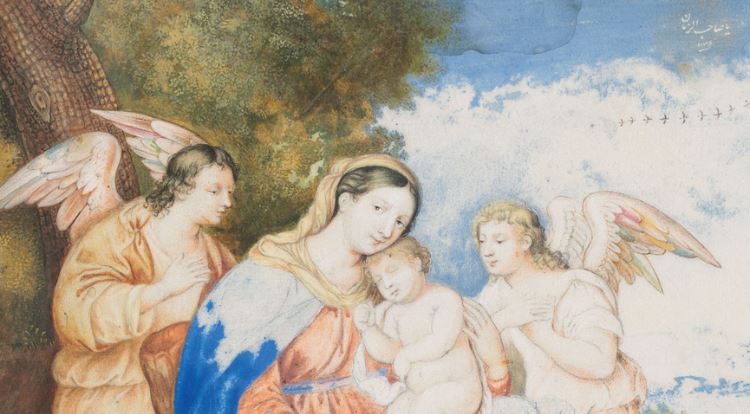
Sotheby’s, Christie’s and Bonhams catalogues contain a majority of later artefacts, mainly 18th and 19th centuries, which reflect the difficulties the houses have encountered sourcing Medieval and Pre-Modern objects. This might be why some attributions to the Safavid era seem a bit far-fetched. For £100.000-150.000, Christie’s is offering an album page showing the rest on the flight into Egypt, given to the famous Safavid painting Muhammad Zaman and dated 1076/ 1665-66. I have several problems with this page beside the commonplace of the inscription, ya saheb al-Zaman, often linked to the painter without much afterthoughts, so here come the bullet points:
Though Biblical themes and copies from European prints have been a constant in Muhammad Zaman career, the style of this particular painting doesn’t fit the painter’s, it lacks the roundness of his forms and the volumes created with strong shades.
The painting is on vellum, which is a highly singular for Muhammad Zaman and Safavid painters in general (though they have experienced with various media).
The painting is signed but unfinished, which is unprecedented in Muhammad Zaman catalogue
The date 1076/1665-66 seems to be too early in the artist’s career. Though Muhammad Zaman biography is still open to debate, the core of his work is dated from the 1670s to 1690s, with a seemingly confirmed date of death in 1700.
Christie’s 1.04.21 lot 20, attributed to Muhammad Zaman, £100-150.000
Despite a smaller catalogue, Bonham’s has managed to remain coherent with their usual focus on later Indian art, particularly Punjabi and Sikh. Their star lot is a 19th century portrait of Raja Lal Singh by the Austrian painter Augustus Theodor Schoefft, valued £150.000-250.000. Among the most prestigious artefacts feature a gorgeous Chand-Tikka from the collection of Maharani Jindan Kaur (1817-63) valued £90.000-120.000 and a large manuscript of Janamsakhi from late 18th century Punjab, given for £25.000-35.000.
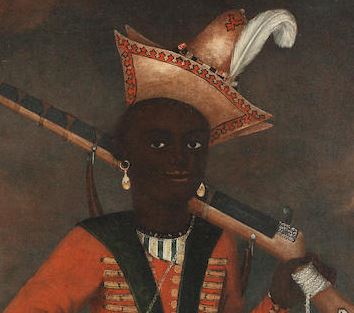
The main object of curiosity in Bonham’s catalogue is an oil on canvas full-length portrait of an “African soldier“, given to Safavid Iran circa 1680-90, valued £100.000-150.000. The notice has been written by Dr Eleanor Sims, scholar of Safavid painting and who has published on a series of 21 full-length portraits on canvas she dates from the 1680s.6 I have personally never been convinced these 21 paintings were produced in the 17th century under Safavid rulers, I think they were made later, maybe during the 18th century during the reigns of Zand or Afshar dynasties. This is an unpopular opinion and no doubt some will disagree, but given what we know about painting production, artistic fashion and stylistic evolution of Pre-Modern Persian painting (16th-19th c. roughly), there is no good explanation for this production of full scale oil paintings, coming from nowhere and disappearing as it came before becoming highly popular under the Qajar dynasty in the 19th century.
“African soldier” Bonhams 30.03.21 lot 28, £100-150.000
Regarding the “African soldier”, I am obviously not convinced neither. Despite the accurate depiction of weapons described by Dr Sims, I do not believe this man to be a soldier, as the garb does not fit the representation of actual Safavid soldiers, and I do not believe he is from the 17th century as evoked above.
Dr Sims worked with Christie’s in 2019 to attribute the paintings of a 15th century manuscript to the famous painter Behzad, in a demonstration that convinced no one since the manuscript remained unsold. Given this track record and the questions surrounding this portrait, it will be particularly interesting to see what price it will achieve.
This Islamic week definitely carries the weight of the pandemic, and though the three catalogues also contain some interesting items, we can wonder if the pressure for spectacular lots haven’t forced the experts to cut some corners. Travel restrictions in 2020 haven’t particularly blocked buyers, but the quality of the catalogues might.
Shah Abbas seated on a terrace, signed Mehdi al-Imami, Iran, 20th c. Bonhams 30.03.21, lot 16, £2-3.000
“Le bilan 2020 du marché de l’art”, L’objet d’Art, 575 (Feb 2021), p. 76.
Last time was the Portrait of a Nobleman signed Isma’il Jalayir, estimated £500.000-800.000 and sold £601.250. Christie’s 13.04.2010, lot 150.
She has published many times on the topic of attributions to this calligrapher. See her latest book, Aux origines du classissisme. Calligraphes et bibliophiles au temps des dynasties mongoles (Brill, 2018), pp. 48-132 in particular.
Thank you to Dr Adeline Laclau for her expertise on this page.
Eleanor Sims, “Five Seventeenth-Century Persian Oil Paintings”, Persian and Mughal Art, London: 1976, pp. 223-32; “The “Exotic” Image: Oil-Painting in Iran in the Later 17th and the Early 18th Centuries”, in The Phenomenon of ‘Foreign’ in Oriental Art, Wiesbaden: 2006, pp. 135-40; “Six Seventeenth-century Oil Paintings from Safavid Persia”, in God is Beautiful and Loves Beauty: The Object in Islamic Art and Culture, New Haven: 2013, pp. 343, 346-47.
Unprecedented times, unprecedented auctions. The covid-19 pandemic has forced major houses to either move their auctions online, like Millon and Chiswick that successfully rose to the challenge, or push back to a later date, a choice made by Christie’s, Sotheby’s, Bonhams and Dreweatts. The slightly smaller Islamic week was finally held from the 9th to the 25th June and despite the many restrictions, among others on exhibitions and international travels, the results reflect the continuous support from collectors.1
All the prices indicated below include Premium.
Christie’s was supposed to open the week but moved their auction more or less last minute to the 25th June. From the relatively small catalogue of 205 lots, 133 lots were sold for a total of £13.361.000, a huge 123% increase compared to the last Islamic week in October 2019 and the second best result for the Islamic department of Christie’s London in the last 10 years.
Timurid or Aqquyunlu Qur’an on Chinese paper, Iran, 15th century, Christie’s lot 29.
The star of the auction was of course an extraordinary Qur’an on Chinese paper2, given to the Timurid or Aqquyunlu dynasties in Iran during the 15th century, sold for £7.016.250 (so more than half of the total results). Beside its aesthetic qualities and formidable state of preservation, this manuscript raised more than one eyebrow for the opacity of its provenance. It seems difficult to believe that a manuscript that exceptional had never been published, nor even seen before. For this reason, the single information given by the auction house that the manuscript was “bought by the current vendor’s father in London in the 1980s” was problematic in more ways than one. This type of “non-provenance provenance”3 is used by auction houses as a work-around of the UNESCO 1970 convention, stating that the sale of objects illegally removed from their country of origin after 1970 is prohibited (this doesn’t apply to artefacts removed before 1970).4 Auction houses use the date as a loophole through the vague mention that the object was bought in Europe or in the US after 1970, or came from “the collection of a gentleman”. In the case of this manuscript, nothing is said on how it reached London and it could have very much be stolen from the library in which it was initially preserved, but legally, Christie’s is covered. The manuscript seems legitimate but the complete absence of ownership marks, such as seals, led some to question its authenticity. Beside that, we can question the fact that the catalogue entry rapidly brushed aside the fact that a few folios were replaced at a later date, though it has a considerable importance to understand the provenance of the manuscript – a topic that was definitely not at the centre of Christie’s preoccupations. The later incipit could be Indian, the illuminations showing a Deccani influence (reading “from the region of the Deccan”). If confirmed, this could have helped greatly in tracing the history of the manuscript. The house hasn’t yet communicated the identity of the buyer, and with that price, we can easily assume it was bought by a collector or an institution in the Gulf, but we can only hope this Qur’an will be landed for exhibitions and further research.
Beside the Qur’an, a few lots were expected to reach high prices, including the Portrait of Sultan Mehmet II with a dignitary, probably produced in Venice in Gentile Bellini workshop. Because Bellini is the most famous Italian painter making the travel to Istanbul in the 15th century, every painting that can be related to him is always put forward in auctions. Initially given at £400.000-600.000, it was sold £935.250. Other mentions, a Tuhfat al-ahrarcopied by the calligraph Sultan Muhammad Nur at the beginning of the 16th century. Valued at £200.000-300.000, the manuscript, decorated with gorgeous borders, went for £923.250.
Nur al-din ‘Abd al-rahman Jami, Tuhfat al-ahrar, signed Sultan Muhammad Nur, 16th century, Christie’s 25th June 2020, lot 53
I was particularly waiting for the 12th and 13th centuries Kashan ceramics making a reappearance on the market after years of absence.5 Without surprise, the small moulded jug largely exceeded its valuation of £50.000-70.000 and reached £401.250, but surprisingly, the turquoise glazed reticulated cockerel-head pottery ewer, valued at £100.000-150.000 remained unsold. Given the price of the previous piece, it is hard to explain why this one didn’t find a buyer.
Also unsold was the Kashan turquoise glazed pottery pitcher presented by Sotheby’s on the 10th June. Valued £120.000-160.000, this ewer was one of the auction star items, and had a clear recent provenance, having been in Edward Binney III’s collection. Bonhams had two Kashan pieces, a classic brown, white and blue star tile with calligraphic borders sold for £3.812, and a nice lustre pottery bottle with figurative decoration, damaged but nicely restored, valued £2.000-4.000 and sold £2.805 (so just above the low estimate without the 25% Premium).
These results are particularly interesting. While I was waiting for Kashan ceramic to come back with a bang, it seems that buyers were not particularly ready for it. The small moulded jug created interest for its aesthetic qualities and significance in the history of arts, the decoration announcing Iznik productions, centuries later, in several ways. Bonhams jug was inexpensive but clearly the cockerel-head ewer and Binney pitcher were too risky to invest in, especially after the several controversies of falsifications from a few years ago.
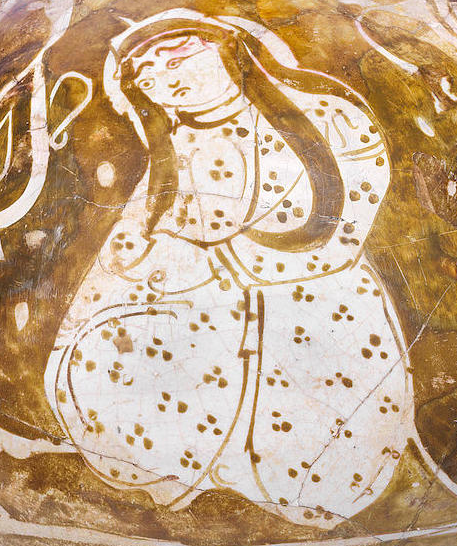
An elegant feminine figure on Bonhams Kashan lustre pottery bottle, late 12th c., lot 63.
Sotheby’s had a larger catalogue of 321 lots, of which 173 were sold for £3.656.000, a 33% decrease compared to the almost £5.5 millions made last October. Only a handful of items went above six figures, the 12th/ 13th c. Nasrid pyxis reaching £519.000. I was personally not convinced by the very early date given by Sotheby’s with the support Julian Raby, director of the Freer| Sackler Gallery in the Smithsonian, just because most of the known pieces of this production are attributed to the 15th century. The wood was dated with radiocarbon C-14 between 970 and 1032 with 95% confidence, but I am always a bit dubious when it comes to C-14 tests. Indeed, wood, like stone, can be reused generations later if preserved in the right conditions, and if it is a known fact for architecture (never date a building by its beams!), it can also be true for small items made of several pieces of wood joint together. That being said, 12th or 15th century, this pyxis is in remarkable conditions and its decor particularly rich.
A rare Almohad or Nasrid Pyxis, Spain, maybe 12th/13th c., Sotheby’s lot 87.
The second star item of Sotheby’s auction was a Diwan of Hafiz copied by the calligraph Shaykh Mahmud Pir Budaqi in 867/ 1462 and dedicated to the library of the prince and keen collector Pir Budaq (d. 1466). This manuscript is of great significance for the history of Islamic arts so the selling price, £375.000, didn’t really come as a surprise. The narcissus, previously discussed on this blog, went for £10.000.
Sotheby’s also presented three Abbasid potteries, two of which were sold within their range, and one Samanid dish unsold. Like Kashan ceramics from the 12th and 13th centuries. Abbasi Iraqi pieces from the 9th/ 10th c. and Samanid Central Asian from the 10th c. represent a gamble, as well as gold dinars and silver dirhams, such the 18 lots presented by Bonhams on the 11th June. Their second biggest lot was an Umayyad gold dinar from the reign of the caliph ‘Abd al-Malik, fifth caliph of the dynasty, (685-705) dated 77/ 696-97. I personally love numismatic, though it is one of the most driest fields of study, for coins truly constitute prints of history. This one is particularly significant, having been minted less than 10 years after the foundation of the Dome of the Rock in Jerusalem. Unfortunately, the estimation £100.000-150.000 was too high for collectors, and overall only six of the eighteen lots of coins were sold.
Bonhams sold 100 of the 247 lots presented, for a total of £1,368,681.25, a small 4.42% decrease compared to last October. As previously, the auction house focused on Indian and Sikh arts, an orientation demonstrated by their main lot, a gem-set gold forehead pendant (chand-tikka) from the collection of Maharani Jindan Kaur (1817-63), wife of Maharajah Ranjit Singh (1780-1839). What a lady she was! The short biography given by Bonhams gives a glimpse into the complexity of her life and the immense strength she held.6 The forehead from her collection, quite simple but refined, and of historical importance, was sold £187.562.
It has been particularly interesting to follow these spring/ summer auctions, whether moved online or postponed. In both cases, collectors have responded well to the changes, though Sotheby’s results were lower than expected. We can hope that autumn auctions will go ahead without too much trouble, but so far 2020 has been full of (really bad) surprises. In the meantime, stay safe and please wear a mask in public!
Nur al-din ‘Abd al-Rahman Jami, Tuhfat al-ahrar, Iran, probably Tabriz, 947/ 1540-41 (detail), Sotheby’s lot 29, sold £47.500
You can read the full text here. You can also read my article on recent illegal looting in Syria and the impact on the market here.
Named after the city of Kashan in Iran, located south of Tehran, in which a very large centre of production was particularly active during the Seldjuk dynasty rule, roughly 11th- 12th centuries. It continued to be very active until the end of the Safavid dynasty rule in the 18th century.
You can also go read this article on The Guardian about her.












 Isabelle Imbert