Tag: expert

  • Auction Catalogues and Reattribution: a Difficult Exercise

    Auction Catalogues and Reattribution: a Difficult Exercise

    All Islamic Art Historians working on large set of material data will tell you the same, spending hours going through auction catalogues to find the forgotten gem is part of the job. Writing my doctoral dissertation of Indian and Persian flower paintings produced between the 16th and the 18th centuries, I dissected countless of catalogues from the 60’s to recent days, hoping to find the long-lost twin of Mansur’s Tulip (which I didn’t). What I found, however, was a lot of questionable attributions, dating, and deeply cut corners.

    This is not the case for all auction catalogues and some houses take very seriously their responsibility to publish accurate analysis of Islamic artefacts, especially for the most prestigious auction lots, but it is common practice to put objects in artificial categories and call it a day. These categories are usually based on one distinctive feature, whether it is a chronological marker such as a ruling dynasty (i.e. Safavid Iran), a city or production centre, loosely attached to chronological range (i.e. Iznik or Kashan), or more rarely another artefact (i.e. The St Petersburg Muraqqa’). Integral part of the catalogue entries, these categories provide an immediate reference to the seasoned reader, but they also constitute a selling argument.

    Some productions are indeed more valued than others, depending on market trends. Earlier this year, I had the opportunity to produce an expertise for a client who was interested in acquiring an archaeological artefact that raised the difficulty of re-attribution.

    Abbasid, Early Islamic, Sasanian: Close Call…

    The objects was an elliptical dish on low foot, flared belly and flattened rim, carved in a single piece of rock crystal. The outside body was cut in a symmetrical composition based on two repeating patterns of a palmette of three main double leaves and two smalls at the base, flanked by long looping stamen and a centric pattern repeating on the long sides. The centre of the dish was marked by a double line forming a medallion. The rim was cross-hatched apart from both ends, highlighted by a symmetrical pattern based on repeating lines.

    The object had been sold previously as Abbasid (750-1258). Based on the pictures I first received, it was my immediate opinion that the piece was not Abbasid, as its shape and ornementation had no equivalent in known objects and architectural decoration from this period. The other clue was the proximity of this piece with two others kept in the Louvre, discovered in the archaeological settlements of Susa.
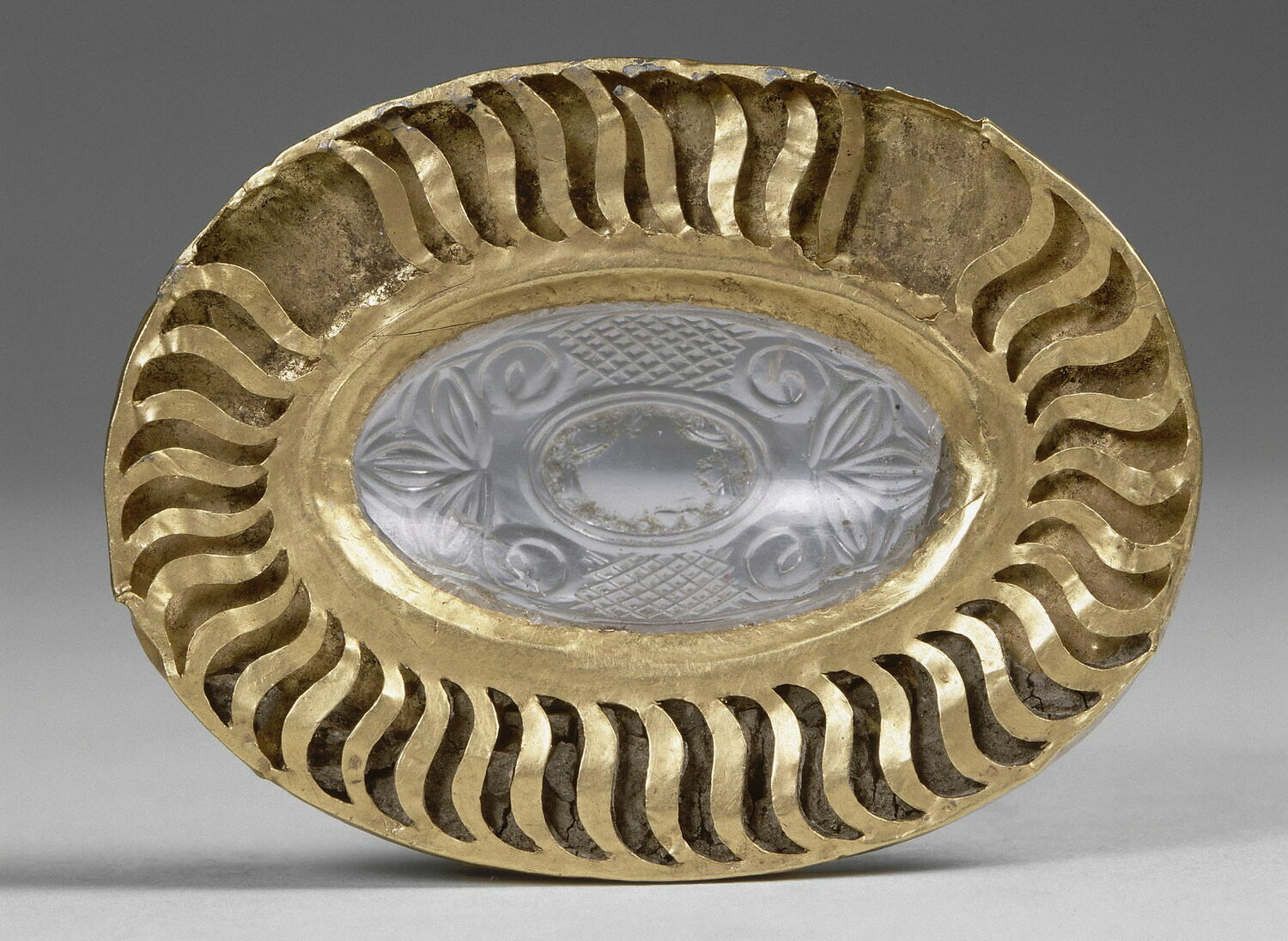
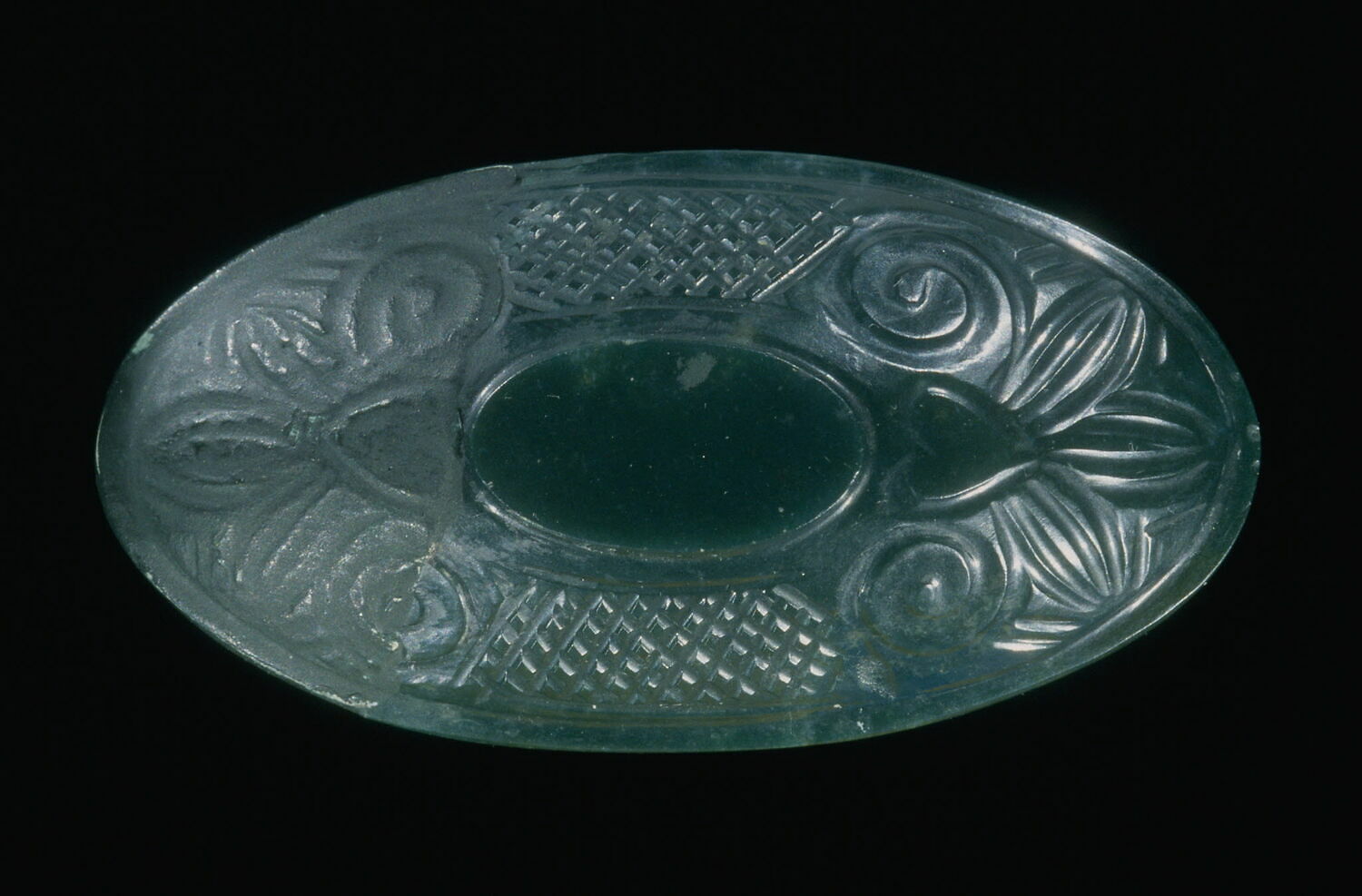
    Archaeological excavations of Susa, spanning from 1851 till 1979 and led by several teams of mostly French nationality, had focused first and foremost on Ancient and Imperial periods up to the Achaemenid dynasty, destroying upper layers in the process. For this reason, the line between late Sasanian and Early Islamic settlements is today blurry and it is virtually impossible to date precisely artefacts that do not bear any distinctive features (such as Arabic inscriptions).

    Stucco relief fragment, Ctesiphon, Iraq, Sasanian, 6th c. MET (32.150.10)

    Individual patterns and the overall shape of the piece led me to suspect the piece had nothing to do with Abbasid productions, even in Susa, but could be linked to late Sasanian productions. For instance, the three-leaves palmettes that occupy each sides of the dish, find numerous equivalences in Sassanian repertoire. Palmettes are extremely common in late Antiquity and in Islamic arts, but the structure of these patterns is specific enough to be used as a point of comparison: three leaves doubled in their centre, two additional leaves at the base in the shape of a crude heart, flanked by symmetrical loops. It appears in stucco decoration found in Ctesiphon, the Sasanian capital, as well as Susa in the late Sasanian/ Early Islamic layers.

    The same way, the elliptical shape of the dish is a commonplace of late Sasanian art.1 Either elliptical or boat-shaped, with or without a foot, these dishes are associate to wine-drinking and can be ornamented lavishly.

    Walters Art Museum, Baltimore (57.625)

    Though archaeological layers haven’t been preserved, Sasanian occupation of Susa is well documented in primary sources2, revealing that the city was conquered in the 3rd century and rebuilt into a vibrant economic trade centre with Mesopotamia and Fārs. The artefacts found on site, including the two Louvre dishes, suggest that rich merchants were installed in the city. It then declined under the last Sasanian rulers but continued to inhabited under the Umayyad and Abbasid, before being progressively abandoned.

    …Or Easy Way Out?

    Attributions to particular productions and chronological eras tend to be passed down from dealer to dealer, as if the first publication was the unalterable authority. Because the object had been published in a previous auction catalogue as Abbasid, the attribution was acted, and going against it without any new archaeological evidence would be a challenge. Intellectual honesty aside, reattributing the piece to what I think is its correct production context, or at least questioning the status quo, have a significant impact of the valuation.
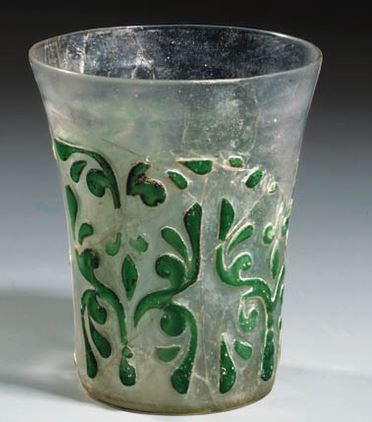
    Glass fragmentary beaker, attributed to Samarra, 9-10 c. Christie’s 11/04/2000, lot 288

    Sasanian and post-Sasanian3 are rare on the market and do not easily find buyer, apart from silver wine-boats with exceptional decoration. The productions are not particularly well studied and raise questions of dating and authenticity. In comparison, glass or rock-crystal objects identified as Abbasid have a lot more chances to reach high prices, sometimes despite questionable attributions. In consequence, it is a safer bet for auction houses and art dealers to put an object as Abbasid. The dynasty lasted more than 500 years and covered a massive territory, so even if doubts remain, attributions do not raise too many eyebrows.

    In truth, attributions to Sasanian, post-Sasanian, Omayyad or Abbasid remain speculative. Certainty is rare in early Islamic arts history, but rethinking the importance of attributing unmarked object and opening the door to doubt would constitute a healthier alternative to catalogues too prescriptive. These might leave interested buyers or potential sellers disappointed, should new information arrise that would render the original attribution obsolete.
    Whether it was the doubt caused my analysis or the price given by the dealer that changed the buyer’s mind regarding the acquisition, I will not know, but finding the right words to question established historiography was certainly a challenge!

    1. A. S. Melikian-Chirvani, “From the Royal Boat to the Beggar’s bowl”, Islamic Art IV, New York, 1992.
    2. See G. Gropp, “Susa v. The Sasanian Period”, Encyclopædia Iranica, online edition, 2005 and associated bibliography.
    3. The term “Post-Sasanian” is attributed to artefacts that cannot be attributed to either Sasanian or early Islamic productions with absolute certainty. It usually encompasses objects linked to Zoroastrianism but found is Islamic occupation layers on archaeological sites, or to objects that more vaguely look Sasanian but cause sufficient doubts.
  • Happy New Year 2019!

    Happy New Year 2019!

    This is with some disbelief that I wish you all a very happy new year 2019. Disbelief that 2018 is already passed and that we are already turning the page. What a year it has been!

    For me, 2018 meant the starting point of my freelance activities, and of course the creation of this website. Coming at the end of a two years break after getting my PhD, 2018 seemed like the right time for returning to what I know and love: writing about Islamic Arts.

    I did not think that I would be able to find people ready to share their passion with me this quickly but sometime the stars just align the right way. For this I wish to thank, among others, Millon & Associés and lot-art.com for giving me opportunities to collaborate on several occasions, but also the numerous collectors, merchants, art historians and enthusiasts who encouraged the launch of my activities.

    If you are ready these lines, thank you.

    I do not know yet what 2019 will precisely be made of, but I am excited to discover it. My biggest project will be to rework and publish my doctoral dissertation. Though it was recognized as a work of high quality by the eminent scholars who composed my jury, it will still need some in-depth work to be actualized and synthesized in a (readable) book.
    As well, I wish to develop my writing activities further with new projects and hopefully I’ll be able to communicate more on that soon.

    So I wish you all a very happy new year, I hope it will be full of joys and discoveries for you and your loved ones, and I hope to see you back on this blog very soon!

    Women celebrating holi, detail of a painting from the Gentil collection. Lucknow or Faizabad, 18th c. BNF (OD44fol, fol. 44)
  • The Autumn continues in Paris

    The Autumn continues in Paris

    It is always difficult to predict the fluctuations of the art market, as tendencies can vary over a few months. In the case of the Islamic arts market, the excercise is even more difficult due to its diversified nature: all medium, a chronology of 14 centuries, more than half the world with no less than a douzen dedicated auctions a year. However, prices resulting from this heterogeneity also depend on the global economy and political context, even more than other markets like contemporary art or modern masters that see less variations in short periods of time.

    This Autumn, two major auctions were held in Paris: Ader Nordmann on the 27th November, Millon et Associés on the 3rd December. Both were really interesting to monitor, as they were the direct continuity of the London Islamic Week. I have commented in my previous article the results achieved by Bonham’s, Sotheby’s and Christie’s and whether some of them could be the start of new trends. Though London and Paris markets are very different in term of lots presented, valuations and overall prices, some tendencies tend to be confirmed. Others, not so much!

    All prices quoted below include VAT.

    Safavid Qur’an, 17th c., sold 5,120€

    Both auctions had a very different selection, reflected in the results. Ader Nordmann presented 326 lots, including 49 lots of archeological artifacts and an amazing gathering of 53 drawings of André Maire. Overall, 65.3% of lots were sold for a total amount of 79,111€. Millon auctioned 402 lots and sold 47.5% for a total of 1,099,397€. This result places Millon directly behind London (for reminder Sotheby’s made almost £8 millions, Christie’s £5 millions and Bonham’s £2.5 millions). Millon has still a bit of a way to go to dethrone London houses but the result is still very impressive for a French auction house and congratulations are in order for this achievement.  

    So how to explain this result, but also the important difference between Millon and Ader? Let’s take a look closer.
    As per tradition, Millon opened with 119 lots of Orientalist and Modern paintings and 15 lots of books, photographs and lithographs. This section did pretty well with some very impressive results, including a painting of Etienne Dinet (1861 – 1929) showing men praying (37,5 x 29cm), valued 6,000-8,000€ and sold 37,700€, as well as a colorful view of Rabat (64,5 x 99 cm) by Edy-Legrand (1892-1970), valued 6,000-8,000€ and sold 23,400€. Unsurprisingly, my personal favorite remained unsold, as Orientalist painting buyers are usually more attracted by signature and date and this view of the Atlas plateau (probably) is not signed. 

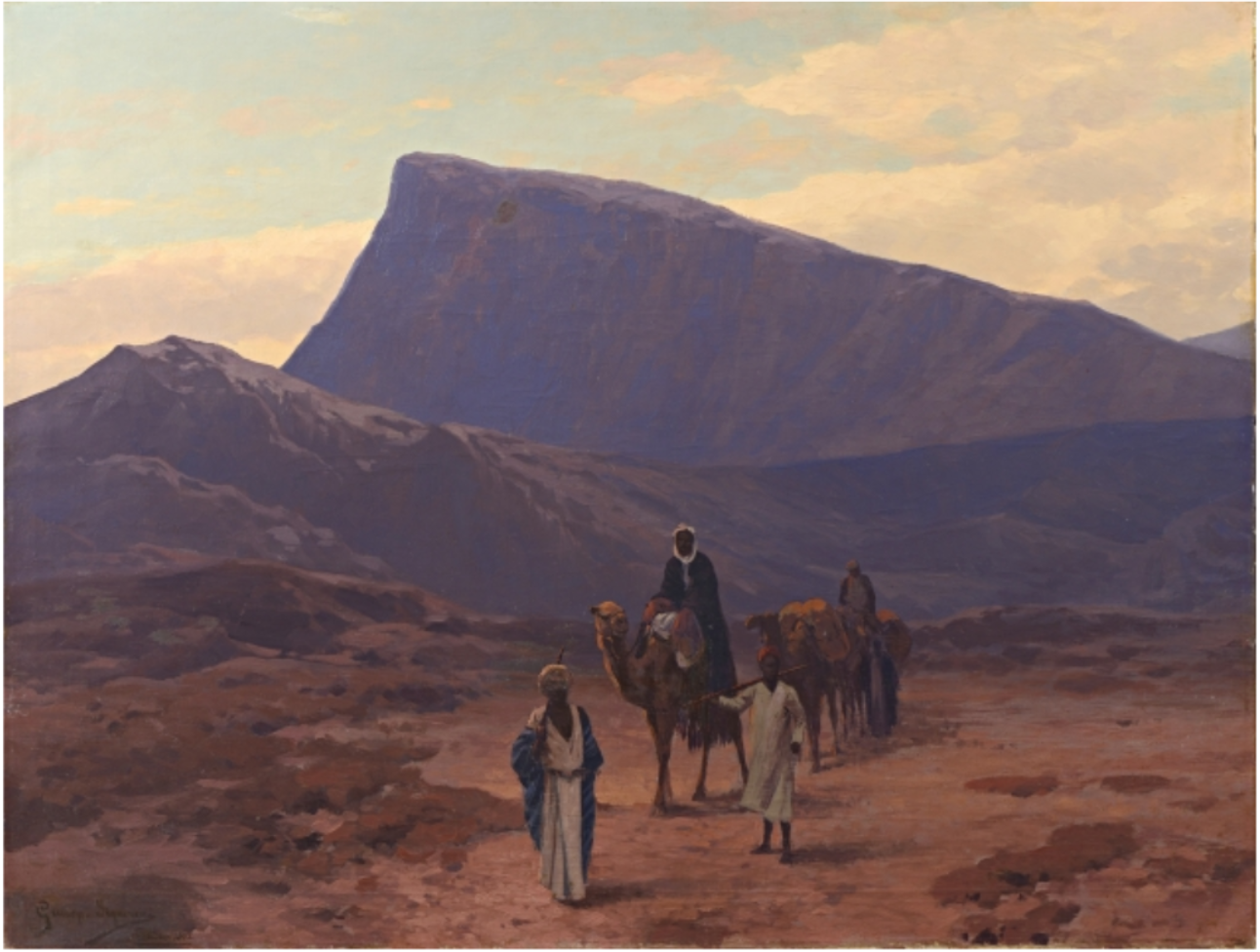
    Despite some restorations, the painting still holds a very interesting monumentality and sense of sublime that are not so common in Orientalist painting

    Ader presented 17 lots of Orientalist paintings, 26 lots of books and hajj certificates, but more importantly 53 drawings of André Maire (1898-1984), a French artist who fought in the two World Wars before leaving for Africa and then Asia where he spent 10 years. He left an immense production of drawings, as demonstrated by Ader selection of views of Egypt, India, Cambogia, Vietnam etc. All the lots were valued 400-600€ and I was expecting higher results. Most of them were sold between 700 and 2,000€, the highest price being achieved by a representation of Buddha and Ganesh.

    Drawing of André Maire are particularly interesting for the proportions of figure and the contrast between humans and environment. 

    The big surprise was the prices achieved in both auctions by Medieval North Africa and al-Andalus objects. For reminder, the last London Islamic week had left most of these lots unsold and I was expected similar results in Paris. Ader presented only one lot, a 12th-13th c. travel Qur’an (only 8.9×6.8cm). Valued at only 1,000-1,500€ due to a poor state of preservation, it reached an unexpected 37,120€, thus breaking the auction record. Millon presented five lots from 10th to 16th c. and five Modern revivals. The large Almohad water jar with an elegant tooled decoration took everybody by surprise by going at 54,600€ (against an estimation at 6,000-8,000€). The two Umayyad carbed marble capitals valued at 10,000-15,000€ reached 21,450€ and all the other lots went within their range. 

    To explain the success of North African and Andalusian items in Paris compared to London is not easy, but the most obvious explanation would be that buyers in Paris are not looking for the same kind of objects than London’s. The long lasting relationship between France and North Africa, and by historical extension south of Spain, has played a central role in the diffusion of art, in the constitution of private collections, but also in the elaboration of tast. The latter is demonstrated by the interest for Orientalist paintings, mainly focused on North Africa and Egypt, as well as the selection of books offered for auction, for instance Ader. The existence of documentation is, of course, a reassurance for buyers, as seen by the fact that Ader small Qur’an and Millon water jar both documented the provenance.

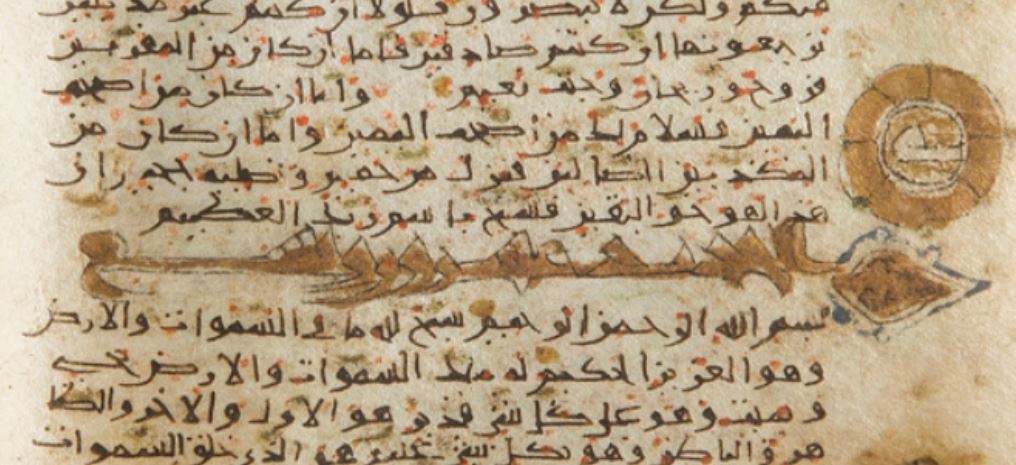
    Detail of Ader small Qur’an showing an interesting “proto-maghribi” script, golden surah title and reading mark

    What really made a difference for Millon lies in the manuscript section. 57 lots were presented and though some were left unsold, buyers displayed a rare enthousiasm for others. I was wondering prior to the Islamic week if isolated Qur’anic leaves on parchimen would still sell but after seeing the results, I had no doubt that the leaf with golden Kufic script and red diacritical dots would do well, and it did. The result went way above the range of 8,000-12,000€ with a total of 71,500€, a price comparable to those achieved by the Blue Qur’an bifolio sold by Christie’s in October, given the difference of valuation.

    If this Qur’an golden leaf was a given success, it was not the case for others whose results came as a complete surprise. A North African treatise of Maliki justice copied before 1692 (date of the waqf) was sold 39,000€, another one on sufism in Lybia copied around 1707 went at 13,000€. In other category, a Chinese Qur’an in 30 volumes from the 18th-19th c. and another 18th c. Chinese Qur’anic juz exceeded its range of 800-1,500€ by going at 5,850€. Usually these two kinds of manuscripts never break records, so I am wandering if we are seeing here a new trend developing in French auctions, or is it just a happy coincidence. Another Modern large Qur’an copied in the Arabic Peninsula in 1865 was sold at 52,000€ but this price is explained by the renown of its patron, the Sheikh Qasem b. Muhammad b. Thani (r. 1878-1913), second sheikh of the al-Thani family, considered like the funder of Qatar.

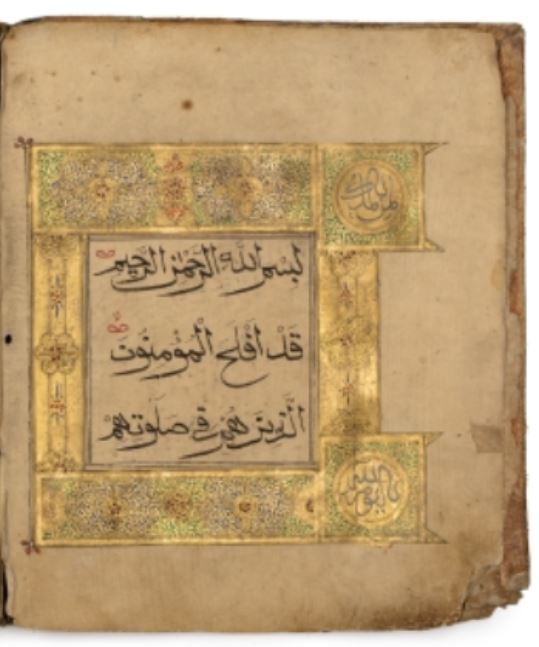
    A 18th c. Chinese Qur’an page, characterized by its golden illumination and script

    Qajar manuscripts and paintings are mostly stable without breaking any records. Two honorable mentions were sold at Ader, a Divan of Sa’adi from the beginning of the 19th c. including 10 paintings of high quality, for 9,216€, and an interesting litograph copy of the Shah Nama dated 1846, sold 12,800€.

    Finally, the category of Indian paintings was uneventful but both selections were not particularly remarkable. Parisian buyers don’t seem to be looking for secondary Indian paintings, while all Mughal high profile pieces are sent directly to London or to private merchants (see for instance Simon Ray current catalogue).

    In conclusion, the large difference of results between the two auction houses came mainly from their selection and what appears to be a shift on the Parisian market towards more high end art events. It will be interesting to see what the spring auctions will offer, and before that what the Carnet de Voyage auction will do in January. Will buyers be still interested in low value items? Time will tell.

    My favorite piece from the Millon auction, sold 3,380€. Click here to read the full catalogue entry written by yours trully


  • Autumn 2018 London Islamic week: results overview

    Autumn 2018 London Islamic week: results overview

    This Autumn Islamic week is over, and what a week it has been! The selection of Bonham’s, Sotheby’s and Christie’s included some breathtaking treasures but also some interesting novelties that I have been really happy to follow. For my predictions prior to the week, you can read my article on this site, or the one I wrote for Lot-Art.com.

    Overall, the three auction houses did pretty well considering the increasing limitations of the market. Bonham’s sold 77% of their 220 lots for a total of £2,513,750; Sotheby’s sold only 53% of the 256 lots presented in the catalogue (three being removed from the auction) but achieved £8,988,25 and broke its own record with the sale of the Debbane Charger for £5,359,950; finally Christie’s achieved £5,075,250 by selling 56% of the 382 lots presented.

    The Debbane Charger bid, a great moment for the Islamic Arts market

    Beside the Debbane Charger, other lots were expected. The emerald seal bearing the name of Marian Hastings, wife of Warren Hastings, Governor General of India from 1773 to 1785 was presented by Bonham’s for only £20,000/30,000, almost nothing when we know the historical importance of the piece, not to mention its intrinsic value (the stone itself is 21.6 x 16.7 x 3.43 mm approx.). Without surprise, it reached £181,250. The gorgeous Reclining Man signed by Riza ‘Abbasi and presented by Chritie’s for £100,000/150,000 achieved £512,750, but not before I could ask the staff to unframe the painting for me to see it up close!*

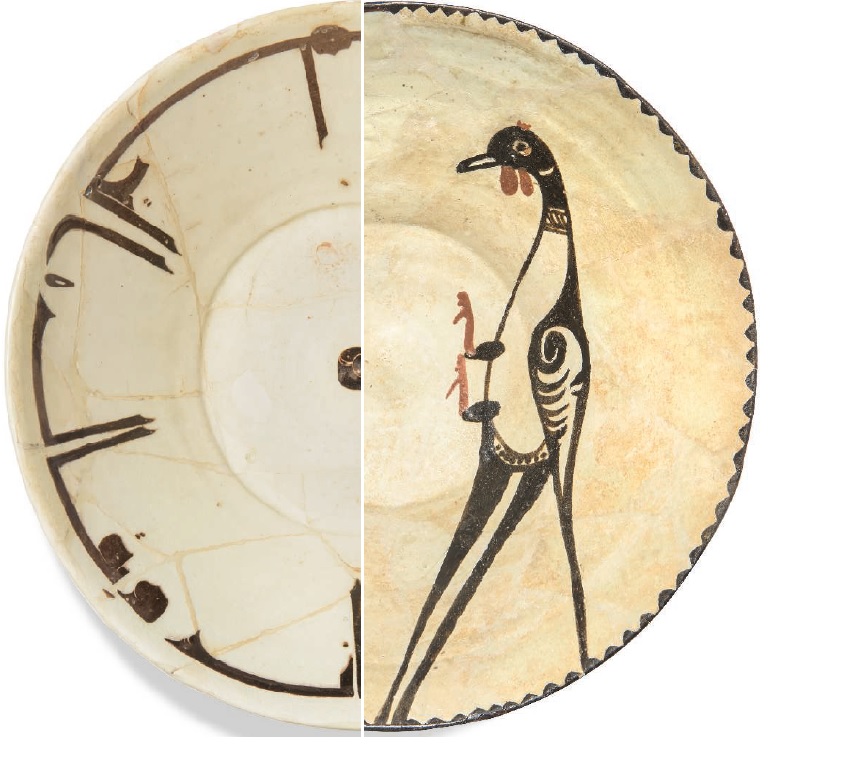
    The three Samanid bowls from the Soudavar collection I discussed in my article for Lot-Art did exceptionally well, better than I was expecting, selling at £65,000 (estim. £15,000/20,000),£12,500 (estim. £12,000/15,000) and £68,700 (estim. £30,000/50,000). The second one was lower and didn’t do very well because of its restored state, but especially because of its non-calligraphic decoration, less valued by collectors. The third plate is comparatively the best preserved, and though it was obviously broken, the repairs are not too important and clearly visible.

    Left: lot 46 sold £68,750. Right: lot 45 sold £12,500

    The last 20 lots presented by Bonham’s were exclusively dedicated to Sikh art. I am happy to see that collectors have indeed followed after the Toor collection exhibition last September and most of the artifacts were sold for good prices.For instance, a 19th century metal-thread embroidered velvet panel depicting Guru Nanak with Bala and Mardana valued at £2,000/3,000 achieved £10,625, and a gold Koftgari steel helmet produced in Lahore around 1840 surpassed its estimation of £5,000/7,000 to achieve £27,500.

    Bonham’s lot 2016, sold £27,500

    There were also many surprises during these auctions, reflecting how difficult it can be to foresee the fluctuations of the market.

    The Diyarbakir mihrab tile panel presented by Sotheby’s for £300,000/500,000 didn’t do as good as I was expecting, reaching only £250,000. More importantly, sale of Ottoman figurative paintings, which I thought would be a “done deal” after the success of the previous Islamic week, completely crumbled. Sotheby’s presented two important lots, an album of costumes attributed to Fenerci Mehmed, valued £200,000/300,000, and the painting of the audience of the Polish Ambassador in the Topkapi Palace, dated 13 August 1707 and valued at £18,000/25,000, both remained unsold. Christie’s offered three lots: a page from the story of Miqdaq bin Aswad, signed and dated from the 16th century, valued at £80,000-120,000, a Qisas al-Anbiya from the 17th c. for £60,000/80,000 and a genealogical tree of the Ottoman dynasty, probably produced in France for the Turkish market at the beginning of the 19th c., valued at £20,000/30,000. Though the last one is not technically Turkish, the style of the portraits is closer to Ottoman painting than French portraiture. Only the Qisas al-Anbiya was sold for £68,750, not particularly high considering its valuation. Were the experts too confident after the success in the Spring? Maybe. Whatever it be, Ottoman figurative painting is visibly not there yet, while illuminated manuscripts and prayer books including views of sacred sites continue to do relatively well without breaking records.

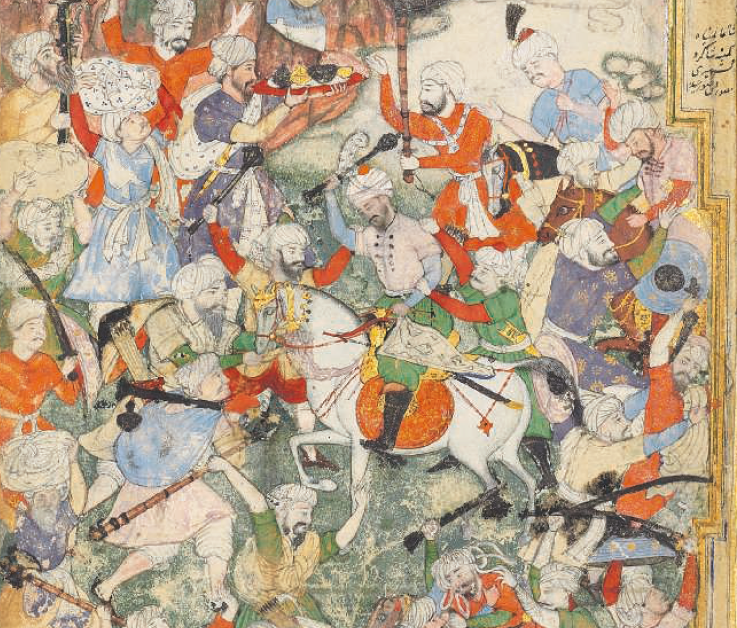
    A detail of the Baburnama page showing pigment deterioration

    Christie’s was presenting a page of the first Baburnama produced under the patronage of the emperor Akbar and presented to him in 1589. This manuscript is extremely important for the history of Mughal arts of the book but the page remained unsold. This can maybe explained by the pigments poor state of preservation, or by the fact that the emphasis was put on the next lot, a gorgeous representation of the goddess Bagalamukhi enthroned in a golden temple, valued at £80,000/120,000 and sold £137,500, that maybe distracted the buyers. There is no doubt in my mind that this
    Baburnama page will reappear in the near future, but maybe with a less enthusiastic estimation.

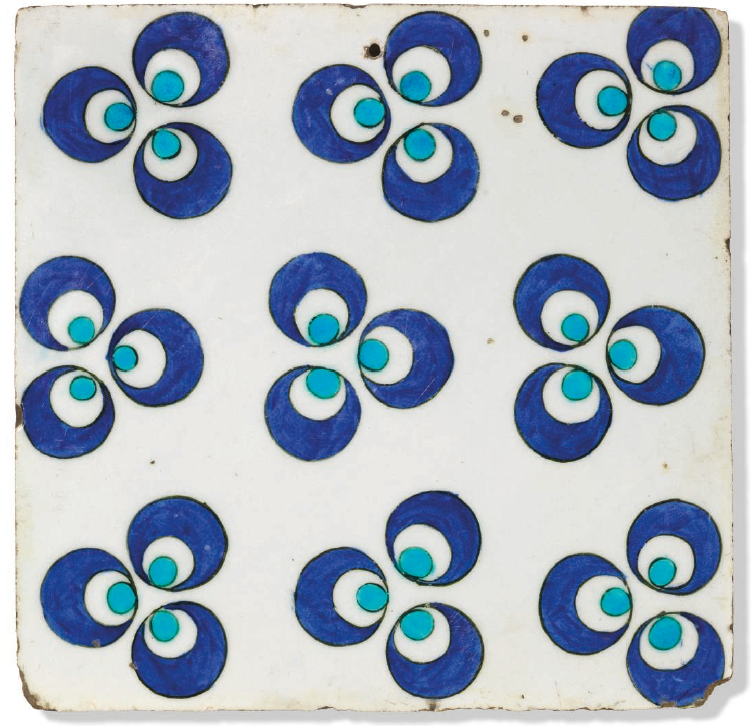
    Bonham’s and Christie’s both presented Safavid pottery tiles of different qualities and pricing. Both did relatively well, Christie’s sold four of their eight lots (not six as announced in my previous article) and Bonham’s six of their eight, mostly within the valuation ranges. We will see what happens during the next auctions and if the number of Safavid tiles continues to increase but we might have to wait a while before Safavid tiles become the new Iznik. As always, the three auction houses presented a large quantity of Iznik dishes, Bonham’s just one and one 19th century copy, Christie’s twelve lots and three copies, Sotheby’s twenty-four lots including the Debbane Charger, and three copies. The market is literally saturated with Iznik potteries and I’d be tempted to say that enough is enough, but most lots find a buyer, sometimes for insane prices as demonstrated by one Çintamani tile circa 1580 presented by Christie’s for £30,000/50,000 and sold at £218,750. Given, it is a very nice tile and the leopard spot motif always adds value to a piece, but in the sea of Iznik potteries, I am starting to fail seeing the value.

    Christie’s lot 217, sold £218,750

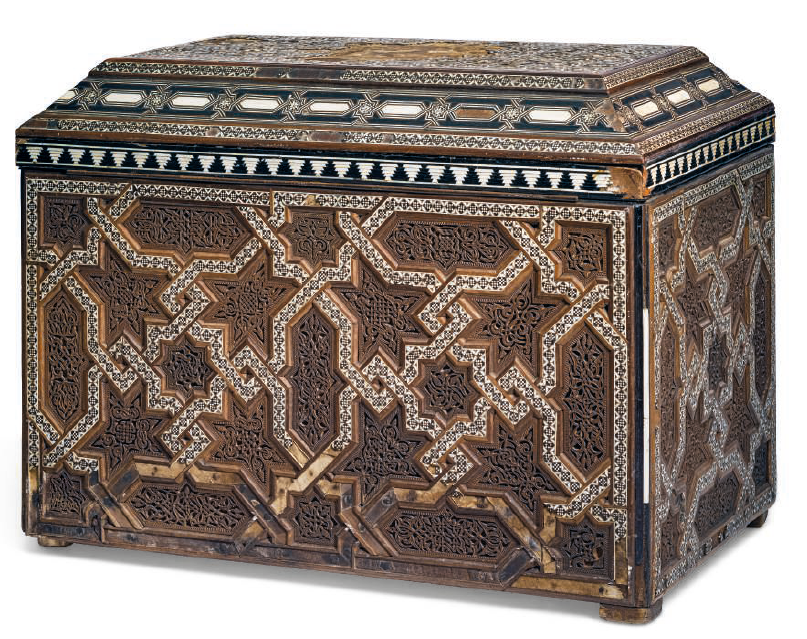
    There are many things that could be discussed but I will finish on two. Firstly, Medieval Spain and North African artifacts beside manuscripts do not have the wind in their sails. Bonham’s had one Almoravid lot unsold, Sotheby’s had four Omeyyad,  Merinid, Nasrid and Nasrid revival, three unsold and Christie’s had six lots, all unsold. Medieval Spain and North Africa are never a big success except for manuscripts, as demonstrated by the £512,750 achieved by the blue Qur’an page sold by Christie’s. However, this Islamic week was surprising by the number of lots and I was expecting better results, especially considering the valuation of certain lots. These results will constitute an interesting point of comparison between the English and French markets, as some similar lots will be presented at Millon the 3rd December. Let’s whish the French house more success in this field.

    Merenid Style casket, Marocco 19th c., Christie’s lot 18, £50,000/70,000 – unsold

    Secondly and finally, I have to mention Sotheby’s album page presented as being from the Leningrad album, attribution that I challenged in my previous article. I like to think that someone read my article because the auctioneer himself questioned the attribution just before the bid, mentioning that the page was “probably” from the Leningrad album (but it’s not). The lot was sold within its range, £25,000, which is not surprising given the overall quality of the page but should have been way more the provenance had been confirmed.

    The next stop before the end of the year will be Paris, Ader-Nordmann on the 27th November and Millon et Associés the 3rd December.

    WordPress has changed its text editor and decided to remove the “justify” option. My text is now aligned left, which differs from my previous publications. I hope you won’t be too bothered by this!

    * I wish to thank Christie’s and Behnaz Atighi Moghaddam for their warm welcome and kind assistance.