Time flies when you’re having fun… And when you’re stuck at home, apparently. 2021 went like a dream in sweatpants, or like a bad sequel to 2020, which was already not that great.
Luckily, 2021 has also been the year of new encounters, collaborations and initiatives, and overall has been a busy year. Two highlights of the year were my participation to the symposium “Eighteenth-century Persianate Albums Made in India: Audiences – Artists – Patrons and Collectors” in Berlin, during which I had the opportunity to talk about floral margins in 18th century Indian albums. The proceedings will be published this year or the next. The second highlight was the launch of the ART Informant podcast at the end of the year, of which three episodes are already out. I debated whether to start this project for a while, as this format did not exist in the fields of Islamic art history, conservation and market. In the end, I am glad I got passed my doubts, as the feedback of the audience and guests have been particularly positive. For this, I thank you all.
What to look for in 2022
In 2022, I want to continue growing the ART Informant community and reach out to a larger audience. There are a lot of fantastic scholars, curators, conservators, collectors, experts and merchants I want to invite, let’s hope they’ll all say yes. The content I offer via the website and the podcast represent a significant investment, and even though I do this with passion, the realities of the world remind themselves to me. For this reason, I am introducing a Paypal donation button on the site. If you like the content I offer and want to support the site and the podcast, please consider donating. Your donations will help me in growing the platforms and eventually offer more diversified content.
[paypal-donation]
I will attend London spring Islamic week, should covid let me. Last time I was able to attend was in 2019, so I’m particularly excited to meet experts and collectors, and to offer new content on the website and the podcast related to the event.
Hopefully, I will publish two papers, or at least get them accepted for publication. Because I’ve been short on time since I got my PhD in December 2015, I haven’t been able to publish my doctoral dissertation. This is still a project, but to do so I will need uninterrupted time, which your donations might be able to get me. In the meantime, I spread information in shorter bursts, such as the paper I published in The Journal of Islamic Manuscripts last year, on “Patronage and Productions of Paintings and Albums in 18th-Century Awadh“.
On a more personal note, I am aiming to finish my Diploma in Art Law offered by the Institute of Art and Law in London. I would also come back to teaching art history, which I miss dearly, and will start to look for opportunities to do so.
Rendezvous in December 2022 to see if all the above have been accomplished!
I wish you all a fantastic year, hoping the journey will be filled with success, joy and surprises.
I admit it, this title might be a bit dramatic, but it is still an accurate depiction of the upcoming Islamic week, as, yes, there are bats.
This year, Bonhams opens on the 25th October with a large catalogue of 342 lots, more than double since last Spring auction; Roseberys presents on the next day with a head-turning catalogue of 557 lots, though not all are Islamic. Going through the selection is not easy, as there is such a thing as too much of a good thing, especially when the internal organisation of the catalogue makes no sense and the online navigation only allows keyword searches. That being said, a large part of Oliver Hoare’s collection is offered for sale and kept as a cohesive whole within the catalogue.1 Sotheby’s holds two auctions on the 27th, in the morning with 29 Company School paintings, in the afternoon with 184 lots, including three going over the million. Christie’s presents a single catalogue of 207 lots on the 28th. Only one item goes over one million, and the catalogue gives the impression that the auction house has struggled to get a high-quality selection. There are still some pretty amazing and unpublished artefacts, so all is not lost. Finally, Chiswick closes the week on the 29th with two catalogues, a single-owner sale of 162 lots in the morning entirely dedicated to 19th and early 20th Qajar Iran, and a larger catalogue of 236 lots in the afternoon.
All previous auction results include premium. You can click on any image below to get to the corresponding catalogue entry.
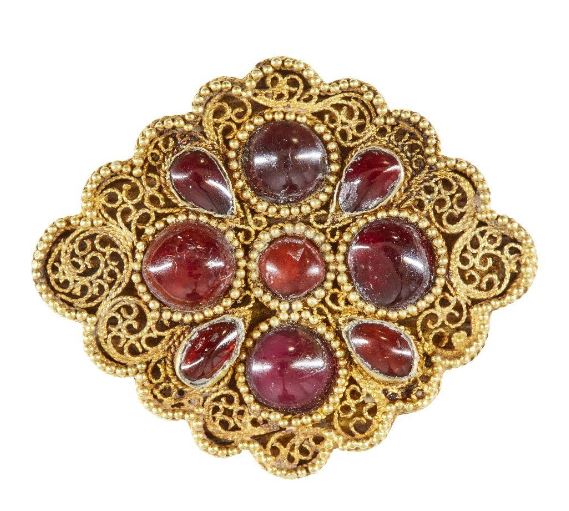
Garnet set gold elements, Roseberys, lot 314, £6-800
The commodity of Indian art
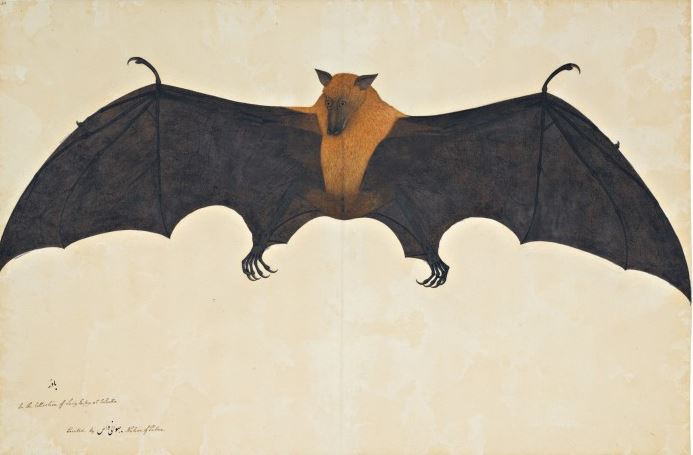
Let’s start with the bats. Sotheby’s first auction is exclusively made of Company School paintings, coming from the collection of the New-York gallery Carlton Rochell. Prices go from £8.000-12.000 to an astonishing £300.000-400.000 for a Great Indian Fruit Bat signed Bhawani Das, produced for Sir and Lady Impey. Elijah Impey was Chief Justice of Bengal from 1774 to 1787 and settled in Calcutta with his wife Mary, where they took a particular interest in hiring local artists to depict Indian natural history. They are today the most famous patrons of “Company School” painting, reflected here in the price of Sotheby’s bat. The flying fox was already famous on the market, having most recently been sold for £458.500 at Bonhams in 2014, before that for £168.500 at Christie’s in 2008 as part of the Niall Hobhouse Collection sale.
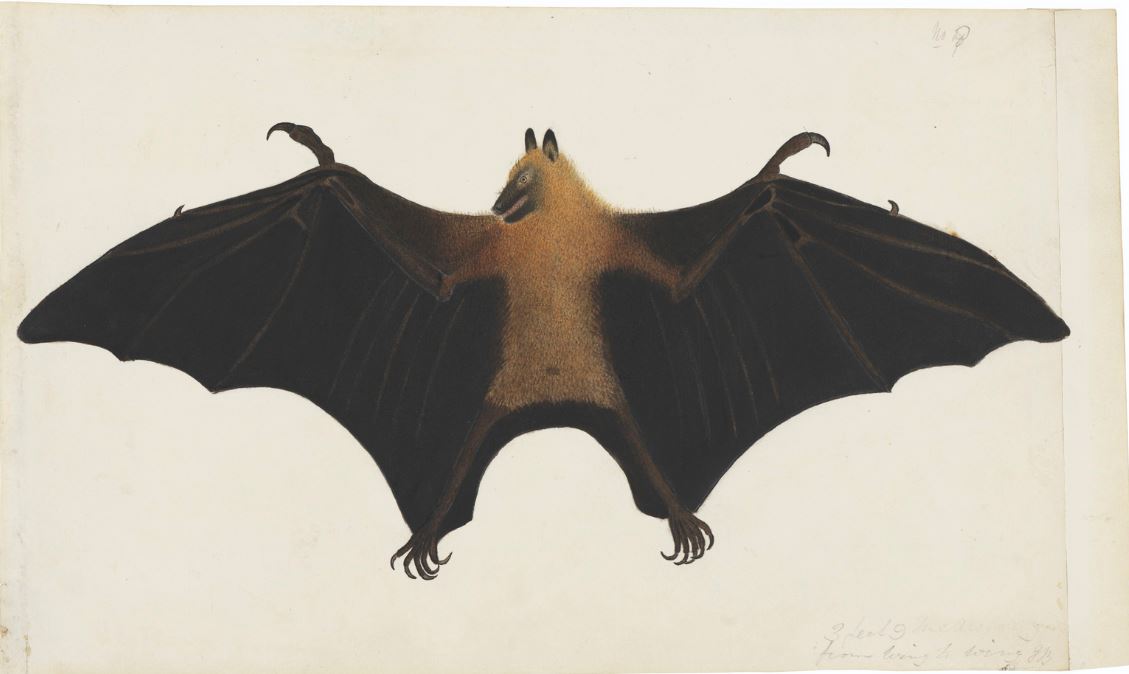
Company School bat, Sotheby’s lot 14, £300-400.000 Company School bat, Christie’s lot 55, £20-30.000
The second flying fox, presented at Christie’s for £20.000-30.000, appears a bit pale in comparison to the first one. Unsigned, it lacks the endearing realism that characterises Sotheby’s bat. As well, the catalogue only mentions one previous provenance and nothing prior to 2018.
Company School paintings haven’t moved crowds in a few years, and estimations rarely exceed £40.000. Sotheby’s is taking a risk by presenting a catalogue exclusively composed of Company School paintings, hence the clever marketing, betting on a foreword of William Dalrymple, famous author and curator of the exhibition Forgotten Masters: Indian Painting for the East India Company, held at The Wallace Collection in 2019-2020. It will be interested to see if the announcement effect bring new buyers, but we can at least expect the Flying Fox to do well.
Sotheby’s details the provenance of most of the paintings, which is always laudable, but was not particularly difficult in this case, the majority having been sold in the past 10 years on the London market, either in public auctions or in galleries such as Simon Ray and Francesca Galloway. Stuck in the close loop of increasing values, this leads to suspect that Sotheby’s Bat and Crimson Horned Pheasant are not collected for their artistic merits, but instead the safety their investment represents. It would be naive to think this is not the case for other, even any, high-value artefacts, but this is particularly obvious in this case.
What is also obvious in this auction, is the unofficial agreement between Sotheby’s and Carlton Rochell. Browsing through the afternoon auction catalogue, many Indian paintings rang a bell. With reason, as they were published not long ago in Carlton Rochell’s 2020 and 2021 catalogue, for instance lots 141, 146 and 147 (as I’m finishing this article, Carlton Rochell’s website has been down for two days, and I didn’t get the chance to download the catalogues to compare with Sotheby’s any further. The site was working on the 5th October when I started writing. As we say in French, mystère et boule de gomme).
Indian glasses?
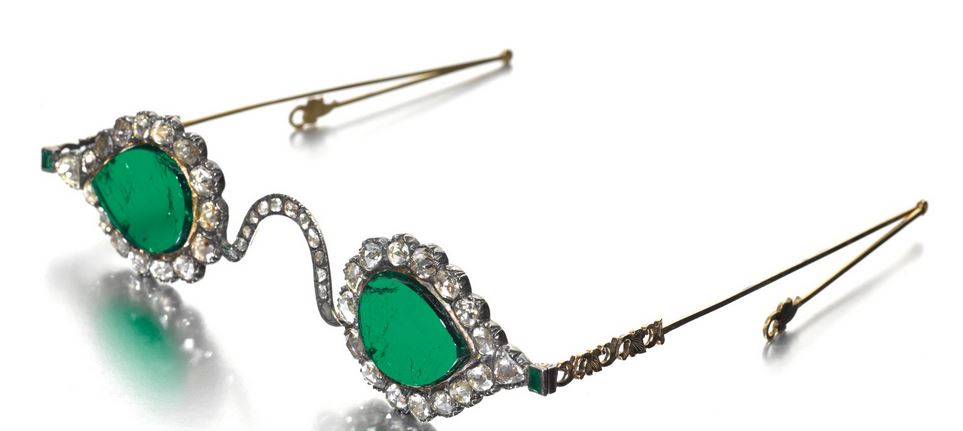
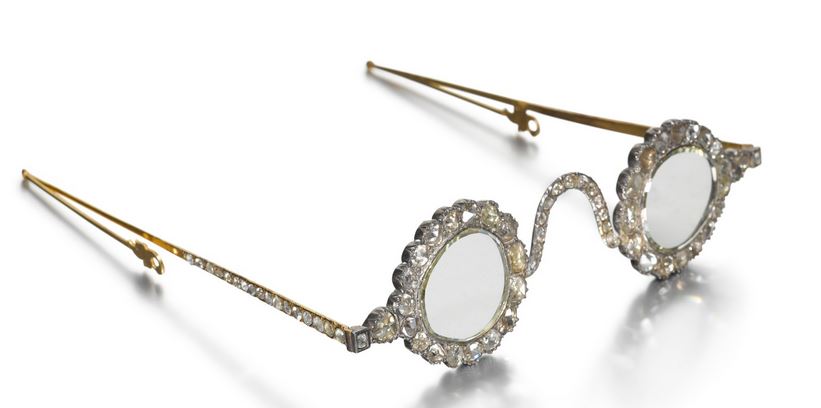
Moving from bats to elephants (the ones in the room), Sotheby’s presents two pairs of 19th century spectacles set with emerald and diamond lenses, each valued at £1.500-2.500.000. I am not a lapidary specialist, so my opinion is solely based on the catalogue, and let’s say I’m confused by these objects. The emeralds originate from a mine in Colombia discovered in 1560, and it is stated in the text that large quantities of emeralds were subsequently acquired by the Mughals. This seems to contradict the fact that emerald deposits can be found in Afghanistan and India. The diamonds “most probably” came from Golconda, but this is not confirmed. Aside from the stone’s origins, the main issue is that the frames are described as European. Indian stone-setting techniques are mentioned in the text, but it is specified that “they incorporate a European ‘open claw’ design”. Examples of figurative paintings showing Pince-nez glasses are also given, such as a portrait of Aurangzeb2, but these spectacles are not pince-nez. The valuation is probably justified by the stones, but the catalogue is extremely misleading, as these beautiful spectacles might very well not be Indian at all. Golconda diamonds and Colombian emeralds on a European frame raise a lot of questions, but I let the reader forms their own opinion.
Emerald spectacles, Sotheby’s lot 213Diamond spectacles, Sotheby’s lot 214
Metalwork in the Place of Honour
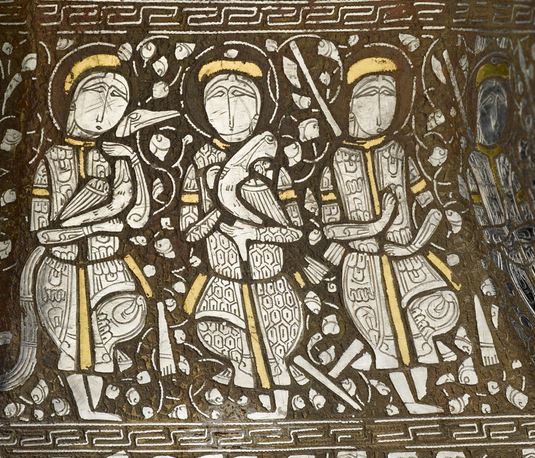
The debatable spectacles are not Sotheby’s high-value lots, the first place goes to a gold and silver inlaid brass candlestick attributed to Mosul circa 1275, offered for £2-3.000.000. Previously sold in Paris in 2003 for a price I was unfortunately not able to retrieve, it was exhibited in the MET from 2017 to 2021. The inscriptions do not give any information on the production context, but the subtle iconography suggests a court commission.
Mosul brass candlestick Sotheby’s lot 170, £2-3.000.000
The same way, Christie’s second-biggest lot is an elegant brass ewer attributed to the Khorassan region c. 1200-1210, valued at £ 300-500.000. Bonhams presents a few early bronzes, including a horse-shaped censer. The piece had previously been presented by Christie’s in 2006 as Byzantine and sold for €20.050, but is rebranded here as Umayyad and valued at £100-120.000. The line between Byzantine and Umayyad is often so thin, deciding on one over the other becomes a marketing question. Early Islamic usually sells better than late Byzantine, but it also involves more risks. Clearly, Bonhams feels confident enough to give a 6 figures’ valuation.
Umayyad bronze burner, Bonham’s lot 23, £100-120.000
Not to be outdone, Roseberys and Chiswick offer a large selection of metalworks. Roseberys presents 12 lots composed of gold elements set with garnets and two similar rings, attributed to 12th century Iran and valued between £2-300 and £2-4.000 (lots 309-320). My guess would be that the gold elements come from two different ensembles, but the 10 pieces would deserve to remain together. From what I could see (again, navigation is really uneasy), their most expensive metal artefact is a 12th century Seljuq bronze incense burner in the shape of a bird, valued £20-30.000. It is close to another burner in the MET, though Roseberys’ is better preserved.
My personal favourite presented at Chiswick is an engraved brass casket attributed to 12th century Sicily with later modifications, offered for £4-6.000. The complex history of the Sicily kingdom makes attributions particularly tricky, and art market professionals tend to stay away from the region, complex to brand and sell. It will then be particularly interesting to see if buyers are willing to invest.
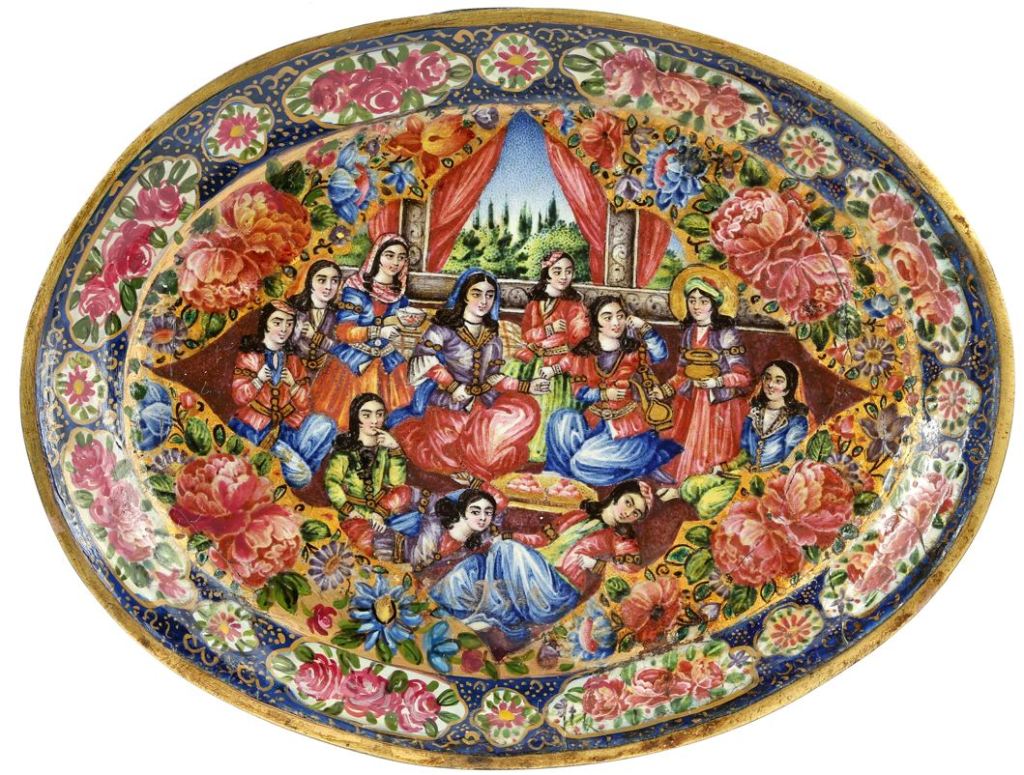
Qajar enamelled copper, Chiswick, lot 201, £6-800
Historical Figures, Historical Manuscripts
Chiswick main attraction in their afternoon auction is a group of 11 ivory figures depicting the Maharaja Ranjit Singh and his court, probably produced in Delhi in the first half of the 19th century. The central figure is identifiable, which is quite rare for this type of artefacts, but not unique in the case of Maharaja Ranjit Singh, as demonstrated by another ivory figure in the Victoria and Albert museum. The identification and the overall quality of the ensemble easily justifies the valuation at £25-30.000. To be noted that a second group of ivory figures is presented by Chiswick in the same auction, 13 anonymous palanquin bearers and attendants, valued only £6-800.
The same way, Bonhams most valuable artefact is a gold-koftgari steel repeating flintlock from the personal armoury of Tipu Sultan, signed by Sayyid Dawud and dated 1785-86. The provenance is no less prestigious, the weapon was acquired by Major Thomas Hart of the East India Company, following the siege of Seringapatam, and kept in the family until March 2019. I would not be surprised if a museum decided to acquire this piece, while Bonhams continues to establish their authority on historical artefacts.
Portrait of Sultan Orhan, Christie’s lot 76, £800-1.200.000
Christie’s is betting big on historical figures this season, with their highest valued lot being six portraits of Ottoman sultans produced in Venice around 1600 for the Grand Vizier Sokollu Mehmed Pasha. The ensemble is very interesting, both for its historical value, but also for the inherent dynamism and quality of each portrait. It seems risky to put European paintings as showrunner of an Islamic art auction, but I believe these will do well.
My favourite item of this entire Islamic Week is a Qur’an produced in Sultanate India, both signed and dated 838/1435, which is extremely rare. Offered by Christie’s for £30-50.000, the valuation doesn’t seem to fit the quality of the manuscript. That being said, Sultanate manuscripts rarely fly, so it will be interesting to see what this one will achieve. The gorgeous illuminations are characteristic of Sultanate Qur’ans, an odd mix of Egyptian and Persian influences, interpreted through then Indian lens.3
To finish, and speaking of rare, Sotheby’s present a complete Chinese Qur’an in 30 volumes, signed and dated 1103/1691. This is a huge event, and I hope the specialists of the field will have the opportunity to rush to London to see it before it is sold. Chinese Qur’ans are almost always dismembered, juz being sold separately, while dates and signatures are art history unicorns. The manuscript is sold without provenance, which is highly problematic, and I sincerely hope Christie’s will open their archive to scholars (which they usually do).
So much more could be said about this Islamic week, but I’ll stop there before rewriting all the catalogues. What do you think about Bonhams, Roseberys, Sotheby’s, Christie’s and Chiswick selections? Please share in the comments below!
Complete Chinese Qur’an, Sotheby’s, lot 119, £40-60.000
Oliver Hoare (1945-2018) was an influential Islamic art dealer, to whom we owe the creation of the first Islamic art department at Christie’s. More info on his Wikipedia page.
Museum für Islamische Kunst, Berlin, inv. I4594 fol.5.
The lot essay finally quotes Pr Brac de la Perriere’s work, one of the few specialists of Sultanate India and who has been mostly ignored in previous auctions. It was about time!
The challenges the world faces this year are of unprecedented magnitude, and with them, the fragile equilibrium of world economy has been thrown off balance completely. For museum and galleries, the blow is particularly hard, as most intitutions were already struggling keeping their doors open and their ceilling from leaking.
Kashan turquoise-glazed pottery figurine of a camel and rider, 13thc. L.A. Mayer Museum auction, Sotheby’s
To Deaccession or Not To
In countries were main museums are public institutions, the gradual decrease of governement fundings have forced museums to look for funds elsewhere. In 2018-2019, the British Museum received £13.1 million grant-in-aid, the lowest since 2015, and particularly significant when put next to the year total expanditure, £96.2 million. This translated, among others, by an acquisition budget going from £1.1 million to £0.8.million. Last year, British Museum public revenues was £39.4 million, also the lowest since 2015, but we can expect 2020 to be particularly disastruous.1
For galleries and private museums, the pandemic and inevitable economical crash that is predicted for 2021 are even more worrying, and it will take some time to recover from the loss of public revenues. Around the world, cultural institutions and associations are forced to look inside for solutions. In April, the American Association of Art Museum Directors (AAMD) passed a series of resolutions to relax the rules of deaccessinioning restricted funds:
The resolutions state that AAMD will refrain from censuring or sanctioning any museum—or censuring, suspending or expelling any museum director—that decides to use restricted endowment funds, trusts, or donations for general operating expenses. The resolution also addresses how a museum might use the proceeds from deaccessioned art to pay for expenses associated with the direct care of collections.2
Could the MET sell this Qur’an folio, Iran 12th c. (1996.238.2)
This means that between April 2020 and April 2022, American museums can sell parts of their collections to replace lost income and finance their operations. In the UK, the powerful Royal Academy of Arts (RA) has been letting a similar idea float, though the debate has been particularly focused on the Taddei Tondo, a marble sculpture of Michelangelo, already threatened of sale in the late 70’s.3 No decision has been made yet regarding the tondo future, and it is unlikely that the piece will end up in an auction, but the financial crisis of cultural institutions, especially the smaller ones, might force hands.
Selling or exchanging pieces of collections to fund new acquisitions is not a new practice, American museums have been doing it for years in a controlled setting4, but the new guideline from the AAMD extends the justification for selling art pieces towards operational means.
The L.A. Mayer Museum auction presented by Sotheby’s
What it means for Islamic Arts
So far, Islamic arts had not been publicly impacted by deaccessioning, though the practice is common behind closed doors and emphasised by controversial sales such as the Timurid Qur’an on Chinese paper witht a more than opaque provenance, sold in June 2020. However, in a market working in a quickly closing loop and given the current context, it was only a matter of time before parts of an Islamic arts collection be presented in a historical auction. The time should have been on the 27th October 2020 and the auction at Sotheby’s of 190 lots from the collections of the L.A. Mayer Museum of Islamic Arts in Jerusalem. The aim of the auction has been clearly stated by the museum director Nadim Sheiban:
We were afraid we could lose the museum and be forced to close the doors. […] If we didn’t act now, we would have to shut down in five to seven years. We decided to act and not wait for the collapse of the museum.5
The star of the auction: an Aq-qoyunlu silver-inlaid helmet, 15th c., £400.000-600.000
The catalogue included lots from all over Islamic lands but none from Israel and Palestine, as the legislation regarding native artefacts leaving the country is particularly strict. The auction, planning to reach around £6 million, would have given financial security to the L.A. Mayer Museum for the years to come, but would also constitute a definite slippery slope for private museums of Islamic arts around the world.
In an unexpected turn of events, the auction was postponed last minute on Monday night. While Sotheby’s website states that the delay is only until November, there is no guarantee the sale will ever occur, as criticisms came from the Israeli government officials and the public. The Hermann de Stern Foundation, that owns the L.A. Mayer Museum collection, still seems keen on moving forward with the sale but might struggle reaching an agreement:
The foundation’s management hopes that the postponement will make it possible to reach agreements that will also be acceptable to the Culture Ministry in the coming weeks.6
What now?
If the sale does go ahead, it will set a new precedent for the market of Islamic arts, as it will open the door for other museums to sell parts of their collections, either to acquire new items or just to keep the light on.
We can also question the motives for selling Islamic artefacts. The conflict between Israel and Palestine and the tensions in the Holy City between Jewish and Muslims come to mind in the case of the L.A. Mayer Museum auction and make the intervention of the pan-Israeli governement more surprising, but Islamic arts are political and ideological tools in more than one region. The Indian governement of Kovind and Modi might use this opportunity to accentuate their efforts to rewrite (not to say errase) India’s Muslim history, but even in Europe where far-right anti-Mulims parties are gaining more influence every day, progressiveley emptying Islamic arts collections could be a way to deny a shared past.
This bleak picture highlights the fact that selling Islamic arts bears a lot of weight, and publicly deaccessionning collections is not anodyne. Auction arts should use caution when selling museum pieces, but in this less than certain economical context, caution might already be gone in the wind. It will be interesting to see if the L.A. Mayer Museum auction goes ahead in November, and what the near future holds for Islamic arts.
Update: Auction delayed again
On Wednesday 19th December, the High Court of Justice has suspended the sale for two additional weeks, time for the L.A. Museum, Sotheby’s and the Culture Ministry to negotiate over holding a more limited auction with less high profile items, though these remain to be defined.7
A painting that could become controversial? Wedding of Dara Shokuh, Awadh, c. 1740, National Museum, New Dehli (58.58/38)
On the 10th June 2020, Sotheby’s will be presenting a painting of a narcissus flower signed by the 18th century Persian painting Muhammad Masih. The painting is not dated but the signature seems genuine, written in gold on each side of the base.
Golden signature of Muhammad Masih, just below a standard form of dedication.
To say that the painting rings a bell is an understatement. Indeed, two other identical versions are currently known. One is mounted in the Hindo-Irani album, also called Nasir al-Din Shah album, currently scattered between the Golestan Palace in Tehran, the Chester Beatty Library for the most part, and other collections.1 The page bears what I call an “attributive signature” to the famous Indian painter Mansur, who worked in Mughal India for emperors Akbar (1556-1605) and Jahangir (1605-1627).
The second page is mounted in the St-Petersburg album, previously called Leningrad album, kept for the most part in Russia, with only a few other folios scattered in various public and private collections (including a never seen before page sold last Winter in Paris). The painting is dated 1105 H./ 1693-94 and signed by the Persian painter Muhammad Zaman.
Nasid al-Din Shah album, attributed to MansurSt Petersburg album, signed Muhammad Zaman, 1105/ 1693-94Sotheby’s 10.06.20, signed Muhammad Masih
The Painters
Nadir al-‘asr Mansur worked in India, first in Akbar Ketabkhana (library), signing paintings in the 1590’s, and at least until 1621 when he was in Kashmir with the emperor Jahangir who wrote:
The flowers seen in the summer pastures of Kashmir are beyond enumeration. Thos drawn by Master Nadir ul-‘asr Mansur the painter number more than a hundred.2
Mansur is particularly reknown for his depictions of animals and flowers, but only two flower paintings indisputably bear his signature, a Tulip today in Aligarh University Museum and a copy of an European engraving in the Golestan palace in Tehran. This particular painting of a narcissus is problematic. Though the wording is similar to others genuine signatures, it is not located on the painting but on the below border, which was added later, when the page was mounted in the album. This is a common feature with Mughal album painting but one that is often ignored by specialists.
The style of the painting differs slightly from Aligarh Tulip and the Golestan “Seven Flowers”, but we can put the variations on the natural evolution of the painter style, as well on the fact that this painting is most probably the copy of an European engraving (more on this below).3
Muhammad Zaman worked in Safavid Iran between 1086 H./1675 or earlier and 1106 H./ 1695. The life of Muhammad Zaman has caused a lot of controversy among specialists, some stating he travelled to India, others to Europe where he converted to Christianism (which has been proven untrue). He is particularly known for his copies of European engravings, and according to his dated works, he seems to have favored flower paintings in the late stages of his career. This particular narcissus, signed and dated, was probably offered to the king Shah Soliman 1st (1666-1694). The style is genuine and corresponds to other flower paintings signed by the artist, mounted in the St-Petersburg album or elsewhere.
Muhammad Masih career is even less clear than the other two artists, about whom a lot still remain unknown. Some state that Muhammad Masih was an Indian painter emigrated in Iran during the 18th century, but this has never been proven.4His work is not particularly well studied, but he seemed to have worked at the end of the 17th century and during the 18th century, as demonstrated by several paintings and drawings scattered in various collection, including a small flower dated 1123 H./ 1711-12, mounted in an album kept in the Muze-ye Honarhā-ye Moʻāser in Ispahan.
Flower signed Muhammad Masih, 1123 H./ 1712
Origin of the Design
Muhammad Masih painting was initially sold at Sotheby’s Paris in 2015. I was busy writting my doctoral dissertation at the time and I completely missed it. Having three pages with an exact same design is however unprecedented.
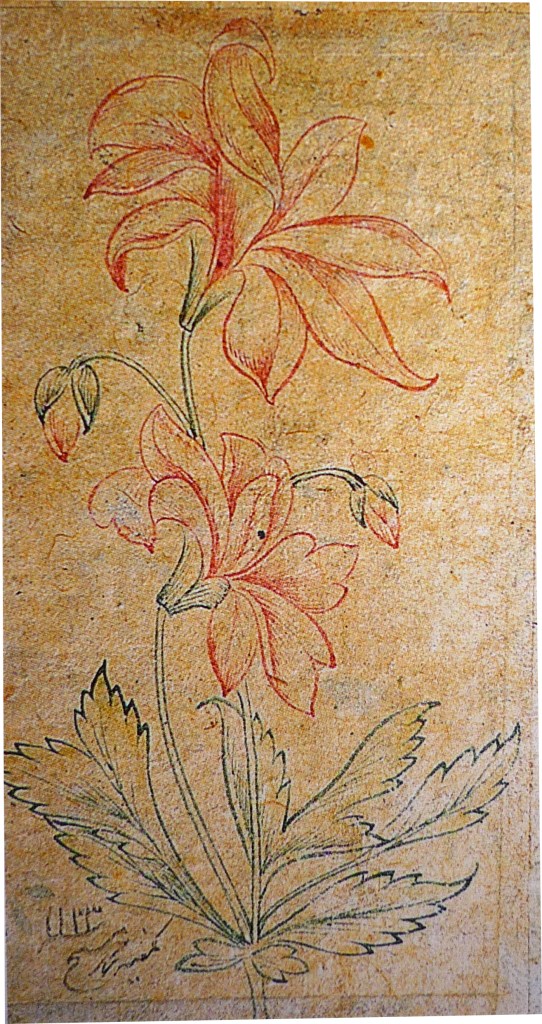
At the time, I was not able to identify the exact model of the two paintings I knew, and despite a follow-up research, I still come empty-handed. However, there is no doubt that the orginal design was made in Europe, most likely during the 16th century, for a printed herbarium, or most likely a florilegium, or “book of flowers”, particularly en vogue during the 17th century.
Contrary to religious and mythological engravings that are pretty well documented, it is unclear how did herbaria and florilegia arrive in India and in Iran, but we know that some European travellers and artists had some books of flowers in their belongings. For this reason, we find many copies of Jan Theodor van de Bry, Florilegium renovatum et auctum, published in Frankfurt in 1641, Pierre Vallet Le Jardin du Roy published in Paris in 1606, Francois L’Anglois Livre de fleurs, Paris, 1620, Adrian Collaert Florilegium, published in 1587, and several others.
On the left, Indian painting, 18th c., Clive album (VAM IS.48:1/A-1956). On the right, the original by Pierre Vallet, Le jardin du Roy, Paris, 1606. Species depicted: Lilium Martagon
Making a copy in the 17th century
Regardless how flower books arrived in the hands of painters, tthis exact model, and many others, were used to create either exact copies, such as our three identical pages, or brand new compositions using several sources.
To make a copy is quite easy. First the artist used a niddle to make small perforations along the contours of the original design. Then, the model was put face against a blank sheet of paper. The painter then put a bit of charcoal powder on the back of the original page, which went through the holes onto the blank page. The “master copy” could be used several times, as demonstrated by the existence of the three similar narcissus.
Pounced drawing of a bird. Iran, 17th c. (British Museum, 1988-4-23.26, f. 15b)
Was Mansur the first one to paint this narcissus? This would explain why Muhammad Zaman chose the subject, as the Indian painter was most probably reknown outside of the Mughal court. Was Muhammad Zaman even aware of the first painting? Probably, though it is unsure how (the first painting probably arrived in Iran later, after Delhi sack by the army of Nader Shah Afshar in 1747). The depiction of narcissus is not uncommon in Iran in the 17th century, as the flower takes on several different meaning in poetry and litterature, but the facination with this particular design is more complex than it looks, and a lot more remains to discover.
For the full list of folios, see E. Wright, Muraqqa, 2008, p. 141. The exact number of pages depend on the author. Wright counts 126, Atabai counts 131. B. Atabai, Fihrist-i Muraqqa’at, 1974, p. 178.
Translation from The Jahangirnama: Memoirs of Jahangir, Emperor of India, ed. W.M. Thackston, 1999, p. 333.
Asok Kumar Das openly challenges this attribution in Wonders of Nature: Ustad Mansur at the Mughal Court, 2012, p. 148-149. I remain slightly more nuanced than the author.
This is the initial assertion of Mohammad ‘Ali Karimzade Tabrizi in Ahval va asar-e Naqqashan-e Qadim-e Iran, 1985, vol. 3, pp. 183-4, recounted by Melikian Chirvani in Le Chant du Monde, 2007, p. 408.









 Isabelle Imbert