Tag: islamic and indian art

  • Retrospective of the Islamic & Indian Art Market in 2023

    Retrospective of the Islamic & Indian Art Market in 2023

    Carved panel, Anatolia (?), 13th c. Sotheby’s 26.4, 87

    Key moments of 2023 in London and Paris

    Glass cup, Rim Encheres, 10.3, 10
    Shahnama (detail), Sothebys 26.4, 41
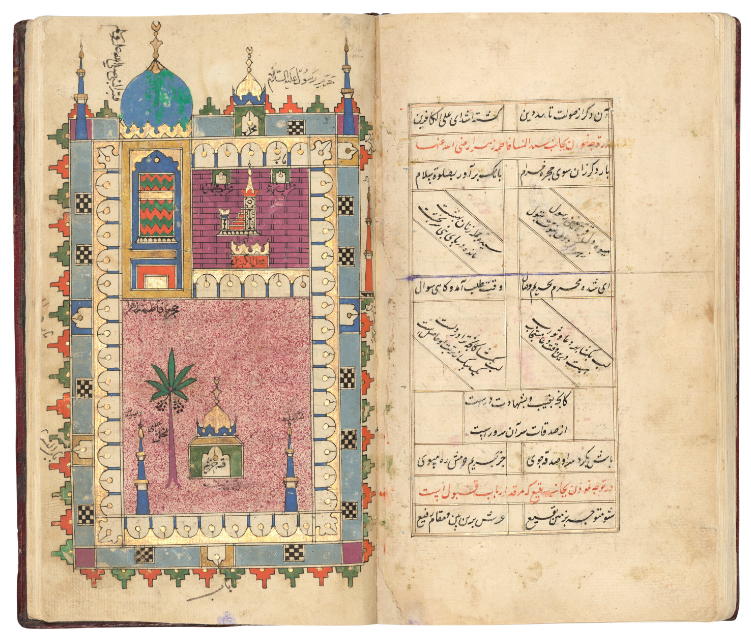
    Futuh al-Haramayn, Christie’s 26.10, 131
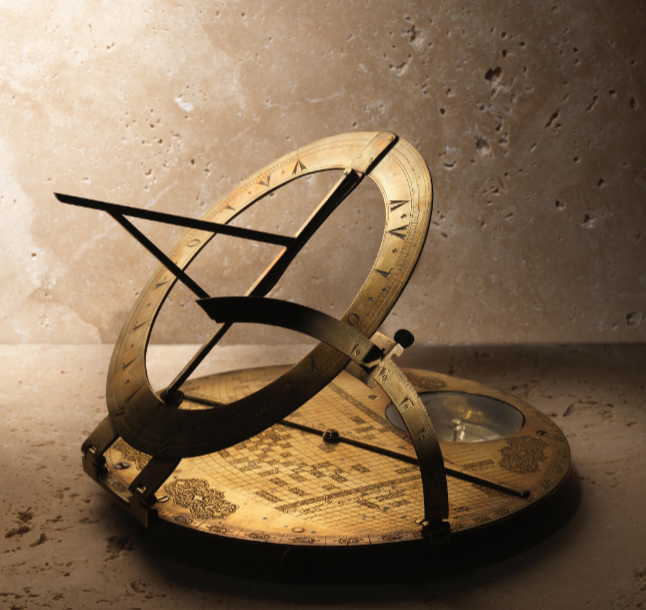
    Mamluk astronomical treatise, Roseberys 28.4, 222
    Tipu Sultan sword, Bonhams 23.5, 175
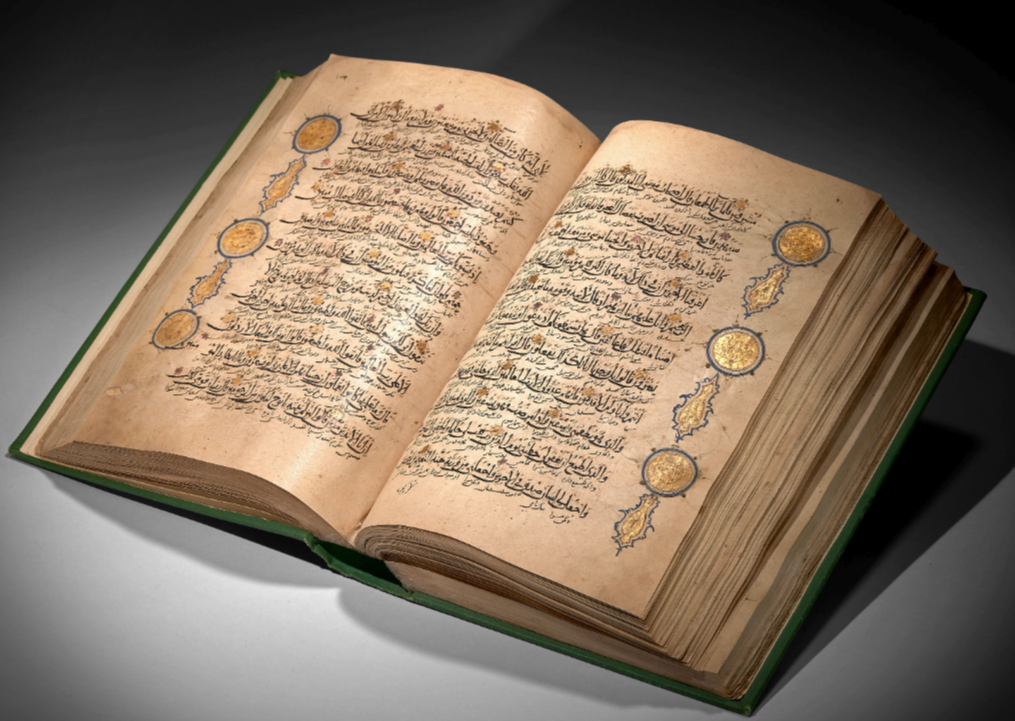
    Qur’an, 12th c., Artcurial 24.5, lot 101
    Qur’an (detail), 12th c., Millon 14.6, 177
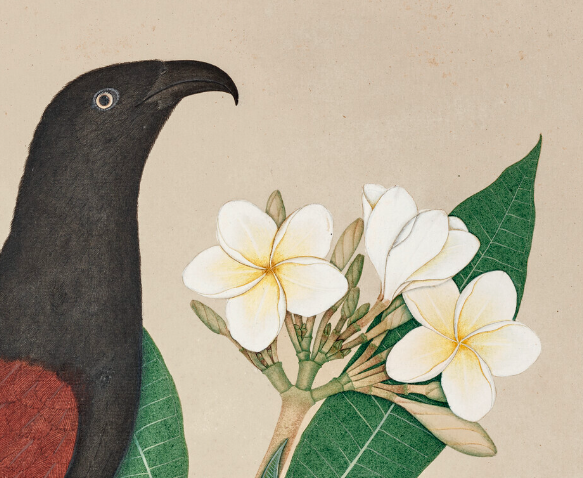
    Coucal, Christie’s
    The “Harvard world map”, Bonhams 14.11, 192p
    Damascus room (detail), Gros & Delettrez, 20.12, 1

    My predictions for 2024

    Tipu Sultan’s sword, Bonhams 14.11
    Hajj map (detail), Sotheby’s 26.4, 2
    Copper ewer, Chiswick 31.10, 9
    Darwaza-i Rauza, c. 1820, Ader, 10.03, 239
  • Top 20 of the Most Expensive Islamic Art Pieces – part 2 (blog)

    Top 20 of the Most Expensive Islamic Art Pieces – part 2 (blog)

    Welcome back for the part 2 of this Top 20, in which we will explore the 12 most expensive pieces of Islamic art ever sold. Yes, 12, despite Part 1 already covering numbers 20 to 11. When initially drafting the list, I forgot to number one of the entries, and I then found another piece which I had completely forgotten about (it was sold in 2010, to be fair). Let’s not dwell too much on my methods, hope that I haven’t forgotten anything else (I might have, in all honesty), and let’s consider these as two bonus entries in this Top… 22!
    For reminder, I purposefully excluded the “Maharajas & Mughal Magnificence” auction held at Christie’s New York in June 2019, which was composed of jewelled pieces, gems and paintings from the Al-Thani collection, some being questionably “Islamic”. As well, I only went back to 2010 for ease and I did not take into account inflation, so the prices discussed here and in part 1 are as they were at the time of the sale. Without further delays, let’s jump in!

    All prices include premium. Click on the auction date and estimate to access the catalogue notice.

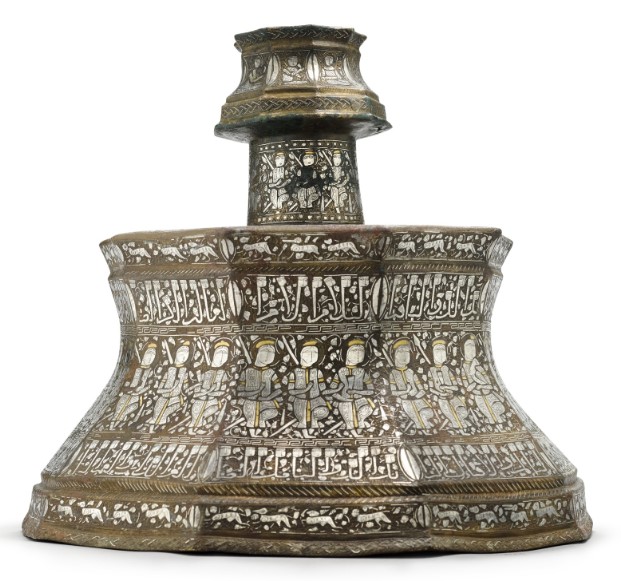
    12 (Bonus entry) – £ 4,521,250: A Mamluk silver & copper-inlaid brass candlestick, Egypt or Syria, 1340-5

    Sotheby’s, 6 April 2011, lot 325: £2,000,000 – 3,000,000 

    Mamluk brass Candlestick, Sotheby’s 06.04.11, 325

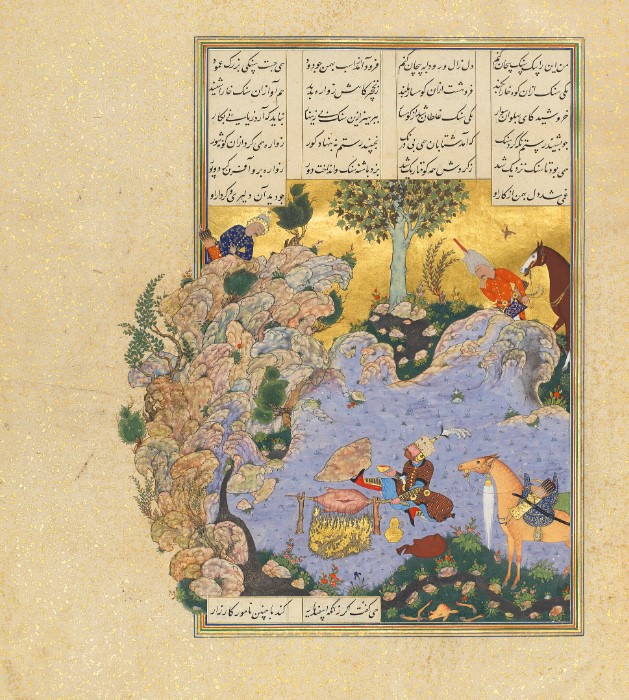
    11 (Bonus entry) –  £ 4,842,000: “Rustam kicking the boulder”, Shah Tahmasp’s Shahnama, Tabriz, c. 1530

    Christie’s, 31 March 2022, lot 41: £2,500,000 – 4,000,000

    “Rustam kicks the boulder”, Shah Tahmasp’s Shahnamah, Christie’s, 31.03.22, 41

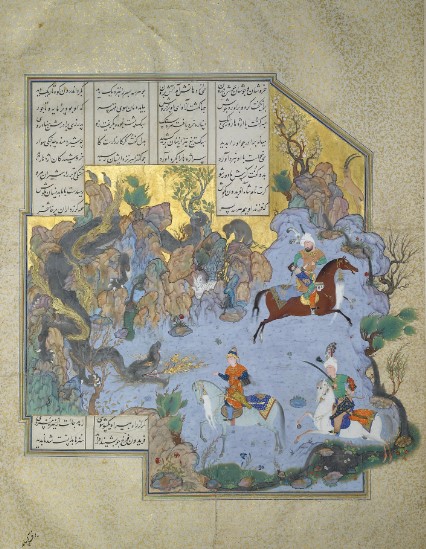
    10 –  £ 4,875,800: “Bizhan slays Nastihan”, Shah Tahmasp’s Shahnama, Tabriz, c. 1530

    Sotheby’s 26 April 2023, lot 41: £4,000,000 – 6,000,000

    “Bizhan slays Nastihan”, Shah Tahmasp’s Shahnamah, Sotheby’s 26.04.23, 41

    9 –  £ 5,323,500: Portrait of Suleyman by a Follower of Gentile Bellini, Venice, c. 1520

    Sotheby’s 01 May 2019, lot 129: £250,000 – 350,000

    Portrait of Suleyman, Sotheby’s 01.05.19, 129

    8 –  £ 5,359,950: A blue & white Pottery Charger, Iznik, Ottoman Turkey, c. 1480

    Sotheby’s 24 October 2018, lot 134: £300,000 – 500,000

    Debbane Charger, Sotheby’s 24.10.18, 134

    7 –  £ 5,442,000: A square Pashmina Carpet, Mughal India, c. 1650

    Christie’s 27 October 2022, lot 200: £2,500,000 – 3,000,000

    Mughal Carpet, Christie’s 27.10.22, 200

    6 – £ 6,201,250: A Kerman ‘vase’ carpet, Persia, 17th century

    Christie’s 15 April 2010, lot 100: £200,000 – 300,000

    5 –  £ 6,632,400: A gold and silver-inlaid brass Candlestick, probably Mosul, circa 1275

    Sotheby’s 27 October 2021, lot 170: £2,000,000 – 3,000,000

    Candlestick, Mossul, c. 1275, Sotheby’s 27.10.21, 170

    4 –  £ 7,433,250: “Faridun tests his Sons”, Shah Tahmasp’s Shahnama, Tabriz, c. 1530

    Sotheby’s, 06 April 2011, lot 78: £2,000,000 – 3,000,000

    “Faridun tests his sons”, Shah Tahmasp’s Shahnamah, Sotheby’s, 06.04.11, 78

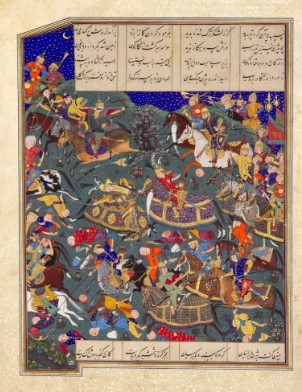
    3 –  £ 8,061,700: “Rustam recovers Rakhsh”, Shah Tahmasp’s Shahnama, Tabriz, c. 1530

    Sotheby’s 26 October 2022, lot 49: £4,000,000 – 6,000,000

    “Rustam recovers Rakhsh”, Shah Tahmasp’s Shahnamah, Sotheby’s 26.04.23, 49

    Honourable Mention: An Abbasid Ka’ba Key, Mecca, dated 573/ 1177-1178: £9,200,000

    Sotheby’s, 9 April 2008, lot 51: £400,000-500,000

    The fake Abbasid Ka’ba key, Sotheby’s 9.04.08, 51

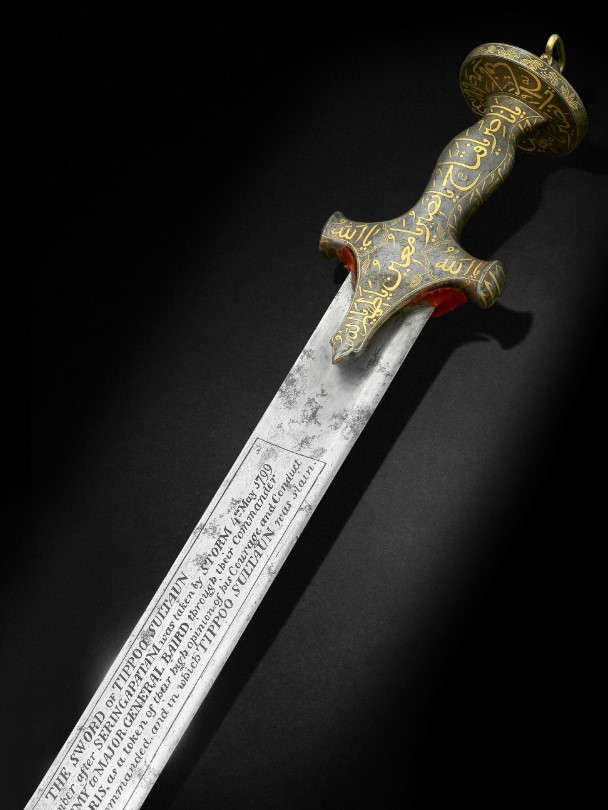
    2 –  £ 14,080,900: The Bedchamber Sword of Tipu Sultan, India, 18th Century

    Bonhams, 23 May 2023, lot 175: £1,500,000 – 2,000,000

    Valued at £1,500,000, the bedchamber sword of Tipu Sultan recently sold for almost 10 times more. The sword itself is of great quality and in an almost pristine state of preservation, but let’s be honest, this price is hardly justified. The sword was ‘found’ in Tipu Sultan’s private apartments after his death in 1799 and offered to the Major General David Baird. It remained in his family until 2003 when it was sold in London for £150,000 (against an estimate of £150,000-250,000). Bonhams recognised the craze for everything Tipu Sultan and presented the sword 20 years later for 10 times the estimate, and it became the 2nd most expensive Islamic art object ever sold. In the mind of many, Tipu Sultan represents the fight against oppression led by corporate greed, so the irony is not lost that his possessions now make millions of pound on London art market.

    Tipu Sultan’s sword, Bonhams, 23.05.23, 175

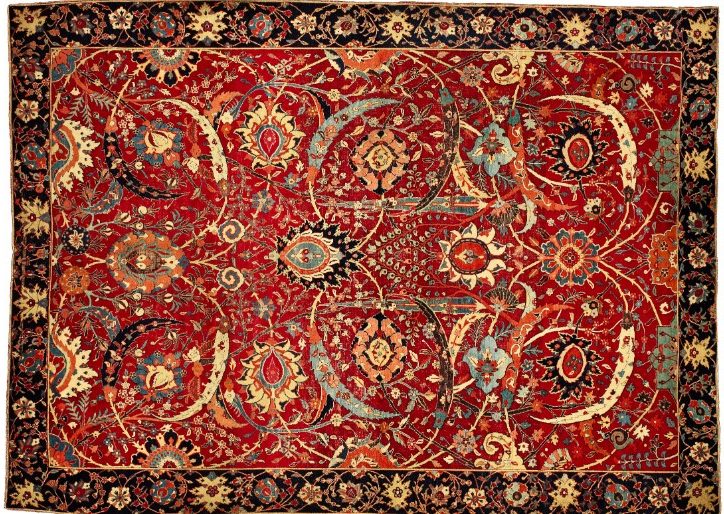
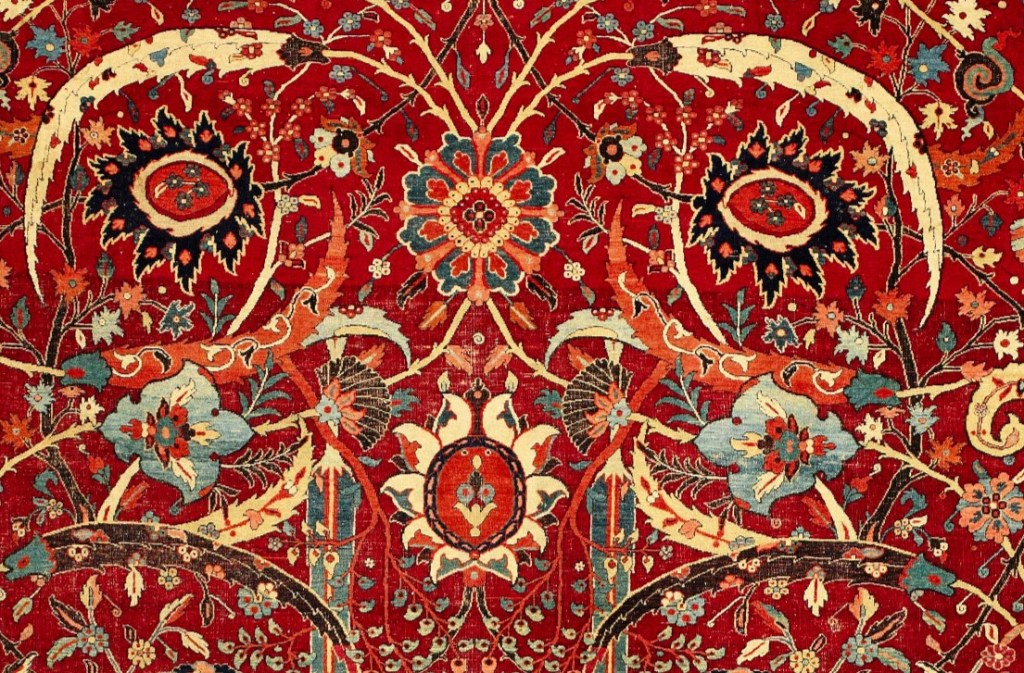
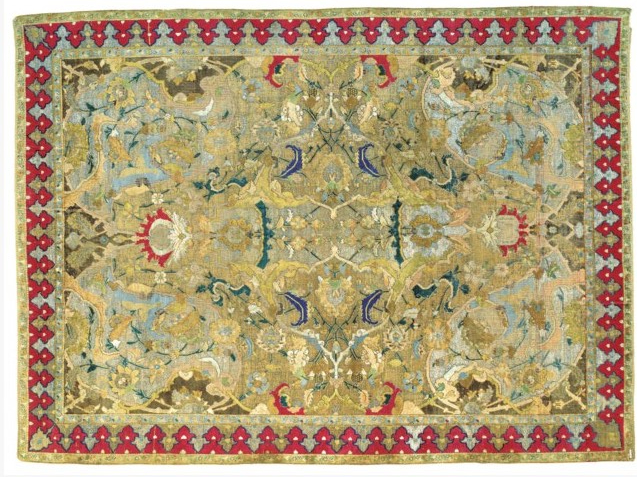
    1 – $33,765,000: The Clark Sickle-Leaf carpet, prob. Kerman, Persia, 17th Century

    Sotheby’s New York, 5 June 2013, lot 12: $5,000,000 – 7,000,000

    Clark Sickle-Leaf carpet, Sotheby’s NY 5.06.13, lot 12
    Detail of the Clark Sickle-Leaf carpet, Sotheby’s NY 5.06.13
  • Top 20 of the Most Expensive Islamic Art Pieces – part 1 (blog)

    Top 20 of the Most Expensive Islamic Art Pieces – part 1 (blog)

    With Summer fast approaching, I thought it would be the perfect time for some light reading to enjoy wherever you’re vacationing, and nothing get lighter than a list of top historical artefacts sold for outrageous amounts.

    Three caveats before starting:

    1. I decided to divide this top 20 in two, it was too long otherwise;
    2. The list only goes back to 2010, mainly for access ease, but also because prices have exploded in the past few years and going back further is not necessarily relevant;
    3. I purposefully left the auction “Maharajas & Mughal Magnificence” out of this list, otherwise most of it would have been composed of objects sold there, and some being debatable as their “Islamic” categorisation. For those who wouldn’t remember, this auction was held at Christie’s New York in June 2019 and was composed of jewelled pieces, gems and paintings from the Al-Thani collection. The most expensive lot, a Cartier devant-de-corsage brooch, was sold for $10,603,500, which would put it in second place of the list after conversion. I wrote about the results of this auction back in the days.

    As mentioned, the reader will quickly notice the dates of the record auctions: most of them occurred between the end of 2018 and 2023. This truly shows how London market has drastically changed in the past few years, with prices increasing rapidly. As Dr Hiba Abid was telling in the episode of the ART Informant podcast, this is an issue for institutions that cannot rely on London’s market to expand their collection. However, this is a question for another day, as we are keeping the content light, so let’s jump into the first part Top20! In true internet fashion, we’ll start with the last.

    All prices include premium. Click on the auction date and estimate to access the catalogue notice.

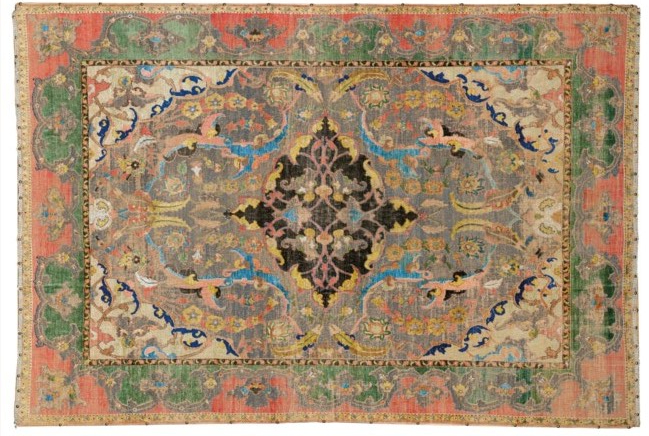
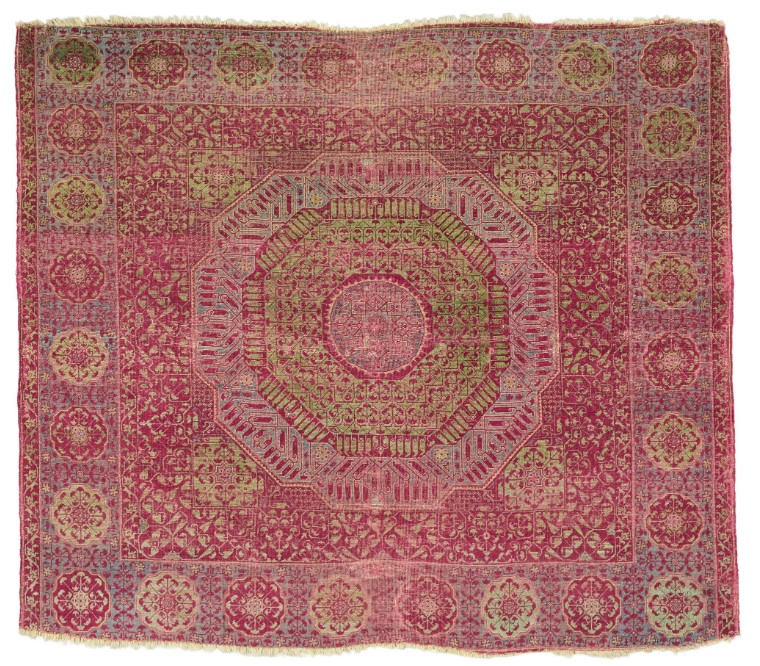
    20 – £1,854,200: A Mamluk Carpet, probably Cairo, end of 15th c./ early 16th c.

    Sotheby’s, 27 October 2020, lot 448: £400,000 – 600,000

    This list starts with a very rare piece on the art market. Probably made in Egypt in a production context that remains to be precisely defined, these carpets were widely popular in 15th and 16th centuries European markets, especially around the Mediterranean sea where several were found in ports such as Venice and Genoa. In 2018, the blog “rugtracker” posted an in-depth article on Mamluk carpets; their popularity in Europe and their representation in Renaissance painting: you can read it here (it’s very good and full of images). These rugs are usually identifiable by their decoration, usually based on kaleidoscopic repetition of small motifs, central medallions, and their limited colour range dominated by brick-red. This particular carpet is a prime example of the production but according to the catalogue, it appears to be the only square carpet with a lobed medallion in its centre, usually this motif is applied to oblong pieces. Buyer’s enthusiasm for this rare piece can easily be understood, which is not necessarily the case for all the artefacts on this list!

    Mamluk carpet, Sotheby’s 27.10.20, 448

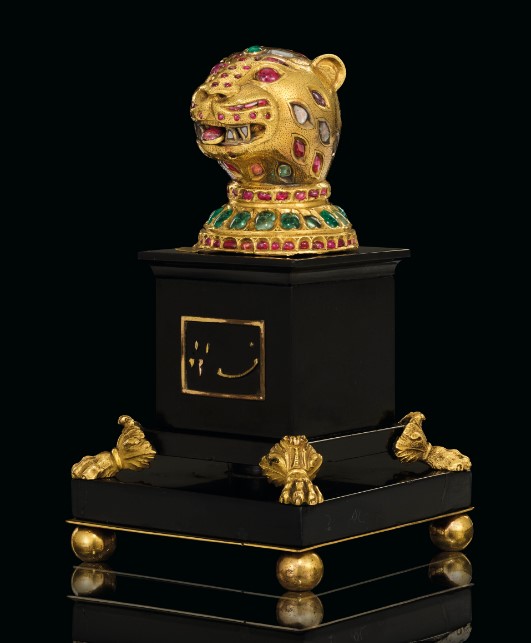
    19 – £1,855,000: A Gold Finial from the Throne of Tipu Sultan, c. 1800

    Christie’s, 27 April 2023, lot 84: £300,000 – 500,000

    If you don’t know who Tipu Sultan was, let me quickly introduce him, as you will see his name several times in that list (and you can be grateful it is only a top 20). Known as “the tiger of Mysore”, he was the ruler of the kingdom of Mysore from 1782 to 1799 (roughly the southern half of India at its largest). His reign is marked by conflicts with his neighbours, but mainly with the British East India Company, whom he fought all his life, sending emissaries to Ottoman Turkey, Afghanistan and France to gather forces against them. Ultimately, his efforts to limit the progression of the British in India were a failure, and he died in 1799 when British armies invaded the capital city. He was such a fierce opponent to the crown that his death was declared a national holiday in Britain, and the obsession for the man has continued ever since. This golden and gem-inlaid tiger head was part of the Al-Thani collection, which bought it at Bonhams in 2013 for £389,600. It was offered in New York in 2019 for $500,000-700,000 and remained unsold, until this year when it was valued roughly the same after conversion, this time achieving nearly 2 millions. This head was probably taken from the throne right after the death of the ruler and brought to England as a souvenir for Thomas Wallace (1763-1843), who was part of the Board of Control overseeing the activities of the East India Company. As we will see, a lot of Tipu’s memorabilia was taken from the palace immediately after his demise and passed to British collections, adding provenance to famous history.

    Tipu Sultan throne finial, Christie’s 27.04.23, 84

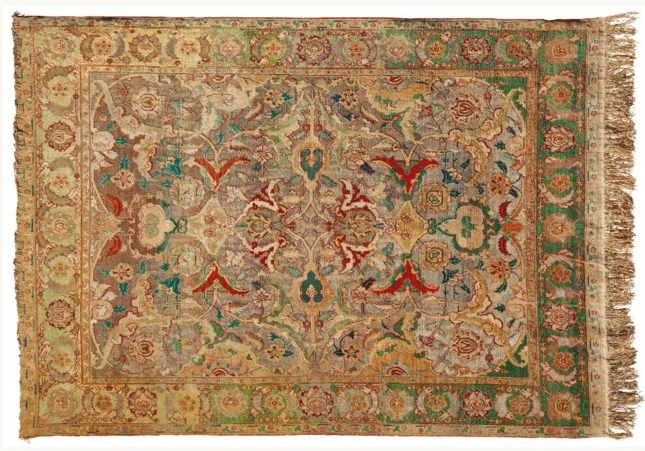
    18 – 2,062,500: A Safavid silk and metal-thread “Polonaise” Carpet, first half of the 17th century

    Christie’s, 1 April 2021, lot 129: £1,500,000 – 2,000,000

    Polonaise carpets are normally quite rare on the market so they usually do quite well, as we will see in this list. The production of these carpets have little to do with Poland and everything to do with the Safavid ruler Shah ‘Abbas I (r. 1587-1629). After moving the capital to Isfahan in 1598, he launched a big campaign to modernise Persia textile industry, and used the Armenian community freshly deported from Julfa to Isfahan to develop a solid trade network with Europe. Polonaise carpets produced at that time were often sent to Europe to either be sold, or to be gifted to royal families to illustrate the finesse of Persia’s craftsmanship. For this reason, a lot of Polonaise carpets have a very prestigious provenance, such as this one which was initially in the collection of Prince Pio Falcó in Rome. Among the particularities of this production is the decoration, often repeated nearly identically on two or more pieces. According to Christie’s catalogue, this one has an exact pair in the Palazzo del Principe in Genoa, built for Andrea Doria in 1521.

    Polonaise carpet, Christie’s 1.4.21, 129

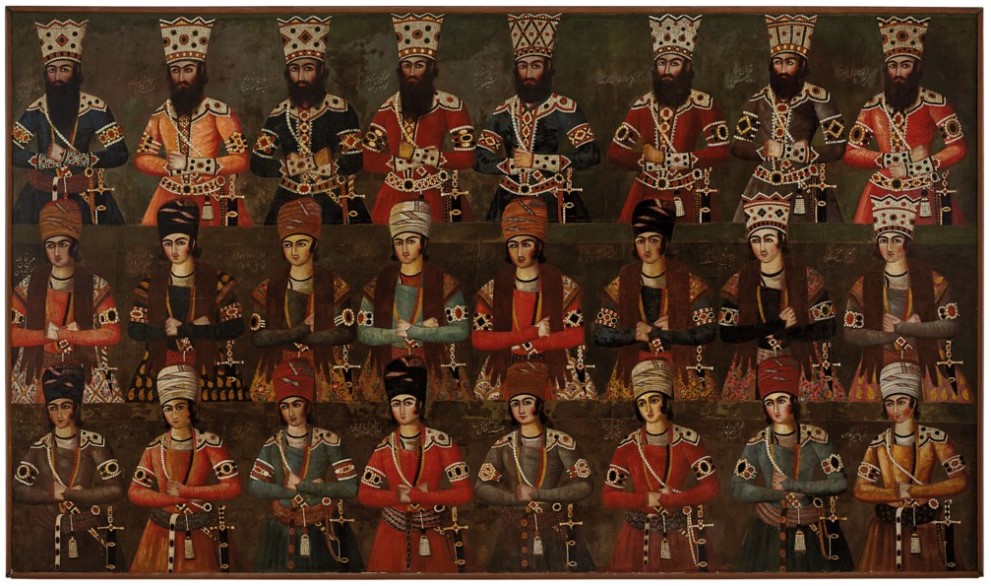
    17 – 2,302,500: A Qajar Group Portrait, c. 1810-20

    Christie’s, 1 April 2021, lot 30: £1,000,000 – 1,500,000

    This massive painting, 2.565 x 4.42 meters, depicts twenty-four royal courtiers portrayed in three rows of eight, all standing facing left and wearing lavish robes and turbans or crowns, each figure identified. It was part of the Bonnet House Museum and Gardens in Fort Lauderdale, the summer residence of the artist and collector Frederic Clay Bartlett, and is truly unique occurrence on the recent market. It was probably made to decorate the walls of the Negarestan Palace, near Tehran, built in 1807 as a summer residence for Fath ‘Ali Shah, second ruler of the Qajar dynasty (r. 1797-1834). Christie’s bet big when offering this painting, and called upon Dr Layla S. Diba, great scholar of the period, to produce the catalogue essay. She did a phenomenal job that I will not paraphrase here, but I encourage all to have a look at it. Qajar painting is increasingly popular, however, and to my knowledge, it had never passed the million at auction. With a valuation at £1 million, this could have flopped dramatically. Instead, it made the list!

    Qajar group portrait, Christie’s 1.4.21, 30

    16 – £2,322,000: A Safavid silk and metal-thread “Polonaise” Carpet, first half of the 17th century

    Christie’s, 31 March 2022, lot 174: £1,000,000 – 1,500,000

    Christie’s seems to have a deal with owners of Polonaise carpets, as this second carpet is not the last one on the list. This one was in the collection of the Baron Adolphe Carl von Rothschild (1823-1900). Regarding the appellation “Polonaise”, it is linked to the passion of 17th century Baroque Europe for these carpets. Louis XV apparently owned 25 of them, but the Polish royal family developed a deeper fascination with Persia. As early as 1584, King Stephen Bathory (r. 1576-1586) bought 34 Persian textiles, and in 1601 a group of 8 Safavid silk and gold carpets was ordered by Sigismund Vasa III of Poland for his daughter’s wedding.1 The term itself was coined a lot later, during Paris Universal Exhibition in 1878 where examples of these carpets were exhibited in the Polish pavilions.

    Polonaise carpet, Christie’s 31.03.22, 174

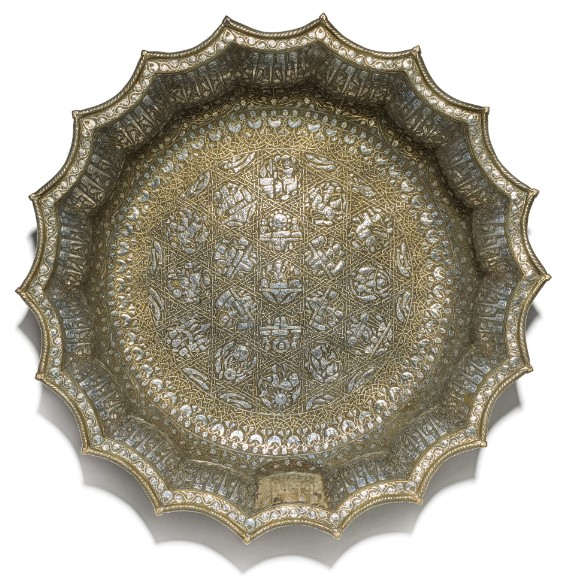
    15 – £3,100,500: A silver-inlaid brass Basin, probably Herat, c.1200

    Sotheby’s, 31 March 2021, lot 74: £1,000,000 – 1,500,000

    This large basin of 50 cm diameter is particularly remarkable for its decoration. The twelve Zodiac signs sit in the bottom of the basin, each represented according to the iconographic codes developed in astrology literature, placed around the centre which features the planetary cycle, with Saturn in the middle, surmounted by the Sun, and clockwise – Mercury, Mars, the Moon, Jupiter and Venus.2 By itself, this piece is incredible, but when put back in the intellectual context of 12th or 13th century Persia, it becomes even more intricate and meaningful.

    Astrological basin, Sotheby’s 31.03.21, 74

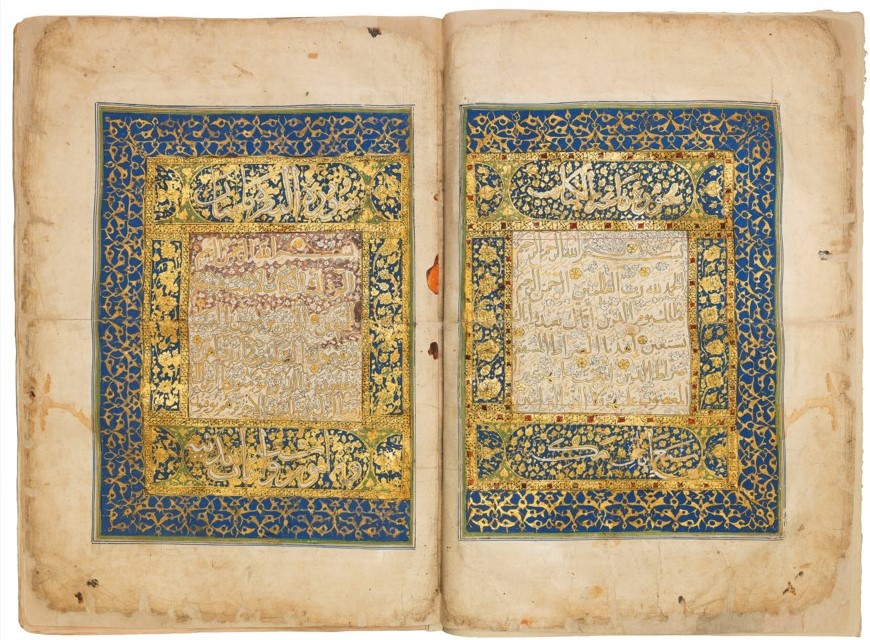
    14 – £3,724,750: Qur’an dated 894 H./ 1489 made for the Sultan Qaytbay, Egypt

    Christie’s, 2 May 2019, lot 11: £500,000 – 800,000

    This is the only manuscript of this list, but also a head scratcher. While 14th century Mamluk Qur’ans are usually quite popular on the market and in academic historiography, the 15th century has suffered from a general lack of interest, and has fallen in an historiographical gap that is only starting to be filled. Among other things, the difference between the two centuries is linked to the change of style and, some would say, of quality, of the manuscripts produced. As noted in Christie’s catalogue, this Qur’an reflects a rapid execution, the calligraphy shows some irregularities and the illumination, nice from a distance, looks quite crude on some details (for instance the title band on picture 17 in the online catalogue: look at the layering of the reddish colour – it might be a repaint – and of the gold in the rosette underneath). The manuscript is a wonderful testimony of artistic patronage under Sultan Qaytbay, but was it worth more than £3 millions? I don’t believe so, but the market decides what the market decides.

    Mamluk Qur’an, Christie’s 2.05.19, 11

    13 – £3,724,750: A Safavid silk and metal-thread “Polonaise” Carpet, first half of the 17th century

    Christie’s 2 May 2019, lot 255: £550,000 – 750,000

    Yes, another Polonaise carpet sold at Christie’s, in the same auction as the Qur’an aforementioned. This one is described as: “With the Saxon Elector and later King of Poland Augustus the Strong. Reputedly gifted in 1695 to Lothar Franz von Schonborn, Prince-Elector and Archbishop of Mainz, Archchancellor of the Holy Roman Empire.”

    Polonaise carpet, Christie’s 2.05.19, 255

    12 – £3,737, 250: A Nasrid period ear-dagger, Spain, 15th century

    Sotheby’s, 6 October 2010, lot 250: £600,000 – 800,000

    This dagger is the only Spanish entry in this list. Nasrid objects are quite rare on the market and usually do quite well without exploding records, except for this one. The Nasrids were the last Muslim dynasty in the Iberian Peninsula, ruling from 1230 to 1492 over a decreasing kingdom. This dagger is a great example of the artistic productions in the Peninsula, but also of the cultural hybridity that characterises the period. Arabic and Latin inscriptions or pseudo-inscriptions decorate the “ear” grips, and the letters R and TT are carved in relief, which might indicate it was owned by a Christian or a Castilian-speaker. The gold was restored, which gives this piece a remarkable finish, and the catalogue entry did a great job relating this dagger to others dated.

    Nasrid ear dagger, Sotheby’s 06.10.10, 250

    11 – £3,895,000: A Safavid silk and metal-thread “Polonaise” Carpet, first half of the 17th century

    Christie’s, 2 May 2019, lot 254: £600,000 – 800,000

    The last Polonaise carpet in this Top20, and the last entry of the first half of the list. Sold with the previous one, it came from the same private Swiss collection and was initially owned by the Archchancellor of the Holy Roman Empire.

    Polonaise carpet, Christie’s 2.05.19, 254

    Honourable Mentions

    To finish, I wanted to mention a few pieces that didn’t make the list but that caught my attention. Click on the links to access the auction catalogue:

    A life-size portrait of Mughal emperor Jahangir, signed Abu’l Hasan, 1026/ 1617: £1,420,000

    Bonhams, 5 April 2011, lot 322: Described as the largest known Mughal portrait, this gouache painting of Jahangir sitting on a throne holding an orb is nothing less than an oddity. It measures 2.10 x 1.41m (including calligraphic borders), a size never seen before and never seen since. Lots of eyebrows were raised at the time, including mines.

    A bronze Cannon from the Gun Carriage Manufactory at Seringapatam, Mysore, late 18th c.: £1,426,500

    Bonhams, 21 April 2015, lot 156: Initially valued at £40,000 – 60,000, this £1,4M canon illustrates the obsession of the market with Tipu Sultan. A large part of Bonhams auction was dedicated to Tipu memorabilia but for reasons that elude me, this particular canon broke records.

    A Qur’an Scroll, signed Mubarak ibn ‘Abdullah, Eastern Anatolia, 754 H./ 1353-54: £1,602,000

    Christie’s, 27 October 2022, lot 28: This extraordinary manuscript deserves its price. Valued at £250,000 – 350,000, it was beautifully exhibited at Christie’s alongside the wall of a small room where it could shine in all its glory. Its sale came with a bit of noise that didn’t go further.

    A monumental bronze oil-lamp, Andalusia, 11th c.: £1,608,000

    Sotheby’s, 26 October 2022, lot 93: Last but not least, this telescopic Andalusian oil lamp valued £300,000-400,000. This one is complete, with all its components present in a very good state of preservation. It is truly a technical masterpiece brighten up with exquisite decoration.

    Stay tuned for part 2, coming soon!

    Qur’an scroll (detail), 754 H./ 1353-54, Christie’s 27/10/22, lot 28, £1,602,000
    1. Axel Langer, The Fascination of Persia, Zurich, 2013, p.121
    2. To learn more about this iconography, you can start with Stephano Carboni’s catalogue of the MET exhibition “Following the Stars: Images of the Zodiac in Islamic Art” held in 1997 (in PDF, free)
  • A Delayed Islamic Week full of Questions: overview of June 2020 results

    A Delayed Islamic Week full of Questions: overview of June 2020 results

    Unprecedented times, unprecedented auctions. The covid-19 pandemic has forced major houses to either move their auctions online, like Millon and Chiswick that successfully rose to the challenge, or push back to a later date, a choice made by Christie’s, Sotheby’s, Bonhams and Dreweatts. The slightly smaller Islamic week was finally held from the 9th to the 25th June and despite the many restrictions, among others on exhibitions and international travels, the results reflect the continuous support from collectors.1

    All the prices indicated below include Premium.

    Christie’s was supposed to open the week but moved their auction more or less last minute to the 25th June. From the relatively small catalogue of 205 lots, 133 lots were sold for a total of £13.361.000, a huge 123% increase compared to the last Islamic week in October 2019 and the second best result for the Islamic department of Christie’s London in the last 10 years.

    Timurid or Aqquyunlu Qur’an on Chinese paper, Iran, 15th century, Christie’s lot 29.

    The star of the auction was of course an extraordinary Qur’an on Chinese paper2, given to the Timurid or Aqquyunlu dynasties in Iran during the 15th century, sold for £7.016.250 (so more than half of the total results). Beside its aesthetic qualities and formidable state of preservation, this manuscript raised more than one eyebrow for the opacity of its provenance. It seems difficult to believe that a manuscript that exceptional had never been published, nor even seen before. For this reason, the single information given by the auction house that the manuscript was “bought by the current vendor’s father in London in the 1980s” was problematic in more ways than one. This type of “non-provenance provenance”3 is used by auction houses as a work-around of the UNESCO 1970 convention, stating that the sale of objects illegally removed from their country of origin after 1970 is prohibited (this doesn’t apply to artefacts removed before 1970).4 Auction houses use the date as a loophole through the vague mention that the object was bought in Europe or in the US after 1970, or came from “the collection of a gentleman”. In the case of this manuscript, nothing is said on how it reached London and it could have very much be stolen from the library in which it was initially preserved, but legally, Christie’s is covered. The manuscript seems legitimate but the complete absence of ownership marks, such as seals, led some to question its authenticity. Beside that, we can question the fact that the catalogue entry rapidly brushed aside the fact that a few folios were replaced at a later date, though it has a considerable importance to understand the provenance of the manuscript – a topic that was definitely not at the centre of Christie’s preoccupations. The later incipit could be Indian, the illuminations showing a Deccani influence (reading “from the region of the Deccan”). If confirmed, this could have helped greatly in tracing the history of the manuscript.
    The house hasn’t yet communicated the identity of the buyer, and with that price, we can easily assume it was bought by a collector or an institution in the Gulf, but we can only hope this Qur’an will be landed for exhibitions and further research.

    Beside the Qur’an, a few lots were expected to reach high prices, including the Portrait of Sultan Mehmet II with a dignitary, probably produced in Venice in Gentile Bellini workshop. Because Bellini is the most famous Italian painter making the travel to Istanbul in the 15th century, every painting that can be related to him is always put forward in auctions. Initially given at £400.000-600.000, it was sold £935.250.
    Other mentions, a Tuhfat al-ahrar copied by the calligraph Sultan Muhammad Nur at the beginning of the 16th century. Valued at £200.000-300.000, the manuscript, decorated with gorgeous borders, went for £923.250.

    Nur al-din ‘Abd al-rahman Jami, Tuhfat al-ahrar, signed Sultan Muhammad Nur, 16th century, Christie’s 25th June 2020, lot 53

    I was particularly waiting for the 12th and 13th centuries Kashan ceramics making a reappearance on the market after years of absence.5 Without surprise, the small moulded jug largely exceeded its valuation of £50.000-70.000 and reached £401.250, but surprisingly, the turquoise glazed reticulated cockerel-head pottery ewer, valued at £100.000-150.000 remained unsold. Given the price of the previous piece, it is hard to explain why this one didn’t find a buyer.

    Kashan turquoise glazed retuiculated cockerel-head pottery ewer, Christie’s lot 8, unsold.

    Also unsold was the Kashan turquoise glazed pottery pitcher presented by Sotheby’s on the 10th June. Valued £120.000-160.000, this ewer was one of the auction star items, and had a clear recent provenance, having been in Edward Binney III’s collection. Bonhams had two Kashan pieces, a classic brown, white and blue star tile with calligraphic borders sold for £3.812, and a nice lustre pottery bottle with figurative decoration, damaged but nicely restored, valued £2.000-4.000 and sold £2.805 (so just above the low estimate without the 25% Premium).

    These results are particularly interesting. While I was waiting for Kashan ceramic to come back with a bang, it seems that buyers were not particularly ready for it. The small moulded jug created interest for its aesthetic qualities and significance in the history of arts, the decoration announcing Iznik productions, centuries later, in several ways. Bonhams jug was inexpensive but clearly the cockerel-head ewer and Binney pitcher were too risky to invest in, especially after the several controversies of falsifications from a few years ago.

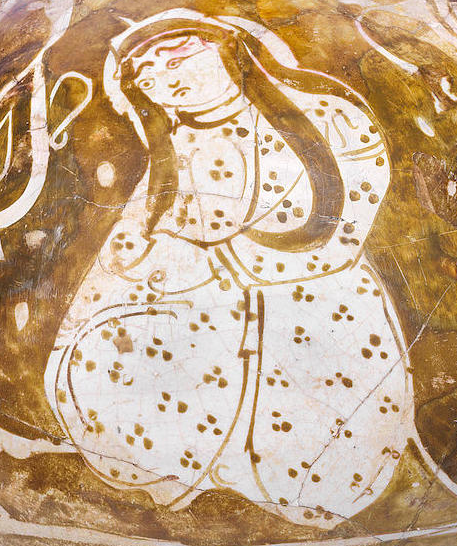
    An elegant feminine figure on Bonhams Kashan lustre pottery bottle, late 12th c., lot 63.

    Sotheby’s had a larger catalogue of 321 lots, of which 173 were sold for £3.656.000, a 33% decrease compared to the almost £5.5 millions made last October. Only a handful of items went above six figures, the 12th/ 13th c. Nasrid pyxis reaching £519.000. I was personally not convinced by the very early date given by Sotheby’s with the support Julian Raby, director of the Freer| Sackler Gallery in the Smithsonian, just because most of the known pieces of this production are attributed to the 15th century. The wood was dated with radiocarbon C-14 between 970 and 1032 with 95% confidence, but I am always a bit dubious when it comes to C-14 tests. Indeed, wood, like stone, can be reused generations later if preserved in the right conditions, and if it is a known fact for architecture (never date a building by its beams!), it can also be true for small items made of several pieces of wood joint together. That being said, 12th or 15th century, this pyxis is in remarkable conditions and its decor particularly rich.

    A rare Almohad or Nasrid Pyxis, Spain, maybe 12th/13th c., Sotheby’s lot 87.

    The second star item of Sotheby’s auction was a Diwan of Hafiz copied by the calligraph Shaykh Mahmud Pir Budaqi in 867/ 1462 and dedicated to the library of the prince and keen collector Pir Budaq (d. 1466). This manuscript is of great significance for the history of Islamic arts so the selling price, £375.000, didn’t really come as a surprise. The narcissus, previously discussed on this blog, went for £10.000.

    Sotheby’s also presented three Abbasid potteries, two of which were sold within their range, and one Samanid dish unsold. Like Kashan ceramics from the 12th and 13th centuries. Abbasi Iraqi pieces from the 9th/ 10th c. and Samanid Central Asian from the 10th c. represent a gamble, as well as gold dinars and silver dirhams, such the 18 lots presented by Bonhams on the 11th June. Their second biggest lot was an Umayyad gold dinar from the reign of the caliph ‘Abd al-Malik, fifth caliph of the dynasty, (685-705) dated 77/ 696-97. I personally love numismatic, though it is one of the most driest fields of study, for coins truly constitute prints of history. This one is particularly significant, having been minted less than 10 years after the foundation of the Dome of the Rock in Jerusalem. Unfortunately, the estimation £100.000-150.000 was too high for collectors, and overall only six of the eighteen lots of coins were sold.

    Bonhams sold 100 of the 247 lots presented, for a total of £1,368,681.25, a small 4.42% decrease compared to last October. As previously, the auction house focused on Indian and Sikh arts, an orientation demonstrated by their main lot, a gem-set gold forehead pendant (chand-tikka) from the collection of Maharani Jindan Kaur (1817-63), wife of Maharajah Ranjit Singh (1780-1839). What a lady she was! The short biography given by Bonhams gives a glimpse into the complexity of her life and the immense strength she held.6 The forehead from her collection, quite simple but refined, and of historical importance, was sold £187.562.

    It has been particularly interesting to follow these spring/ summer auctions, whether moved online or postponed. In both cases, collectors have responded well to the changes, though Sotheby’s results were lower than expected. We can hope that autumn auctions will go ahead without too much trouble, but so far 2020 has been full of (really bad) surprises. In the meantime, stay safe and please wear a mask in public!

    Nur al-din ‘Abd al-Rahman Jami, Tuhfat al-ahrar, Iran, probably Tabriz, 947/ 1540-41 (detail), Sotheby’s lot 29, sold £47.500
    1. For a presentation of the auctions, see my article for lot-art.com.
    2. Edit June 2021: The catalogue entry for this Qur’an has been removed from Christie’s website.
    3. Term coined by Dr. Stephennie Mulder on Twitter.
    4. You can read the full text here. You can also read my article on recent illegal looting in Syria and the impact on the market here.
    5. Named after the city of Kashan in Iran, located south of Tehran, in which a very large centre of production was particularly active during the Seldjuk dynasty rule, roughly 11th- 12th centuries. It continued to be very active until the end of the Safavid dynasty rule in the 18th century.
    6. You can also go read this article on The Guardian about her.