Tag: islamic arts

  • Islamic Week Spring 2022: A Broken Balance? (blog)

    Islamic Week Spring 2022: A Broken Balance? (blog)

    This spring, London Islamic Week will be focused on four auctions: Bonhams opens on the 29th March with a catalogue of 248 lots; the 30th March, Sotheby’s presents a catalogue of 169 lots; Christie’s on the 31st March offers 209 lots; Rosebery’s closes the week on the 1st April with a large catalogue of 456 lots including 104 antiquities. To learn more about Rosebery’s auction, you can listen to the ART Informant podcast episode with Alice Bailey, Head of the Islamic and Indian Arts department.

    Chiswick will hold their Spring auction later in April, while Dreawatts Islamic department is on hold since the expert left.

    I hesitated a while to write this short article, as I was unsure how to approach it. However, it seems interesting to take a look at the current status of London art market and try to make sense of it.
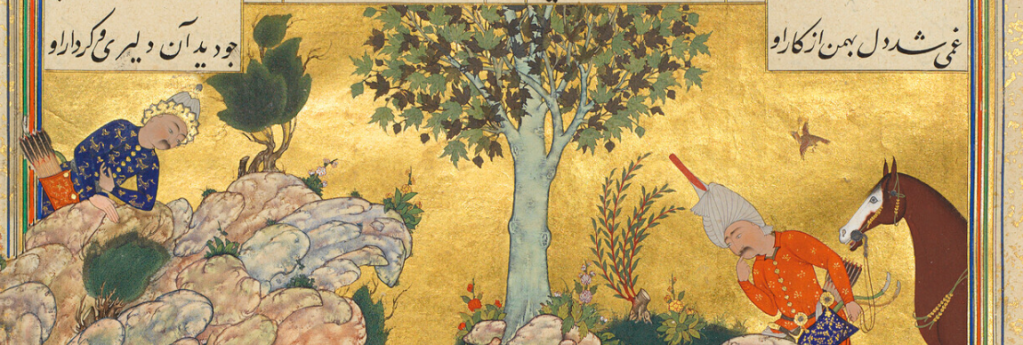
    “Rustam kicking away the boulder pushed by Bahman”, Shah Tahmasp’s Shahnama, fol. 451 (detail). Christie’s, 31.03.22, £2,5,000,000-4,000,000

    The highlight of the show is indubitably the page from Shah Tahmap’s Shahnama, offered by Christie’s for £2,5 to 4 millions. The valuation is justified given the fact that the last page from the same manuscript sold in public auction went for more than £8 millions.1 This copy of the Shahnama, the book of kings, was started for Shah Isma’il, first king of the Safavid dynasty in Persia (1501-1722), and was finished by his successor Shah Tahmasp. The paintings are the apotheosis of Persian painting for their refinement, iconography, technique… In short, seeing one of the manuscript’s pages is always an event, and I am particularly excited for it. Not many will be able to bid on the lot and I would not be surprised if it ended in Qatar or the U.A.E. Beside the beauty of the page, we can also applaud the neatly documented provenance.

    For the specialists and aficionados of Persian carpet – which I am not, so I’ll keep this brief – Christie’s is offering a so-called Polonaise carpet for £1 million, which should also do quite well, as carpets seem to be of stable value.

    Battle of Pollilur (detail), Sotheby’s 30.03.22, lot 70, £500,000-800,000

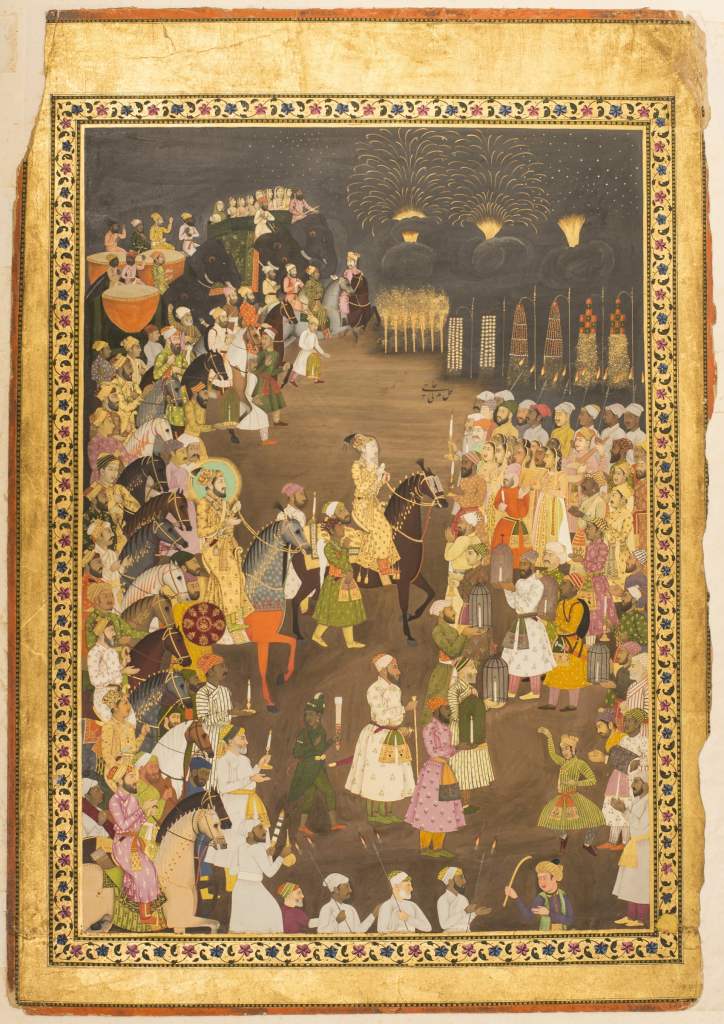
    These are the only two items over the million. Sotheby’s biggest lot is a massive painting from early 19th century India, depicting the battle of Pollilur, which opposed Mysore armies led by Haidar Ali and the British troops of the East India Company. The whole composition is 978.5 by 219 cm and was most likely intended as an advanced preparative study for a mural. Offered at £500,000 to 800,000, the sale constitutes a peak for later Indian painting other than Company School2, and is definitely on trend with the current interest of buyers for 17th to 19th century Indian painting.

    The huge gap between Christie’s and Sotheby’s create an imbalance echoed in the entire catalogue. The important size reduction of auction catalogues, almost automatically triggers an increase of prices, but some in Sotheby’s catalogue are very difficult to justify. A 13th century silver-inlaid qalamdan is offered for £200,000-300,000. The state of preservation is nice, and some silver incrustations have been restored, but the box isn’t signed nor dedicated, while the shape or decor are not particularly rare, so I fail to understand the valuation rationale. More debatable is the so-called Abbasid rock-crystal bowl, valued at £100,000-150,000. In a nutshell, I do not think this piece is Abbasid given the fact that all comparison pieces are either older or unjustifiably attributed to the Abbasid dynasty. The shape and decor of the bowl are a lot closer to late Sassanian dynasty productions than 9th century Basra, which leave me to question the valuation even further, given the fact that Sassanian pieces rarely sell well.
    Some other prices are simply bananas (this is the technical terminology). How is a 16th century Safavid Qur’an with 19th century additions and lacquer binding given at £50,000-80,000? Same question with a non dated and unsigned 19th century Qajar copy of Sa’adi’s Kulliyat valued at £30,000-50,000. In comparison, Christie’s presents a similar but slightly bigger copy of the same text, with signed and dated illuminations and calligraphy, but valued at £5,000-7,000.

    I am extremely curious to see if this artificial price inflation will convince buyers, or if they will give more attention to the less expensive but still quite interesting pieces that Sotheby’s is offering, such as a rare miniature Qur’an from Sultanate India (pre-Mughal), complete but in the wrong order, valued £10,000-15,000; the Indian Qur’an on green paper dated 1311/1893-4, valued £20,000-30,000, or the Abbasid dish with Kufic inscriptions, offered £20,000-30,000 but with no published provenance.
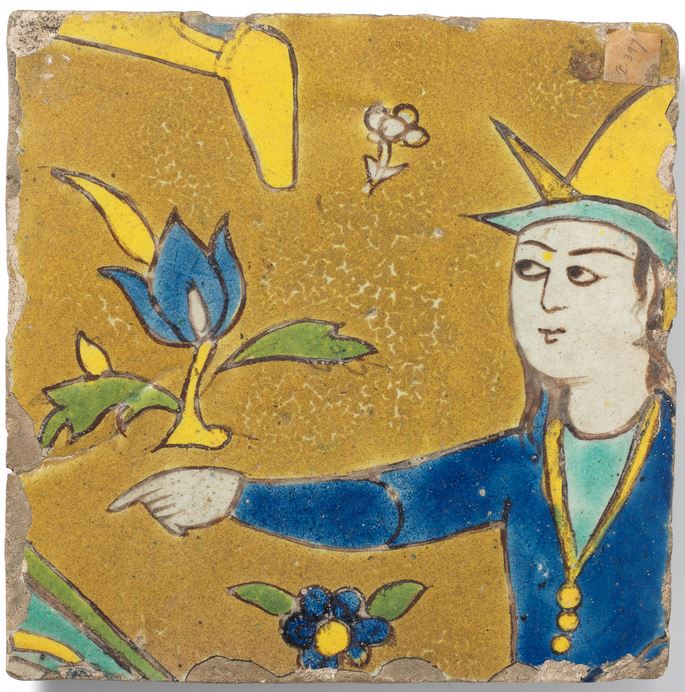
    Safavid tile, Bonhams 29.30.22, lot 75, £2,000-3,000

    While late Indian paintings are getting some well deserved attention at Sotheby’s, Bonhams seems to be swimming against the current by focusing more than usual on Persian art, especially Medieval ceramics. Their top three lots are from Iran, starting with a silver-inlaid 13th century candlestick offered at £150,000-200,000. The second lot raises the same questions of dating and attribution as Sotheby’s so-called Abbasid rock crystal bowl discussed earlier. The beautiful bronze horse and rider valued £100,000-150,000 is given “early Islamic, Persia 7th/8th centuries”, which could be a possibility, apart from the fact that all comparisons given are either Sassanian, pre-Islamic, or Seljuk, 13th century. This doesn’t take from the inherent aesthetic quality of the piece, but Bonhams also has an annoying tendency to leave out provenance from their catalogue, which is risky with this type of already problematic pieces. The market will decide.
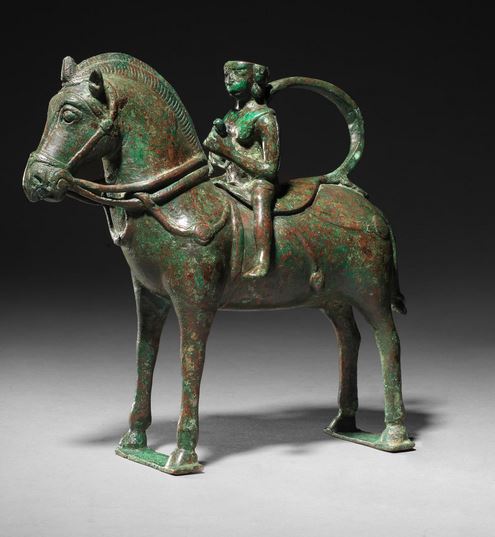
    Bronze horse and rider, Bonhams, 29.03.22 lot 18, £120,000-150,000

    That being said, it wouldn’t be a Bonhams auction without late Indian art, especially Sikh, that plays in a very specific demographic and have been doing well in previous sales. A particularly interesting lot is the album of 60 paintings depicting Sikh rulers, monuments and people, most likely produced in Lahore in the 1840’s. The patron of this volume is not known (probably a British official given the English annotations on some pages), but its preservation state is quite rare and valuable.
    The main item of this section is a lovely emerald and diamond-set gold pendant from the collection of Maharani Jindan Kaur (1817-63), wife of Maharajah Ranjit Singh (1780-1839), valued £60,000-80,000. Here lies the strength of Bonhams, its capacity to source exciting pieces with clear historical background and clear provenance.

    An imperial Mughal spinel, Rosebery’s 01.04.22, lot 126 – £60,000-80.000

    For the same estimate, Rosebery’s is offering an imperial Mughal spinel, inscribed with the title of Shah Jahan and dated 1[0]39AH (1629-30AD), as well as other prestigious Indian jewellery from the late 18th and 19th century. Here as well, Indian painting is in the spotlight, as well as Chinese Qur’an with a selection of 14 ajzaʼ from different manuscripts. Alice Bailey, head of department, will speak about her auction better than I can, so go check the latest ART Informant episode!

    After two years of pandemic, I am very excited for this Spring Islamic week, and look forward seeing all the incredible selections. If you’re in London between the 28th and the 30th March, get in touch and come say hi!

    A large annotated drawing showing the currents of energy in a horse, Rajasthan, 19th c. Bonhams 29.03.22, lot 235, £2,000-3,000
    1. Sotheby’s 31st May 2011.
    2. For reminder, the Great Indian Fruit Bat from the Impey Album sold last year at Sotheby’s for £644,200 incl. premium.
  • The Future of the Islamic Art Market could be Now

    The Future of the Islamic Art Market could be Now

    Click here to jump to the latest update (22nd Nov.)

    The challenges the world faces this year are of unprecedented magnitude, and with them, the fragile equilibrium of world economy has been thrown off balance completely. For museum and galleries, the blow is particularly hard, as most intitutions were already struggling keeping their doors open and their ceilling from leaking.

    Kashan turquoise-glazed pottery figurine of a camel and rider, 13thc. L.A. Mayer Museum auction, Sotheby’s

    To Deaccession or Not To

    In countries were main museums are public institutions, the gradual decrease of governement fundings have forced museums to look for funds elsewhere. In 2018-2019, the British Museum received £13.1 million grant-in-aid, the lowest since 2015, and particularly significant when put next to the year total expanditure, £96.2 million. This translated, among others, by an acquisition budget going from £1.1 million to £0.8.million. Last year, British Museum public revenues was £39.4 million, also the lowest since 2015, but we can expect 2020 to be particularly disastruous.1

    For galleries and private museums, the pandemic and inevitable economical crash that is predicted for 2021 are even more worrying, and it will take some time to recover from the loss of public revenues. Around the world, cultural institutions and associations are forced to look inside for solutions. In April, the American Association of Art Museum Directors (AAMD) passed a series of resolutions to relax the rules of deaccessinioning restricted funds:

    The resolutions state that AAMD will refrain from censuring or sanctioning any museum—or censuring, suspending or expelling any museum director—that decides to use restricted endowment funds, trusts, or donations for general operating expenses. The resolution also addresses how a museum might use the proceeds from deaccessioned art to pay for expenses associated with the direct care of collections.2

    Could the MET sell this Qur’an folio, Iran 12th c. (1996.238.2)

    This means that between April 2020 and April 2022, American museums can sell parts of their collections to replace lost income and finance their operations.
    In the UK, the powerful Royal Academy of Arts (RA) has been letting a similar idea float, though the debate has been particularly focused on the Taddei Tondo, a marble sculpture of Michelangelo, already threatened of sale in the late 70’s.3 No decision has been made yet regarding the tondo future, and it is unlikely that the piece will end up in an auction, but the financial crisis of cultural institutions, especially the smaller ones, might force hands.

    Selling or exchanging pieces of collections to fund new acquisitions is not a new practice, American museums have been doing it for years in a controlled setting4, but the new guideline from the AAMD extends the justification for selling art pieces towards operational means.

    The L.A. Mayer Museum auction presented by Sotheby’s

    What it means for Islamic Arts

    So far, Islamic arts had not been publicly impacted by deaccessioning, though the practice is common behind closed doors and emphasised by controversial sales such as the Timurid Qur’an on Chinese paper witht a more than opaque provenance, sold in June 2020.
    However, in a market working in a quickly closing loop and given the current context, it was only a matter of time before parts of an Islamic arts collection be presented in a historical auction.
    The time should have been on the 27th October 2020 and the auction at Sotheby’s of 190 lots from the collections of the L.A. Mayer Museum of Islamic Arts in Jerusalem. The aim of the auction has been clearly stated by the museum director Nadim Sheiban:

    We were afraid we could lose the museum and be forced to close the doors. […] If we didn’t act now, we would have to shut down in five to seven years. We decided to act and not wait for the collapse of the museum.5

    The star of the auction: an Aq-qoyunlu silver-inlaid helmet, 15th c.,  £400.000-600.000

    The catalogue included lots from all over Islamic lands but none from Israel and Palestine, as the legislation regarding native artefacts leaving the country is particularly strict. The auction, planning to reach around £6 million, would have given financial security to the L.A. Mayer Museum for the years to come, but would also constitute a definite slippery slope for private museums of Islamic arts around the world.

    In an unexpected turn of events, the auction was postponed last minute on Monday night. While Sotheby’s website states that the delay is only until November, there is no guarantee the sale will ever occur, as criticisms came from the Israeli government officials and the public. The Hermann de Stern Foundation, that owns the L.A. Mayer Museum collection, still seems keen on moving forward with the sale but might struggle reaching an agreement:

    The foundation’s management hopes that the postponement will make it possible to reach agreements that will also be acceptable to the Culture Ministry in the coming weeks.6

    What now?

    If the sale does go ahead, it will set a new precedent for the market of Islamic arts, as it will open the door for other museums to sell parts of their collections, either to acquire new items or just to keep the light on.

    We can also question the motives for selling Islamic artefacts. The conflict between Israel and Palestine and the tensions in the Holy City between Jewish and Muslims come to mind in the case of the L.A. Mayer Museum auction and make the intervention of the pan-Israeli governement more surprising, but Islamic arts are political and ideological tools in more than one region. The Indian governement of Kovind and Modi might use this opportunity to accentuate their efforts to rewrite (not to say errase) India’s Muslim history, but even in Europe where far-right anti-Mulims parties are gaining more influence every day, progressiveley emptying Islamic arts collections could be a way to deny a shared past.


    This bleak picture highlights the fact that selling Islamic arts bears a lot of weight, and publicly deaccessionning collections is not anodyne. Auction arts should use caution when selling museum pieces, but in this less than certain economical context, caution might already be gone in the wind. It will be interesting to see if the L.A. Mayer Museum auction goes ahead in November, and what the near future holds for Islamic arts.

    Update: Auction delayed again

    On Wednesday 19th December, the High Court of Justice has suspended the sale for two additional weeks, time for the L.A. Museum, Sotheby’s and the Culture Ministry to negotiate over holding a more limited auction with less high profile items, though these remain to be defined.7

    A painting that could become controversial? Wedding of Dara Shokuh, Awadh, c. 1740, National Museum, New Dehli (58.58/38)
    1. British Museum governance.
    2. AAMD Board of Trustees Approves Resolution to Provide Additional Financial Flexibility to Art Museums During Pandemic Crisis 15 April 2020.
    3. Royal Academy of Arts considers selling Michelangelo marble to plug financial hole—and not for the first time 25 Sept 2020.
    4. The Permanent Collection May Not Be So Permanent, The New York Times, 26 Jan 2011. The Indiana Museum of Art lists all the deaccessioned pieces since the 1930’s.
    5. Jerusalem’s Islamic art museum says it has to auction off part of its collection, The Times of Israel, 24 Sept 2020.
    6. Auction for Jerusalem museum’s treasures postponed at last minute, The Guardian, 26 Oct. 2020.
    7. High Court Delays Controversial Sale of Rare Islamic Artifacts by Israeli Museum, Haaretz, 19th Nov. 2020.
  • The Mystery of the Narcissus

    The Mystery of the Narcissus

    On the 10th June 2020, Sotheby’s will be presenting a painting of a narcissus flower signed by the 18th century Persian painting Muhammad Masih. The painting is not dated but the signature seems genuine, written in gold on each side of the base.

    Golden signature of Muhammad Masih, just below a standard form of dedication.

    To say that the painting rings a bell is an understatement. Indeed, two other identical versions are currently known. One is mounted in the Hindo-Irani album, also called Nasir al-Din Shah album, currently scattered between the Golestan Palace in Tehran, the Chester Beatty Library for the most part, and other collections.1 The page bears what I call an “attributive signature” to the famous Indian painter Mansur, who worked in Mughal India for emperors Akbar (1556-1605) and Jahangir (1605-1627).

    The second page is mounted in the St-Petersburg album, previously called Leningrad album, kept for the most part in Russia, with only a few other folios scattered in various public and private collections (including a never seen before page sold last Winter in Paris). The painting is dated 1105 H./ 1693-94 and signed by the Persian painter Muhammad Zaman.

    The Painters

    Nadir al-‘asr Mansur worked in India, first in Akbar Ketabkhana (library), signing paintings in the 1590’s, and at least until 1621 when he was in Kashmir with the emperor Jahangir who wrote:

    The flowers seen in the summer pastures of Kashmir are beyond enumeration. Thos drawn by Master Nadir ul-‘asr Mansur the painter number more than a hundred.2

    Mansur is particularly reknown for his depictions of animals and flowers, but only two flower paintings indisputably bear his signature, a Tulip today in Aligarh University Museum and a copy of an European engraving in the Golestan palace in Tehran. This particular painting of a narcissus is problematic. Though the wording is similar to others genuine signatures, it is not located on the painting but on the below border, which was added later, when the page was mounted in the album. This is a common feature with Mughal album painting but one that is often ignored by specialists.

    The style of the painting differs slightly from Aligarh Tulip and the Golestan “Seven Flowers”, but we can put the variations on the natural evolution of the painter style, as well on the fact that this painting is most probably the copy of an European engraving (more on this below).3

    Muhammad Zaman worked in Safavid Iran between 1086 H./1675 or earlier and 1106 H./ 1695. The life of Muhammad Zaman has caused a lot of controversy among specialists, some stating he travelled to India, others to Europe where he converted to Christianism (which has been proven untrue).
    He is particularly known for his copies of European engravings, and according to his dated works, he seems to have favored flower paintings in the late stages of his career. This particular narcissus, signed and dated, was probably offered to the king Shah Soliman 1st (1666-1694). The style is genuine and corresponds to other flower paintings signed by the artist, mounted in the St-Petersburg album or elsewhere.

    Muhammad Masih career is even less clear than the other two artists, about whom a lot still remain unknown. Some state that Muhammad Masih was an Indian painter emigrated in Iran during the 18th century, but this has never been proven.4His work is not particularly well studied, but he seemed to have worked at the end of the 17th century and during the 18th century, as demonstrated by several paintings and drawings scattered in various collection, including a small flower dated 1123 H./ 1711-12, mounted in an album kept in the Muze-ye Honarhā-ye Moʻāser in Ispahan.

    Flower signed Muhammad Masih, 1123 H./ 1712

    Origin of the Design

    Muhammad Masih painting was initially sold at Sotheby’s Paris in 2015. I was busy writting my doctoral dissertation at the time and I completely missed it. Having three pages with an exact same design is however unprecedented.

    At the time, I was not able to identify the exact model of the two paintings I knew, and despite a follow-up research, I still come empty-handed. However, there is no doubt that the orginal design was made in Europe, most likely during the 16th century, for a printed herbarium, or most likely a florilegium, or “book of flowers”, particularly en vogue during the 17th century.

    Contrary to religious and mythological engravings that are pretty well documented, it is unclear how did herbaria and florilegia arrive in India and in Iran, but we know that some European travellers and artists had some books of flowers in their belongings. For this reason, we find many copies of Jan Theodor van de Bry, Florilegium renovatum et auctum, published in Frankfurt in 1641, Pierre Vallet Le Jardin du Roy published in Paris in 1606, Francois L’Anglois Livre de fleurs, Paris, 1620, Adrian Collaert Florilegium, published in 1587, and several others.

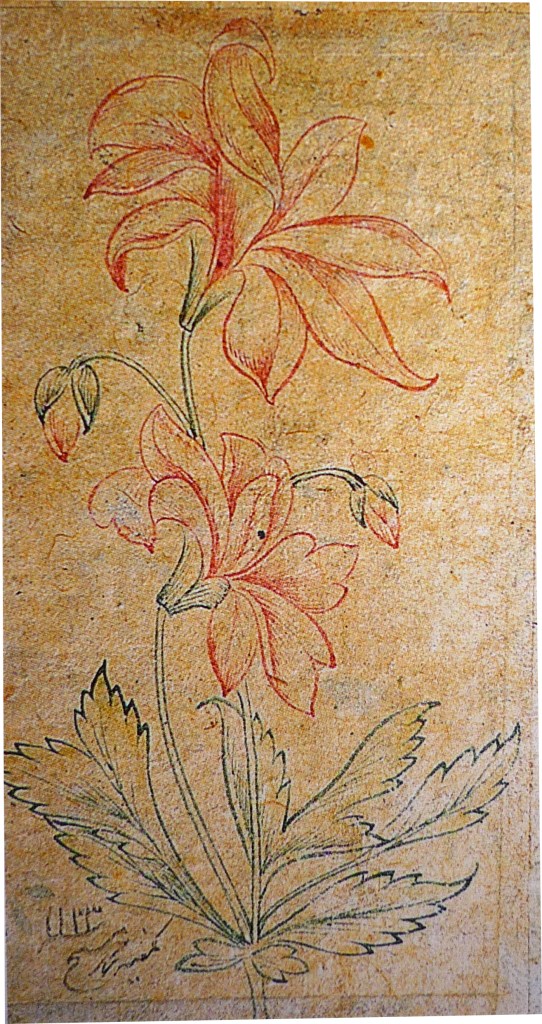
    On the left, Indian painting, 18th c., Clive album (VAM IS.48:1/A-1956). On the right, the original by Pierre Vallet, Le jardin du Roy, Paris, 1606. Species depicted: Lilium Martagon

    Making a copy in the 17th century

    Regardless how flower books arrived in the hands of painters, tthis exact model, and many others, were used to create either exact copies, such as our three identical pages, or brand new compositions using several sources.

    To make a copy is quite easy. First the artist used a niddle to make small perforations along the contours of the original design. Then, the model was put face against a blank sheet of paper. The painter then put a bit of charcoal powder on the back of the original page, which went through the holes onto the blank page. The “master copy” could be used several times, as demonstrated by the existence of the three similar narcissus.

    Pounced drawing of a bird. Iran, 17th c. (British Museum, 1988-4-23.26, f. 15b)

    Was Mansur the first one to paint this narcissus? This would explain why Muhammad Zaman chose the subject, as the Indian painter was most probably reknown outside of the Mughal court. Was Muhammad Zaman even aware of the first painting? Probably, though it is unsure how (the first painting probably arrived in Iran later, after Delhi sack by the army of Nader Shah Afshar in 1747).
    The depiction of narcissus is not uncommon in Iran in the 17th century, as the flower takes on several different meaning in poetry and litterature, but the facination with this particular design is more complex than it looks, and a lot more remains to discover.

    1. For the full list of folios, see E. Wright, Muraqqa, 2008, p. 141. The exact number of pages depend on the author. Wright counts 126, Atabai counts 131. B. Atabai, Fihrist-i Muraqqa’at, 1974, p. 178.
    2. Translation from The Jahangirnama: Memoirs of Jahangir, Emperor of India, ed. W.M. Thackston, 1999, p. 333.
    3. Asok Kumar Das openly challenges this attribution in Wonders of Nature: Ustad Mansur at the Mughal Court, 2012, p. 148-149. I remain slightly more nuanced than the author.
    4. This is the initial assertion of Mohammad ‘Ali Karimzade Tabrizi in Ahval va asar-e Naqqashan-e Qadim-e Iran, 1985, vol. 3, pp. 183-4, recounted by Melikian Chirvani in Le Chant du Monde, 2007, p. 408.