Tag: Museum

  • The Splendours of Uzbekistan’s Oases in the Louvre (blog)

    The Splendours of Uzbekistan’s Oases in the Louvre (blog)

    Being in Paris for two weeks before Christmas, I had the opportunity to see the latest Louvre exhibition dedicated to a region of the Islamic world, Uzbekistan. Friends previously gave me feedback regarding the exhibit, but I went with an open mind, and left with conflicting thoughts.
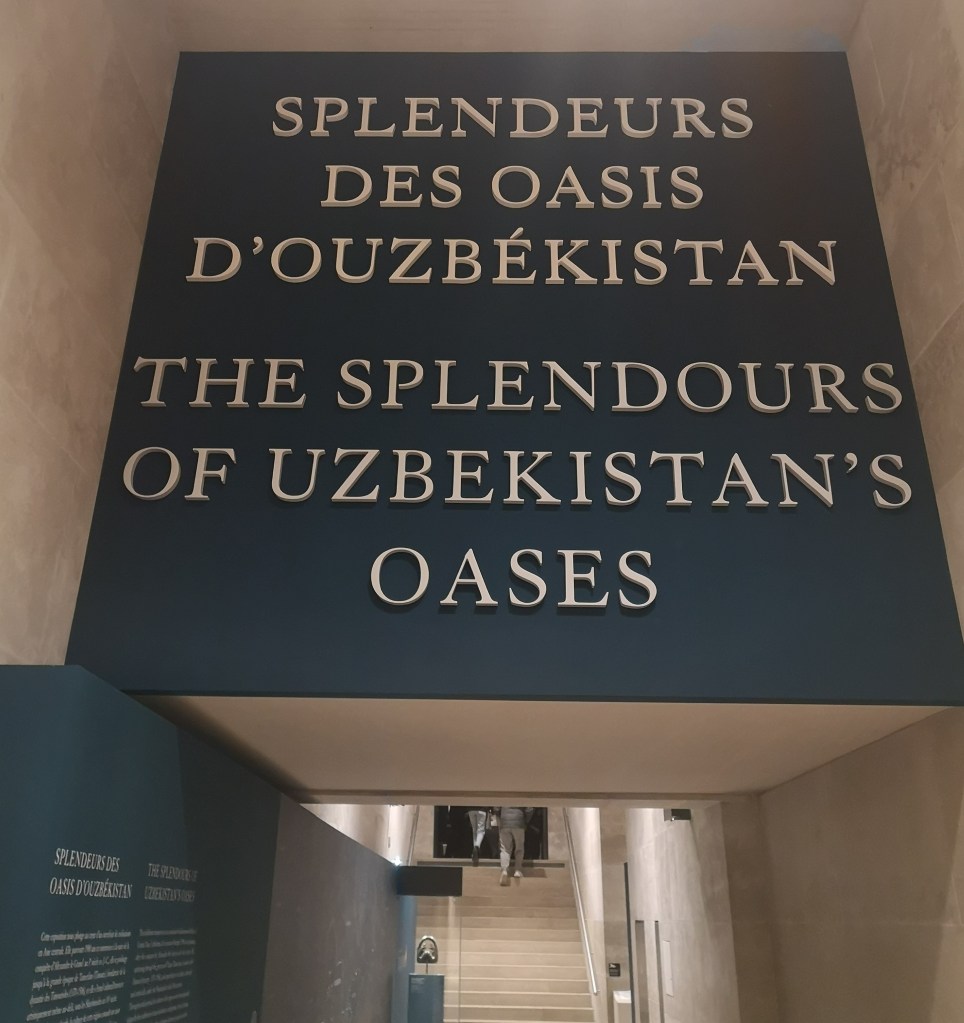
    Entrance, first text panel, object and stairs

    The exhibition is installed in a small space of the Richelieu aisle, after a flight of stairs that create a dramatic entrance. The first text panel is placed at the bottom of the stairs and gives the chronological limits of the exhibit, as well as the ambition of the project: 3rd c. BC- 16th c. AD, but the first object displayed is dated from the 3rd millennium BC. The whole exhibition is set in two rooms, a small first and a larger second, separated by a narrow. The installation is quite minimalistic, with a sober teal blue scheme colour and barely visible geometrical patterns repeating on the walls (This is beside the point, but every time I see geometrical patterns in connexion to Islamic arts, the wise words of Miranda Priestly come to mind: “Flowers, for spring? Groundbreaking.”1). There are a few explicative panels on the walls, which I’m not too mad about, but creates a bigger issue I talk about below, and the exhibition includes a small screen and a massive projection in the second room.

    I realise, writing this blog, that I took very few pictures during my visit, as I wanted to “take it in” and not spend the entire time stuck to my phone. I’ll do my best to describe from memory, but you can also buy the exhibition catalogue for all the reproductions.

    View of the entrance from the top of the stairs

    Splendours of Uzbekistan from Uzbekistan

    “Object with harpy”, Termez, 11th -12th c., localisation and accession unknown

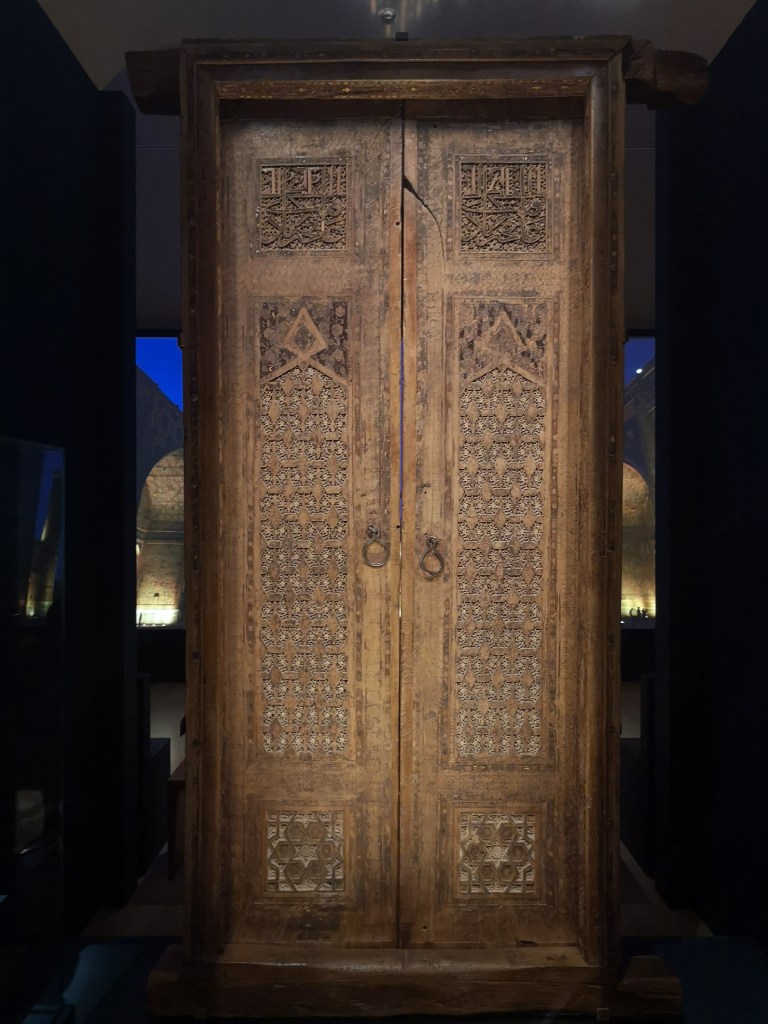
    The exhibition biggest quality is the display of artworks from Uzbek collections, especially Tashkent and Samarkand. I don’t recall ever seeing these pieces in a French exhibition before, and I probably won’t have the opportunity to go to Uzbekistan right away, so it is a real chance to see these artworks displayed. The choice of the objects is thoughtful, some having been picked for their historical and /or emotional values, such as the original door of the Gur-i Mir in Samarkand, the mausoleum where lies the conqueror Timur. Other objects, also from Uzbek institutions, are simply stunning, such as what appears to be the plate of a larger bowl, in an alloy of copper casted, showing an inscription and a “harpy”. This piece really caught my eye.

    The exhibition is very ambitious, aiming at covering 14 centuries in two rooms, and I enjoyed the diversity of chronological eras. The route starts with impressive sculptures mixing Buddhist and Chinese influences, followed by the virtual reconstitution of Bukhara oasis put next to the Varakhsha fresco to highlight its original setting. Other portions of the fresco come on the screen following the reconstitution, as well as a third portion on the wall opposite the screen. This put this gorgeous fresco back in context in the best way possible. The chronology then moves forward to the first centuries of Islam, best exemplified by two folio of the “Katta Langar” Qur’an, a masterpiece amongst the earliest known copy of the text. Other pieces are more expected, such as Samanid dishes from 10th century Samarkand, but here again the selection is very qualitative. A bowl decorated with an incredibly elegant inscriptions that reads “Renunciation of desire is the noblest of riches” is particularly striking.
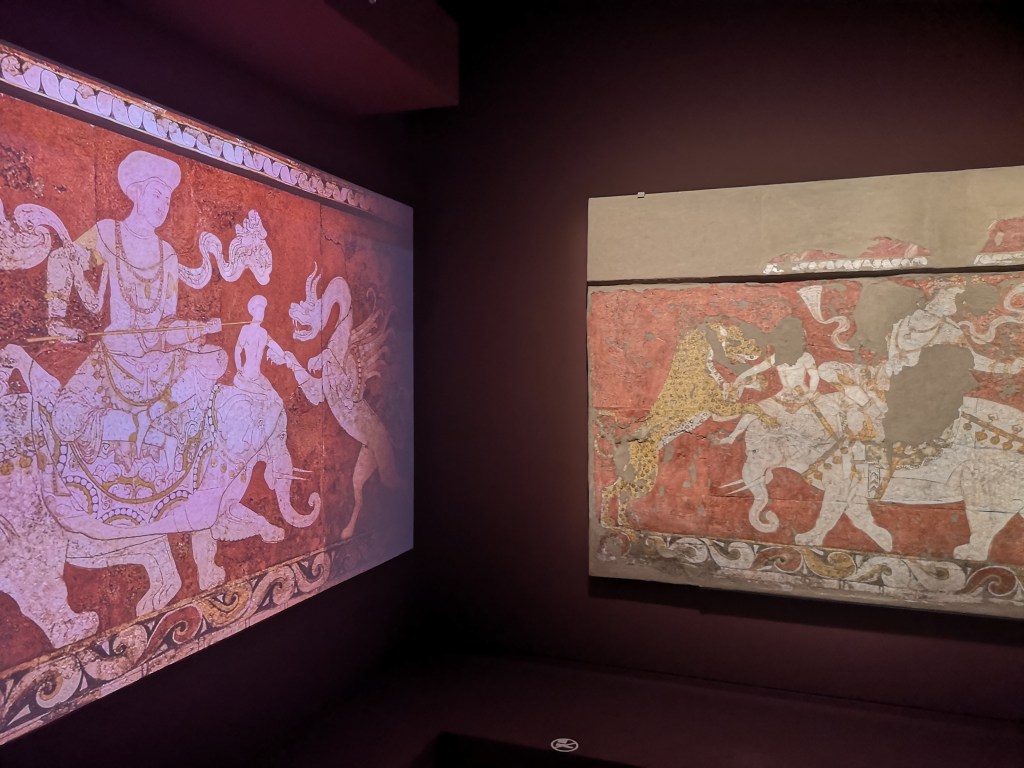
    Varakhsha fresco (right) and virtual reconstitution (left)

    The second room offers a nice selection of medieval textiles and metals, as well as illustrated manuscripts from 16th century Bukhara, most from the Bibliotheque nationale de France in Paris. The exhibition closes with a large screen showing videos of the Shah-e zende in Samarkand, the necropolis of Timur and his descendants. Overall, the viewer will leave with the impression to have spent a nice hour or so amongst rarely seen treasures.

    A final touch, the informed visitor can then go to the Islamic art department to south portion of the extraordinary “Paintings of the Ambassadors”, a fresco from the middle of the 7th century found in the ruins of Afrasiyab (north of Samarkand), landed by the Republic of Uzbekistan to the Louvre. I assume the large section couldn’t fit in the exhibition space with the required distance, but the signalling could have insisted more on its location, I only saw one sign at the beginning of the exhibition and nothing after.
    I should have bought the catalogue

    However, there were a few problems with the exhibition that made me twitch a little. The main one is the impression that the display of objects is only one half of a whole. I will preface by saying that I went through the exhibition catalogue very rapidly to check who participated in it, and no much more. This was a mistake I quickly regretted after leaving the room. Though I enjoyed the diversity of the exhibition, I left with the feeling that I was missing some crucial information regarding artworks I knew less about, as well as the main key to understand the intention and the coherence of the exhibition. Indeed, what is the link between the Paintings of the Ambassador and the door of the Gur-i Mir, beside their geographical location? Is there even a connexion? That answer might be in the exhibition catalogue, for which I would have to pay an additional €39, while I already paid €17 to see the exhibition. Some will say that all is not about money, but in this economy, I disagree. I am not saying exhibitions should be free, because Museum personnel need to eat, but an exhibition should be contained within itself and not depend on additional material. I understand that the reduced exhibition space allocated to the exhibit forced to make choices, but maybe more explicative panels, or a clearer route would have helped.

    Two folios from the Katta Langar Qur’an, 1/2 half 8th c. (Tashkent, Uzbekistan Islamic Council, acc. 179)

    An inconsistent museography

    I’m going to try not to be too picky here, but I must admit I was a little disappointed by some very avoidable mistakes. This is the Louvre, one of the leading museums in the world, so rigour should be key. Some labels have mistakes in their description, some are missing accession numbers and localisation (such as the harpy mentioned above), but one of the main issue was the absence of numbered references between the labels and the objects. Some displays hold several objects, but their labels are grouped on the side, so the viewer has to play “who’s who” to retrieve the reference. The displays are very minimalist and sleek, but it is detrimental to the readability.

    Cordon separating the viewer from the display

    As well, someone needs to explain why there is a security cordon 1 meter from the glassed displays in the first room; are people in the Louvre afraid of finger marks? This makes the objects barely visible and the labels unreadable.

    The exhibition offers information on historical figures such as Marco Polo and al-Biruni, but they are difficult to see, being placed on the opposite wall or pillar of the display. This comes from the main issue of the installation: the division of spaces and the overall route. The two rooms and the corridor that compose the spaces are each divided in two halves, each half corresponding to a chronological period. It is particularly clear in the second room, where the display at the immediate left of the entrance is dedicated to the 11th to 13th centuries, and the display at the immediate right focuses on the 15th-16th centuries. In front of the entrance is placed the 15th c. door of the Gur-i Mir. Entering the room, the viewer would need to ignore the door, go left and to the back of the room, then cross in front of the giant screen toward the right where 15th-16th c. manuscripts are displayed, walk their way back toward the entry, then check the door in the middle and finish by the 15th-16th c. display at the right of the entrance, turn around and leave. This is a bit complicated but doable, except there is no indication that this is the most logical route and none of the objects are numbered. Entering the room, I went immediately to the display on the right, then realised the exit was next to it so turned around and went to see the door, then turned around again to the display left of the entrance, it was overall confusing.

    Conclusion: Is it worth a visit?

    If you’re in Paris and planning to go to the Louvre, go see this exhibition but also do manage your expectations and maybe get ready to invest in the catalogue. The absence of objects from Russian collections is regrettable but understandable and independent of the Louvre’s will, and could have been better filled from more objects from the Louvre, but overall the artworks displayed are worth the visit, especially those coming from Uzbekistan.

    South wall Funeral procession led by King Varkhuman, in honour of his predecessor Shishpir. Afrasiyab, 648-651 AD (Afrasiyab Museum, Samarkand). (image from Wikipedia)
    1. From the film The Devil wears Prada.
  • The Future of the Islamic Art Market could be Now

    The Future of the Islamic Art Market could be Now

    Click here to jump to the latest update (22nd Nov.)

    The challenges the world faces this year are of unprecedented magnitude, and with them, the fragile equilibrium of world economy has been thrown off balance completely. For museum and galleries, the blow is particularly hard, as most intitutions were already struggling keeping their doors open and their ceilling from leaking.

    Kashan turquoise-glazed pottery figurine of a camel and rider, 13thc. L.A. Mayer Museum auction, Sotheby’s

    To Deaccession or Not To

    In countries were main museums are public institutions, the gradual decrease of governement fundings have forced museums to look for funds elsewhere. In 2018-2019, the British Museum received £13.1 million grant-in-aid, the lowest since 2015, and particularly significant when put next to the year total expanditure, £96.2 million. This translated, among others, by an acquisition budget going from £1.1 million to £0.8.million. Last year, British Museum public revenues was £39.4 million, also the lowest since 2015, but we can expect 2020 to be particularly disastruous.1

    For galleries and private museums, the pandemic and inevitable economical crash that is predicted for 2021 are even more worrying, and it will take some time to recover from the loss of public revenues. Around the world, cultural institutions and associations are forced to look inside for solutions. In April, the American Association of Art Museum Directors (AAMD) passed a series of resolutions to relax the rules of deaccessinioning restricted funds:

    The resolutions state that AAMD will refrain from censuring or sanctioning any museum—or censuring, suspending or expelling any museum director—that decides to use restricted endowment funds, trusts, or donations for general operating expenses. The resolution also addresses how a museum might use the proceeds from deaccessioned art to pay for expenses associated with the direct care of collections.2

    Could the MET sell this Qur’an folio, Iran 12th c. (1996.238.2)

    This means that between April 2020 and April 2022, American museums can sell parts of their collections to replace lost income and finance their operations.
    In the UK, the powerful Royal Academy of Arts (RA) has been letting a similar idea float, though the debate has been particularly focused on the Taddei Tondo, a marble sculpture of Michelangelo, already threatened of sale in the late 70’s.3 No decision has been made yet regarding the tondo future, and it is unlikely that the piece will end up in an auction, but the financial crisis of cultural institutions, especially the smaller ones, might force hands.

    Selling or exchanging pieces of collections to fund new acquisitions is not a new practice, American museums have been doing it for years in a controlled setting4, but the new guideline from the AAMD extends the justification for selling art pieces towards operational means.

    The L.A. Mayer Museum auction presented by Sotheby’s

    What it means for Islamic Arts

    So far, Islamic arts had not been publicly impacted by deaccessioning, though the practice is common behind closed doors and emphasised by controversial sales such as the Timurid Qur’an on Chinese paper witht a more than opaque provenance, sold in June 2020.
    However, in a market working in a quickly closing loop and given the current context, it was only a matter of time before parts of an Islamic arts collection be presented in a historical auction.
    The time should have been on the 27th October 2020 and the auction at Sotheby’s of 190 lots from the collections of the L.A. Mayer Museum of Islamic Arts in Jerusalem. The aim of the auction has been clearly stated by the museum director Nadim Sheiban:

    We were afraid we could lose the museum and be forced to close the doors. […] If we didn’t act now, we would have to shut down in five to seven years. We decided to act and not wait for the collapse of the museum.5

    The star of the auction: an Aq-qoyunlu silver-inlaid helmet, 15th c.,  £400.000-600.000

    The catalogue included lots from all over Islamic lands but none from Israel and Palestine, as the legislation regarding native artefacts leaving the country is particularly strict. The auction, planning to reach around £6 million, would have given financial security to the L.A. Mayer Museum for the years to come, but would also constitute a definite slippery slope for private museums of Islamic arts around the world.

    In an unexpected turn of events, the auction was postponed last minute on Monday night. While Sotheby’s website states that the delay is only until November, there is no guarantee the sale will ever occur, as criticisms came from the Israeli government officials and the public. The Hermann de Stern Foundation, that owns the L.A. Mayer Museum collection, still seems keen on moving forward with the sale but might struggle reaching an agreement:

    The foundation’s management hopes that the postponement will make it possible to reach agreements that will also be acceptable to the Culture Ministry in the coming weeks.6

    What now?

    If the sale does go ahead, it will set a new precedent for the market of Islamic arts, as it will open the door for other museums to sell parts of their collections, either to acquire new items or just to keep the light on.

    We can also question the motives for selling Islamic artefacts. The conflict between Israel and Palestine and the tensions in the Holy City between Jewish and Muslims come to mind in the case of the L.A. Mayer Museum auction and make the intervention of the pan-Israeli governement more surprising, but Islamic arts are political and ideological tools in more than one region. The Indian governement of Kovind and Modi might use this opportunity to accentuate their efforts to rewrite (not to say errase) India’s Muslim history, but even in Europe where far-right anti-Mulims parties are gaining more influence every day, progressiveley emptying Islamic arts collections could be a way to deny a shared past.


    This bleak picture highlights the fact that selling Islamic arts bears a lot of weight, and publicly deaccessionning collections is not anodyne. Auction arts should use caution when selling museum pieces, but in this less than certain economical context, caution might already be gone in the wind. It will be interesting to see if the L.A. Mayer Museum auction goes ahead in November, and what the near future holds for Islamic arts.

    Update: Auction delayed again

    On Wednesday 19th December, the High Court of Justice has suspended the sale for two additional weeks, time for the L.A. Museum, Sotheby’s and the Culture Ministry to negotiate over holding a more limited auction with less high profile items, though these remain to be defined.7

    A painting that could become controversial? Wedding of Dara Shokuh, Awadh, c. 1740, National Museum, New Dehli (58.58/38)
    1. British Museum governance.
    2. AAMD Board of Trustees Approves Resolution to Provide Additional Financial Flexibility to Art Museums During Pandemic Crisis 15 April 2020.
    3. Royal Academy of Arts considers selling Michelangelo marble to plug financial hole—and not for the first time 25 Sept 2020.
    4. The Permanent Collection May Not Be So Permanent, The New York Times, 26 Jan 2011. The Indiana Museum of Art lists all the deaccessioned pieces since the 1930’s.
    5. Jerusalem’s Islamic art museum says it has to auction off part of its collection, The Times of Israel, 24 Sept 2020.
    6. Auction for Jerusalem museum’s treasures postponed at last minute, The Guardian, 26 Oct. 2020.
    7. High Court Delays Controversial Sale of Rare Islamic Artifacts by Israeli Museum, Haaretz, 19th Nov. 2020.