Tag: paris

  • The Splendours of Uzbekistan’s Oases in the Louvre (blog)

    The Splendours of Uzbekistan’s Oases in the Louvre (blog)

    Being in Paris for two weeks before Christmas, I had the opportunity to see the latest Louvre exhibition dedicated to a region of the Islamic world, Uzbekistan. Friends previously gave me feedback regarding the exhibit, but I went with an open mind, and left with conflicting thoughts.
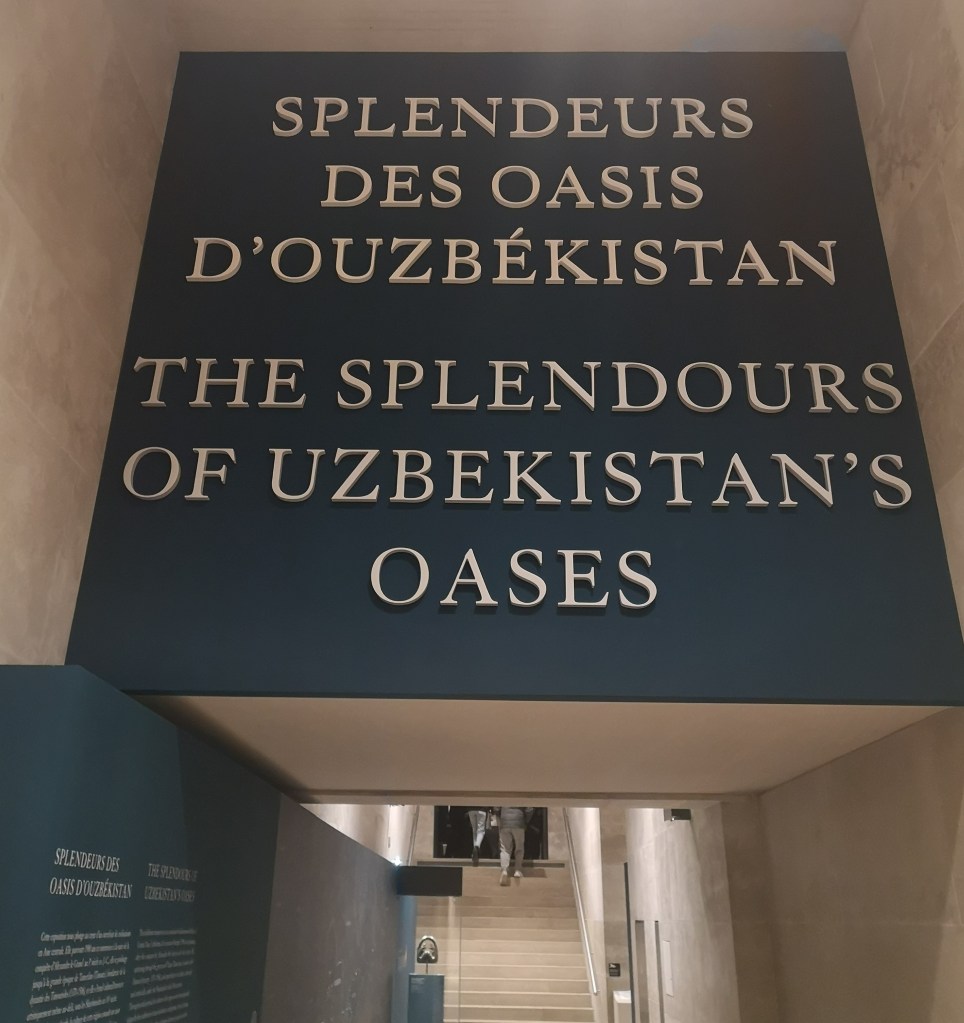
    Entrance, first text panel, object and stairs

    The exhibition is installed in a small space of the Richelieu aisle, after a flight of stairs that create a dramatic entrance. The first text panel is placed at the bottom of the stairs and gives the chronological limits of the exhibit, as well as the ambition of the project: 3rd c. BC- 16th c. AD, but the first object displayed is dated from the 3rd millennium BC. The whole exhibition is set in two rooms, a small first and a larger second, separated by a narrow. The installation is quite minimalistic, with a sober teal blue scheme colour and barely visible geometrical patterns repeating on the walls (This is beside the point, but every time I see geometrical patterns in connexion to Islamic arts, the wise words of Miranda Priestly come to mind: “Flowers, for spring? Groundbreaking.”1). There are a few explicative panels on the walls, which I’m not too mad about, but creates a bigger issue I talk about below, and the exhibition includes a small screen and a massive projection in the second room.

    I realise, writing this blog, that I took very few pictures during my visit, as I wanted to “take it in” and not spend the entire time stuck to my phone. I’ll do my best to describe from memory, but you can also buy the exhibition catalogue for all the reproductions.

    View of the entrance from the top of the stairs

    Splendours of Uzbekistan from Uzbekistan

    “Object with harpy”, Termez, 11th -12th c., localisation and accession unknown

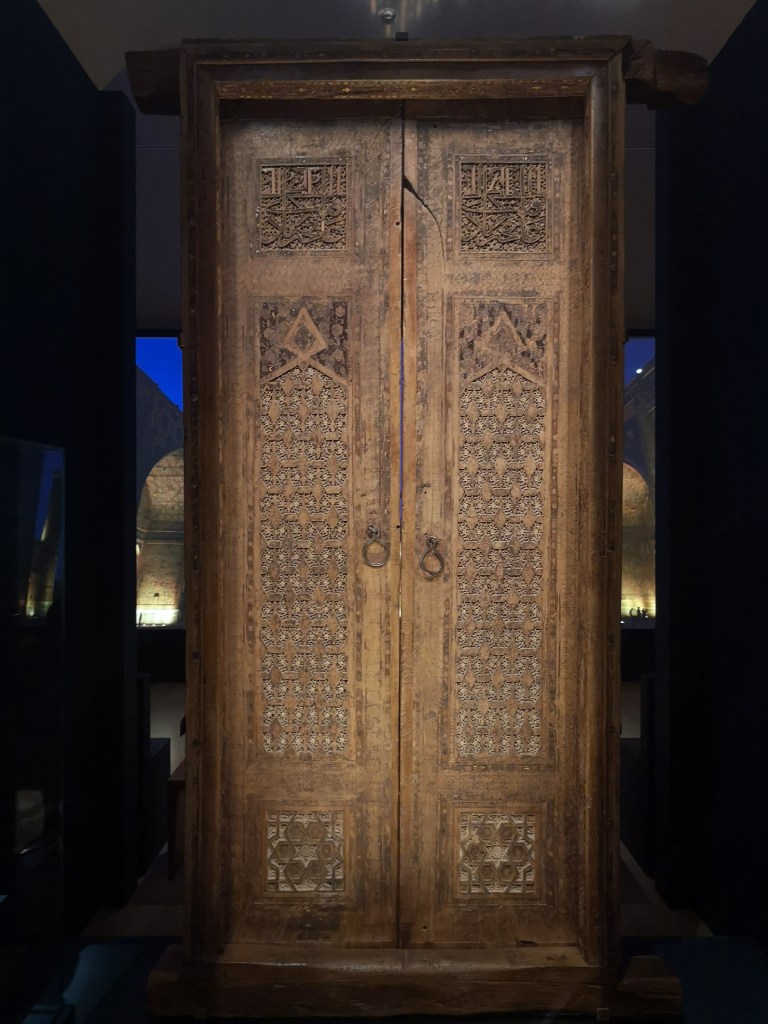
    The exhibition biggest quality is the display of artworks from Uzbek collections, especially Tashkent and Samarkand. I don’t recall ever seeing these pieces in a French exhibition before, and I probably won’t have the opportunity to go to Uzbekistan right away, so it is a real chance to see these artworks displayed. The choice of the objects is thoughtful, some having been picked for their historical and /or emotional values, such as the original door of the Gur-i Mir in Samarkand, the mausoleum where lies the conqueror Timur. Other objects, also from Uzbek institutions, are simply stunning, such as what appears to be the plate of a larger bowl, in an alloy of copper casted, showing an inscription and a “harpy”. This piece really caught my eye.

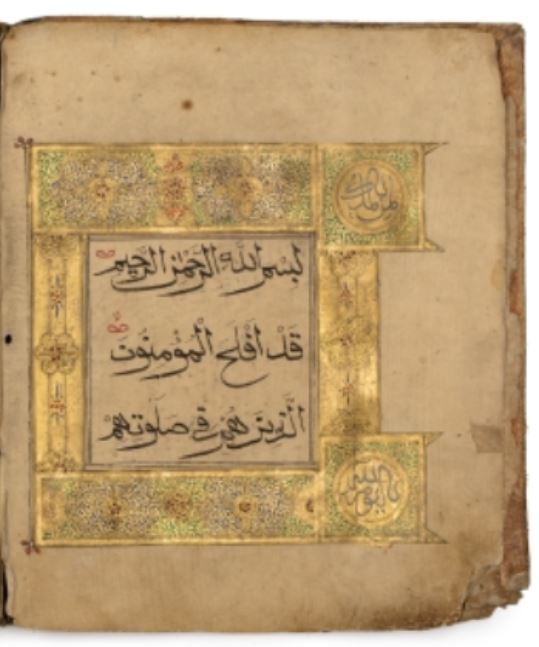
    The exhibition is very ambitious, aiming at covering 14 centuries in two rooms, and I enjoyed the diversity of chronological eras. The route starts with impressive sculptures mixing Buddhist and Chinese influences, followed by the virtual reconstitution of Bukhara oasis put next to the Varakhsha fresco to highlight its original setting. Other portions of the fresco come on the screen following the reconstitution, as well as a third portion on the wall opposite the screen. This put this gorgeous fresco back in context in the best way possible. The chronology then moves forward to the first centuries of Islam, best exemplified by two folio of the “Katta Langar” Qur’an, a masterpiece amongst the earliest known copy of the text. Other pieces are more expected, such as Samanid dishes from 10th century Samarkand, but here again the selection is very qualitative. A bowl decorated with an incredibly elegant inscriptions that reads “Renunciation of desire is the noblest of riches” is particularly striking.
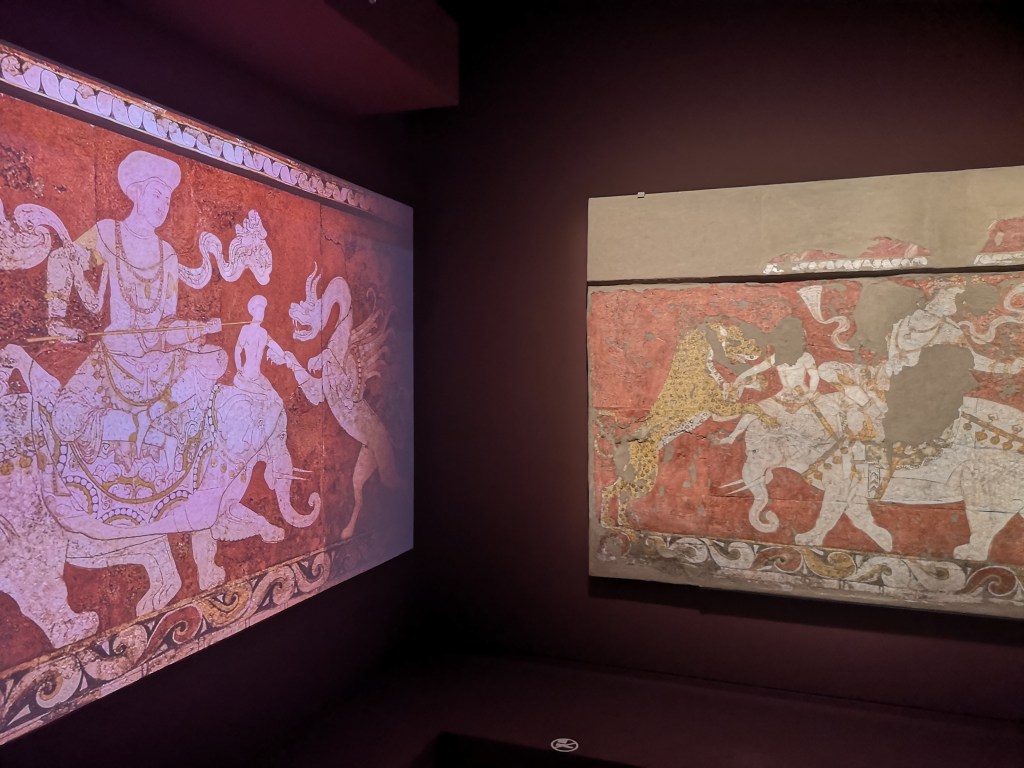
    Varakhsha fresco (right) and virtual reconstitution (left)

    The second room offers a nice selection of medieval textiles and metals, as well as illustrated manuscripts from 16th century Bukhara, most from the Bibliotheque nationale de France in Paris. The exhibition closes with a large screen showing videos of the Shah-e zende in Samarkand, the necropolis of Timur and his descendants. Overall, the viewer will leave with the impression to have spent a nice hour or so amongst rarely seen treasures.

    A final touch, the informed visitor can then go to the Islamic art department to south portion of the extraordinary “Paintings of the Ambassadors”, a fresco from the middle of the 7th century found in the ruins of Afrasiyab (north of Samarkand), landed by the Republic of Uzbekistan to the Louvre. I assume the large section couldn’t fit in the exhibition space with the required distance, but the signalling could have insisted more on its location, I only saw one sign at the beginning of the exhibition and nothing after.
    I should have bought the catalogue

    However, there were a few problems with the exhibition that made me twitch a little. The main one is the impression that the display of objects is only one half of a whole. I will preface by saying that I went through the exhibition catalogue very rapidly to check who participated in it, and no much more. This was a mistake I quickly regretted after leaving the room. Though I enjoyed the diversity of the exhibition, I left with the feeling that I was missing some crucial information regarding artworks I knew less about, as well as the main key to understand the intention and the coherence of the exhibition. Indeed, what is the link between the Paintings of the Ambassador and the door of the Gur-i Mir, beside their geographical location? Is there even a connexion? That answer might be in the exhibition catalogue, for which I would have to pay an additional €39, while I already paid €17 to see the exhibition. Some will say that all is not about money, but in this economy, I disagree. I am not saying exhibitions should be free, because Museum personnel need to eat, but an exhibition should be contained within itself and not depend on additional material. I understand that the reduced exhibition space allocated to the exhibit forced to make choices, but maybe more explicative panels, or a clearer route would have helped.

    Two folios from the Katta Langar Qur’an, 1/2 half 8th c. (Tashkent, Uzbekistan Islamic Council, acc. 179)

    An inconsistent museography

    I’m going to try not to be too picky here, but I must admit I was a little disappointed by some very avoidable mistakes. This is the Louvre, one of the leading museums in the world, so rigour should be key. Some labels have mistakes in their description, some are missing accession numbers and localisation (such as the harpy mentioned above), but one of the main issue was the absence of numbered references between the labels and the objects. Some displays hold several objects, but their labels are grouped on the side, so the viewer has to play “who’s who” to retrieve the reference. The displays are very minimalist and sleek, but it is detrimental to the readability.

    Cordon separating the viewer from the display

    As well, someone needs to explain why there is a security cordon 1 meter from the glassed displays in the first room; are people in the Louvre afraid of finger marks? This makes the objects barely visible and the labels unreadable.

    The exhibition offers information on historical figures such as Marco Polo and al-Biruni, but they are difficult to see, being placed on the opposite wall or pillar of the display. This comes from the main issue of the installation: the division of spaces and the overall route. The two rooms and the corridor that compose the spaces are each divided in two halves, each half corresponding to a chronological period. It is particularly clear in the second room, where the display at the immediate left of the entrance is dedicated to the 11th to 13th centuries, and the display at the immediate right focuses on the 15th-16th centuries. In front of the entrance is placed the 15th c. door of the Gur-i Mir. Entering the room, the viewer would need to ignore the door, go left and to the back of the room, then cross in front of the giant screen toward the right where 15th-16th c. manuscripts are displayed, walk their way back toward the entry, then check the door in the middle and finish by the 15th-16th c. display at the right of the entrance, turn around and leave. This is a bit complicated but doable, except there is no indication that this is the most logical route and none of the objects are numbered. Entering the room, I went immediately to the display on the right, then realised the exit was next to it so turned around and went to see the door, then turned around again to the display left of the entrance, it was overall confusing.

    Conclusion: Is it worth a visit?

    If you’re in Paris and planning to go to the Louvre, go see this exhibition but also do manage your expectations and maybe get ready to invest in the catalogue. The absence of objects from Russian collections is regrettable but understandable and independent of the Louvre’s will, and could have been better filled from more objects from the Louvre, but overall the artworks displayed are worth the visit, especially those coming from Uzbekistan.

    South wall Funeral procession led by King Varkhuman, in honour of his predecessor Shishpir. Afrasiyab, 648-651 AD (Afrasiyab Museum, Samarkand). (image from Wikipedia)
    1. From the film The Devil wears Prada.
  • Islamic Week, Autumn 2022 – Part 2 and Other Things (blog)

    Islamic Week, Autumn 2022 – Part 2 and Other Things (blog)

    I finally have a spare minute to do a part 2 of my Islamic week review, but because it was already three weeks ago, I’m going to share only a few additional thoughts, including on “current affairs”. With these 2-part posts, I’m trying a new, shorter format, that’ll allow me to publish more often, and that is hopefully nice to read. Let me know what you think of it!

    To restore or not to restore, here is the (undisclosed) question

    Some are going to say that I am on a personal crusade against big auction houses, which is completely false, but we need to talk about restoration practices. They are inherently not a bad thing, but as always, I find the lack of transparency problematic.

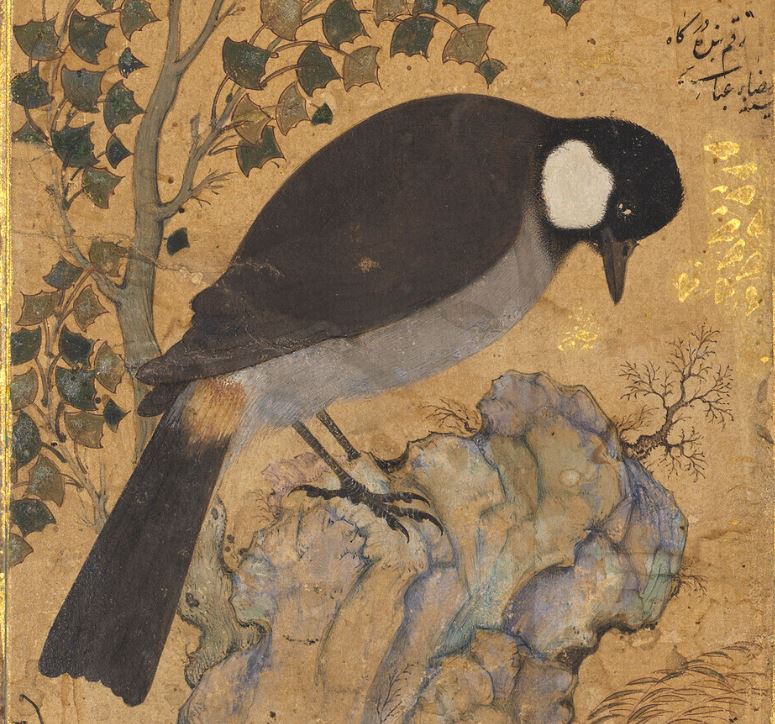
    Christie’s sold a painting of a bird signed by the famous Safavid painter Riza ‘Abbasi for £163,800, against an estimate of £100,000-150,000. It was an event to see this painting on the art market again, as the catalogue noted that it was previously sold in 1961 as part of the sale of the Sevadijan collection. Unfortunately, this is not exactly true. As I mentioned in my initial review of the Islamic week, the painting was sold last June in Versailles by Chevau-Leger Encheres for €36,000, against a laughable estimate of €100-150 (talk to specialists, people).1 This auction is not mentioned as part of the provenance in Christie’s auction catalogue. Legally, all bases were covered with the 1961auction, and there was no need to add any information on more recent movements. The problem this omission raises is ethical, and it is misleading to imply that the page had been in a single collection since 1961, when it is, in fact, not the case. The other issue is that between June and October 2022, the painting was restored.

    It is a common practice for auction houses to send prestigious pieces such as this one to the restorer. It is particularly common for metalworks, where silver or gold get injected to revive the inlays. Now, I am not against restorations, on the contrary. Restorations are part of the history of individual artworks, and it is great to see a beautiful piece getting back to its former glory. It also makes sense economically, everybody prefers buying pieces in good state rather than completely decrepit. However, restorations should be documented, and in the case of the art market, they should be disclosed. In Western museums, restorations are carefully analysed, weighted and documented. As well, the restoration in case of compensation or loss: “should be detectable by common examination methods.”2 There is no such guideline for auction houses.

    The restorations were not mentioned in Christie’s condition report available on the website and laid below, which probably indicates they were conducted by the vendor, as the auction house has an obligation to mention them in condition reports (but not in the catalogue):

    This painting is in good and stable condition overall. There are small areas of discoloration on the cream and illuminated background. The gilded areas bear faint discoloration in some areas and some surface craquelure. The pigments used on the bird eye bear light craquelure, as seen from the catalogue image. The multicoloured rock and part of the bird bears small and faint water stains which are only visible upon close inspection. Small area of crease along the left and middle of the painting. The ink of the signature is very slightly flaked, but remains fully legible. The illuminated outer margins include light areas of rubbing and slight discoloration as a result of light exposure. The painting has been pasted down on a blue card as part of the album page it once belonged to.

    I will not assume anything regarding Christie’s knowledge, but this shows, once again, the importance of thorough and documented provenance. Collectors should be made aware of potential restorations carried out on their newly acquired piece, as, again, it is part of the history. It is also an element buyers take into account when purchasing a piece, and it is an important piece of information for future restorations. I hope the person or organisation responsible for the repaints on Riza Abbasi’s painting gave all the documentation to the buyer.

    The stars shine bright in Paris…

    Lustre Lantern,Syria,12th/13th c. Artcurial 15/11/22, lot 66, 111520 €

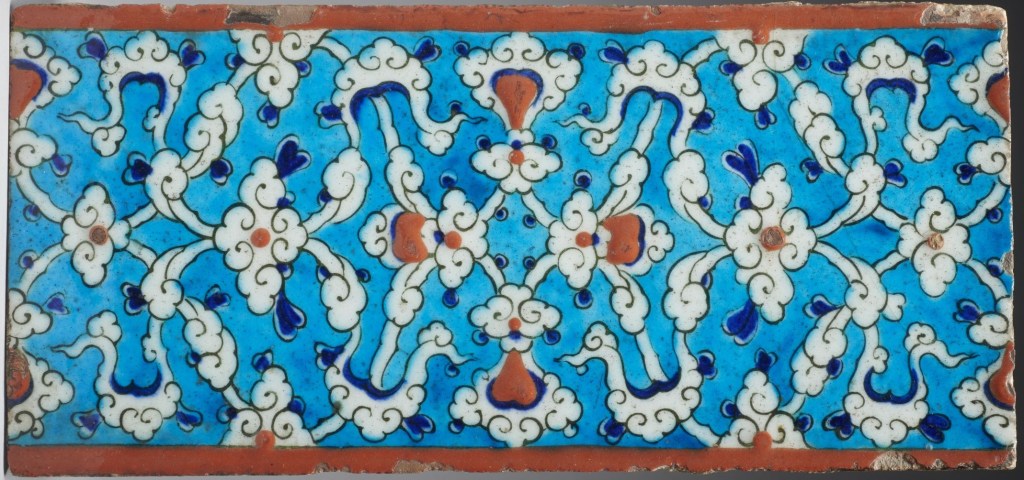
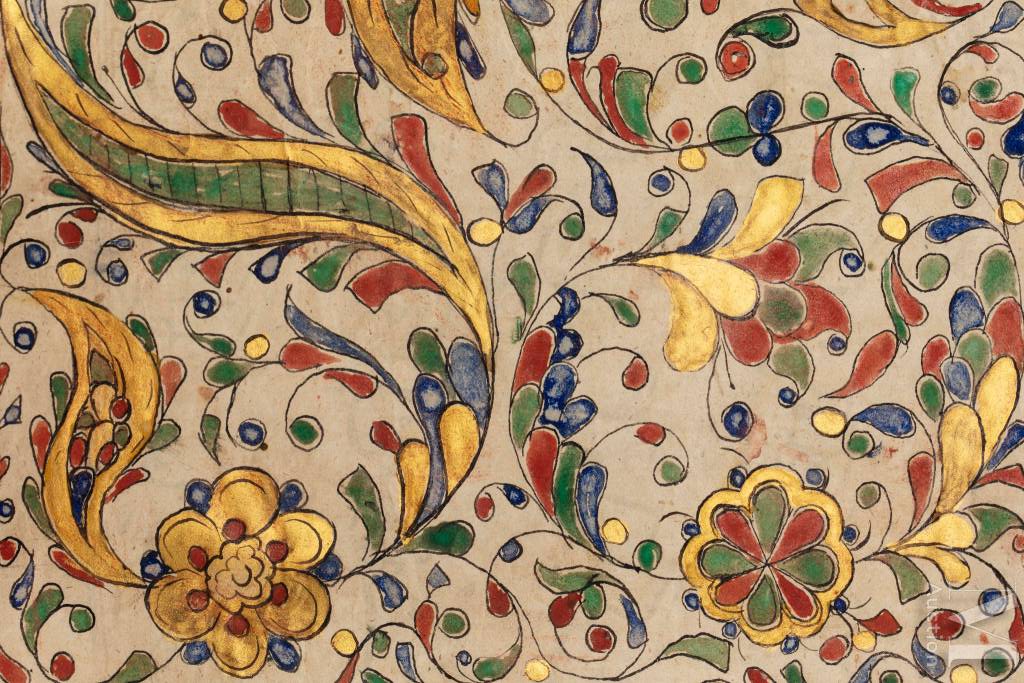
    The auction season has started in Paris, and the first results deserve their dramatic title. The auction house Artcurial held their Islamic art auction on the 15th November, under the expertise of Pingannaud-David. They achieved a whooping 813,735€ total (including premium, as for all prices thereafter), an impressive result given that Pingannaud-David expertise was only created a year ago, and that their first auction at Artcurial this summer made only 211,336€. This massive progression is due to a combination of factors, starting with a better selection. Indian painting, which has proven to be quite unpopular in French auctions, was almost completely absent from the catalogue, replaced by a large amount of manuscripts and arms, which are more in favour. Estimates were also scaled down, with very affordable pieces of good quality. Finally, most of the objects had excellent provenances (yes, I’m going to write about provenance again). Objects from R. Froment’s collection were presented, acquired by between the 1950s and 1980s, as well as a selection of manuscripts from the collection of Princess Roxane Qajar (written Kadjar), descendant of Muhammad ‘Ali Shah Qajar (r. 1907-1909). It doesn’t get any better than that. Some of these manuscripts achieved expected high prices, such as the incredibly rare album of illumination motifs from the end of the 19th century, sold 65,600€ against an estimate of 8,000-12,000€. Some prices came as a surprise, such as the 36,736€ paid for a 19th century copy of Khosrow va Shirin value 1,500-2,000€ (dated and signed, admittedly). Among the other success, a rare lustre lantern from 12thor 13th century Ayyubid Syria, sold by Jean Soustiel to R. Froment in 1970, valued 15,000-20,000€ and sold for 111,520€, proving that Medieval ceramics require good provenance to sell well, and an Iznik panel of 3 tiles, proved circa 1570-80, from the same collection, sold at €81,344 against 20,000-30,000€. The craze for Iznik ceramics continues!

    Iznik border, Ottoman Turkey, c. 1560-80, Artcurial 15/11/22, lot 80, 20992€

    …But not on Medieval metalworks

    What also continues is the funk in which Medieval metalworks seem to have fallen. Only one was offered, a 12th-13th c. Seljuk silver and copper-inlaid bronze inkwell, which looked nice on pictures (I wasn’t in Paris for the exhibition), but had no provenance other than Sotheby’s 2008. Medieval metalworks didn’t sell in London last month neither, apart at Chiswick which sold everything anyway. Two Egyptian pieces valued at £40,000-60,000 remained unsold at Christie’s, despite the hanging lamp having a provenance line; Sotheby’s kept more than half of their items, etc. I wonder why these artworks fell out of fashion so fast. I mentioned above undisclosed restorations, and of course the question of provenance that is now an important argument, but that’s not all. Rumour has it that many fakes were sold over the years, which would explain the disdain, but I haven’t seen any major public scandal that would have notoriously tainted the medium. This needs further investigation, so I’ll keep my eyes peeled!

    The rest of the season will be quite busy: On the 23rd November, Millon will have their third “Orient classique, Trendy, Arty” auction with a large selection at various prices; the 2nd December, Collin du Boccage will present lots from the library of an Orientalist (expertised by Pingannaud-David), Millon will have their main auction on the 13th December, and the 14th December will hold a single-owner numismatic auction, which genuinely excites me. We will have to wait until the beginning of 2023 for Ader (expert Camille Cellier) and Rim Encheres (expert Rim Mezghani), which haven’t announced the dates yet. Stay tuned!

    Detail of a Qur’an, Oriental Europe, 1290/ 1872, Millon 23/11/2022, lot 219, 5,000-6,000€
    1. I am grateful to the person behind the account @completement.marteau for posting first about it in June.
    2. American Institute for Conservation, Conservation Code of Ethics and Guidelines, art. 23.
  • Parisian Art Market Debrief and Other News (blog)

    Parisian Art Market Debrief and Other News (blog)

    As I am about to enter a studious summer, let’s take a look at the Parisian art market most recent months, which were packed with action. I also want to share with you some of my ongoing and upcoming projects and plans. If this article interests you, please comment below and share on social medias!

    Moulded bowl with hunting scenes, Seldjuk Persia, 12th/13th c.. Artcurial, sold €20,992
    Moulded bowl with hunting scenes, Seldjuk Persia, 12th/13th c.. Artcurial, sold €20,992

    The Islamic Art Market in Paris: New Players, New Scores

    This spring, excitement was palpable around Drouot, the Parisian main marketplace. No less than four large auctions were scheduled in May and June, as well as individual lots passed in non-specialist auctions, and that ended being major surprises.

    Result summary

    All prices include premium.

    On the 16th May, Pingannaud-David expertise opened the season with their first solo auction and new collaboration with Artcurial. They chose to focus on a small catalogue of 118 lots (excluding archaeology), with low estimates ranging from €300 to €25,000.

    As for the results, Artcurial arrives in fourth position with 52% of lots sold for €211,336, a halftone result for the bold selection offered to the public. The biggest success was achieved by a late 19th century Ottoman karlik, a silver cooling vessel from a French collection, bearing the tughra of either Sultan ‘Abd al-‘Aziz (r.1861-76) or Sultan ‘Abd al-Hamid II (r.1876-1909). Valued €6,000-8,000, it was sold for €26,240, 437% of its low estimate. The second record, a beautiful moulded pottery bowl with hunting scenes, from 12th or 13th century Seldjuk Persia, was sold within its estimate of €15,000/20,000, for €20,992.

    Silver cooling vessel (karlik), Ottoman Egypt or Turkey, late 19th century. Artcurial, 15.05.22, sold €26,240
    Silver cooling vessel (karlik), Ottoman Egypt or Turkey, late 19th century. Artcurial, 15.05.22, sold €26,240

    The next day, Rim Encheres, with Rim Mezghani supported by the expertise of Laure Soustiel, was also taking its first steps inside the hotel Drouot. After an inaugural sale in November, the challenge was to show a clear progression margin for the newly created auction house. Were presented 154 lots divided in two thematic groups, “shades of blue” and “empires and artisans”, with estimates from €80 to €30,000.

    Rim Encheres achieved a total of €279,253 with 56% lots sold, which is not extraordinary, given the estimate of some unsold lots, but still shows a clear progression compared to their inaugural sale, which had made €220,580 for 50% sold. Challenge succeeded for the Parisian latest comer. The most successful lot sold within its estimate of €30,000/50,000: A rare Qur’an from the second half of the 15th century, probably produced under the Aq-Qoyunlu dynasty in Iran, with a 16th century Safavid binding, sold for  €41,600. The second-biggest lot came as a surprised: A nice Iznik dish from circa 1590, with a charming decor of sailing ships, and an impeccable provenance, was valued at €4,000/6,000, and sold for €29,900, 748% of its low estimate.

    A month later, on the 15th and 16th June, Millon and Anne-Sophie Joncoux-Pilorget, Parisian market almost veterans in this context, were offered over two days a large catalogue of 441 lots from €50 to €200,000, risking daring estimates and a two-day sale to assert its place on the market.

    I was contracted by Millon, with whom I worked in the past, to support with marketing and communication surrounding the sale, bringing more awareness to the event (with more or less success given the current climate in France, following the scandal in the Louvre).

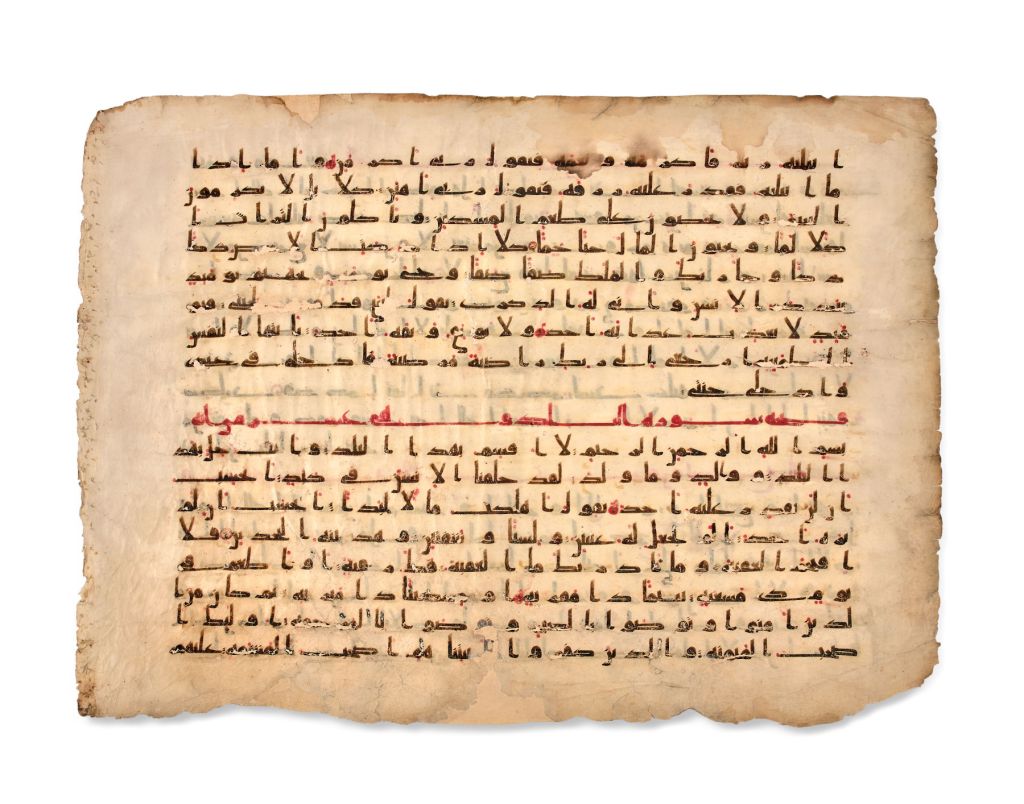
    Page from a monumental Qur’an on vellum, Mesopotamia, second half of the 8th century, Millon, 15.06.22, sold €650,000 €
    Page from a monumental Qur’an on vellum, Mesopotamia, second half of the 8th century, Millon, 15.06.22, sold €650,000 €

    Millon broke records with €2,014,727 achieved in total, and €650,000 for a monumental Qur’an page on vellum from the second half of the 8th century, beating all French sale records for single Qur’an pages. Overall, Millon was in the average with 56% of lots sold, but managed to sell well above estimate in many cases. The second-biggest lot, a Qur’an juz’ from 12th century Baghdad, also sold for 200% of its low estimate (without premium): €200,000 against €80,000/120,000.

    Finally, Camille Célier was also taking her first solo steps with Ader-Nordmann on the 28th June, presenting a catalogue of 293 lots (including Orientalist painting, excluding archaeology) between €50 and €15,000.

    Lacquered mirror case, signed Muhammad Isma’il Isfahani, Qajar Persia 1274 H/1857-58. Ader-Nordmann 28.06.22, sold €19,840
    Lacquered mirror case (detail), signed Muhammad Isma’il Isfahani, Qajar Persia 1274 H/1857-58. Ader-Nordmann 28.06.22, sold €19,840

    Comparatively, this auction was the most successful one with 69% of lots sold for a total of €330,656. The auction house had made the choice of presenting more objects with lower estimates, around half below €1,000, and it clearly paid off since buyers from all backgrounds gathered. Both top lots were sold within their estimate: A lacquer mirror case with historical scenes and a crucifixion from Qajar Iran, dated and signed Muhammad Isma’il Isfahani (1814-1892,) sold €19,840; and a large Orientalist oil painting by Rigolot (1862-1932) sold €19,200. Here again the surprise came for an Iznik dish (that looks like Kutahya), valued €3,000/5,000 and sold €16,640.

    Success and Deceptions

    Iznik dish, Ottoman Turkey, c. 1590. Rim Encheres, 16.05.22, sold €29,900
    Iznik dish, Ottoman Turkey, c. 1590. Rim Encheres, 16.05.22, sold €29,900

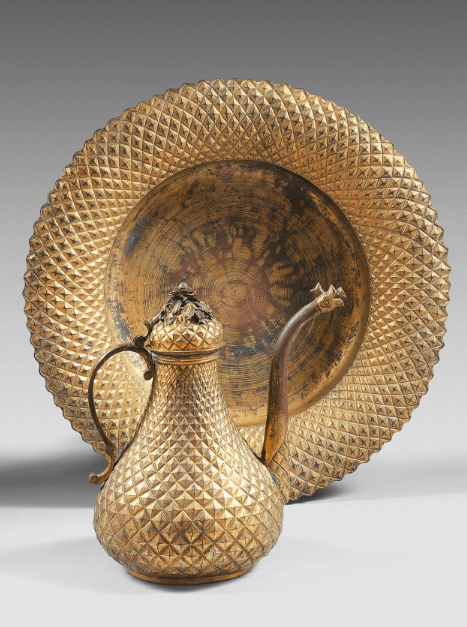
    Ottoman productions encountered a massive success for most. Beside Artcurial’s karlik sold €26,240, Alexis Renard and Beaussant-Lefevre sold a magnificent tombak ewer and basin dedicated to the princess Mihrimah Sultan (1812-1838), daughter of Sultan Mahmud II (r. 1808-1839), dated 1236 H./1820 for €130 560 against an estimate of €20,000/30,000, pre-empted by the Louvre. Millon presented Ottoman arms, especially a curious 18th century yatagan sword with hidden mechanisms that sold €24,000, a price within its estimate of €25,000/35,000.
    Iznik and Kutahya potteries also broke records, confirming the cravings for these productions, especially Iznik’s, that had already been seen in London last Autumn. Rim Encheres, in particular, sold the 11 Ottoman ceramics – dishes and architectural, as well as Ader which achieved high prices with 5 of the 7 lots presented.

    Ewer and Basin in tombak, Ottoman Turkey, 1236 H./1820. Beaussant-Lefevre, sold €130,560
    Ewer and Basin in tombak, Ottoman Turkey, 1236 H./1820. Beaussant-Lefevre, sold €130,560

    The biggest deception was probably Indian paintings. Artcurial presented 23 lots of Indian paintings, 18 being in temporary importation (which incurs an additional 5.5% premium on hammer price, for the buyer), but only managed to sell 8, most within or below estimate. Most likely, Pingannaud-David imported lots from London in a daring effort to hype up Indian painting on the Parisian art market. This could have worked, given the reputation and legacy of late Marie-Christine David in the field, but it might have been too early for the newly created expertise, or estimates might have been too high (some definitely made me raise an eyebrow), and buyers did not respond.
    The same goes for Millon which offered 13 paintings, only 4 were sold, including one more than 300% above estimate.

    However, and because there is always an exception to the rule coming to contradict my shiny theories, a 19th century Awadh painting was offered at Coutau-Begarie on the 3rd June, expertised by Anne-Sophie Joncoux-Pilorget, which clearly unleashed all passions. Valued €3,000/4,000, it was sold for more than 10 times its value.

    Finally, manuscripts made sellers and buyers very happy, confirming here again the importance of the media on the market. Apart from the extraordinary result achieved on the monumental Qur’an page, Millon confimed its leadership on the market by selling the vast majority of manuscripts, including a copy of the Book of Conduct for Sufi Aspirants, written by the great Persian philosopher Sohravardi and copied in 717 H./1317 by his indirect descendant, Ahmad ibn al-Sohravardi al- Bakri (1256-1340), sold for €152,000. Ader managed to sell a 19th century Ottoman miniature Qur’an for €16,640 against an estimate of €3,000/5,000, and Artcurial sold most of their manuscripts (not the biggest ones unfortunately), including an illuminated frontispiece from a 16th century Layla wa Majnun probably made in Herat, gone at €2,099, that is 350% of its low estimate.

    Qur'an juz, Baghdad, 588H./1192-3. Millon, 15.06.22, sold: €160,000
    Qur’an juz, Baghdad, 588H./1192-3. Millon, 15.06.22, sold: €160,000

    It seems that the Parisian art market is entering a new phase of its history. Experts are younger (but highly experienced), with new ideas and new ways of working. Provenances were put under a shining light in the catalogues, which is, as we know, particularly appreciable. We can look forward the Winter auctions to see how Paris will find its new balance.


    Art Informant Update

    The ART Informant podcast, started in November 2021, is now taking a short break after an eventful first season full of amazing guests. It will be back for a second season in September 2022. I also hope to expand on the concept with additional content, but it will depend on external factors I will hopefully be able to talk about in a few months.

    The podcast has been received very positively, and I am really grateful to the community that has helped share the episodes, grow the audience, and gave me very constructive feedback.

    Stay tuned for more info on season 2 very soon, relayed on the ART Informant’s Instagram and Twitter accounts. Don’t forget to follow!

    1. To learn more about Drouot, listen to the ART Informant episode with Rim Mezghani.
    2. France24, “Louvre ex-director charged in art trafficking case”; The Art Newspaper, “Antiquities trafficking case escalates as Louvre Abu Dhabi joins civil action and Swiss collector files criminal complaint”; 247 News Agency, “Accusations against former Louvre director uncover global art smuggling scandal”.
    3. You can check some of the press releases I wrote here and there.
  • The Autumn continues in Paris

    The Autumn continues in Paris

    It is always difficult to predict the fluctuations of the art market, as tendencies can vary over a few months. In the case of the Islamic arts market, the excercise is even more difficult due to its diversified nature: all medium, a chronology of 14 centuries, more than half the world with no less than a douzen dedicated auctions a year. However, prices resulting from this heterogeneity also depend on the global economy and political context, even more than other markets like contemporary art or modern masters that see less variations in short periods of time.

    This Autumn, two major auctions were held in Paris: Ader Nordmann on the 27th November, Millon et Associés on the 3rd December. Both were really interesting to monitor, as they were the direct continuity of the London Islamic Week. I have commented in my previous article the results achieved by Bonham’s, Sotheby’s and Christie’s and whether some of them could be the start of new trends. Though London and Paris markets are very different in term of lots presented, valuations and overall prices, some tendencies tend to be confirmed. Others, not so much!

    All prices quoted below include VAT.

    Safavid Qur’an, 17th c., sold 5,120€

    Both auctions had a very different selection, reflected in the results. Ader Nordmann presented 326 lots, including 49 lots of archeological artifacts and an amazing gathering of 53 drawings of André Maire. Overall, 65.3% of lots were sold for a total amount of 79,111€. Millon auctioned 402 lots and sold 47.5% for a total of 1,099,397€. This result places Millon directly behind London (for reminder Sotheby’s made almost £8 millions, Christie’s £5 millions and Bonham’s £2.5 millions). Millon has still a bit of a way to go to dethrone London houses but the result is still very impressive for a French auction house and congratulations are in order for this achievement.  

    So how to explain this result, but also the important difference between Millon and Ader? Let’s take a look closer.
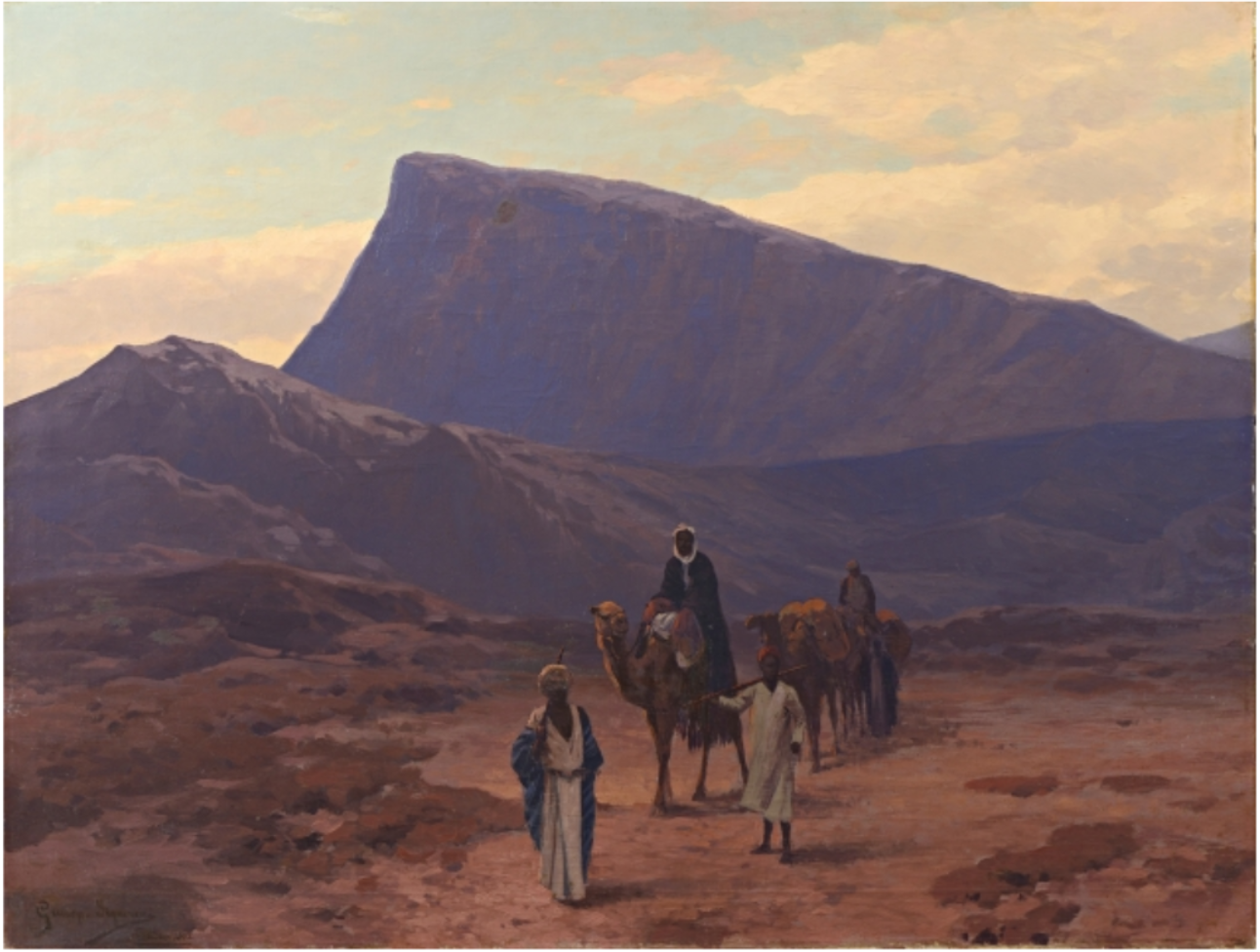
    As per tradition, Millon opened with 119 lots of Orientalist and Modern paintings and 15 lots of books, photographs and lithographs. This section did pretty well with some very impressive results, including a painting of Etienne Dinet (1861 – 1929) showing men praying (37,5 x 29cm), valued 6,000-8,000€ and sold 37,700€, as well as a colorful view of Rabat (64,5 x 99 cm) by Edy-Legrand (1892-1970), valued 6,000-8,000€ and sold 23,400€. Unsurprisingly, my personal favorite remained unsold, as Orientalist painting buyers are usually more attracted by signature and date and this view of the Atlas plateau (probably) is not signed. 

    Despite some restorations, the painting still holds a very interesting monumentality and sense of sublime that are not so common in Orientalist painting

    Ader presented 17 lots of Orientalist paintings, 26 lots of books and hajj certificates, but more importantly 53 drawings of André Maire (1898-1984), a French artist who fought in the two World Wars before leaving for Africa and then Asia where he spent 10 years. He left an immense production of drawings, as demonstrated by Ader selection of views of Egypt, India, Cambogia, Vietnam etc. All the lots were valued 400-600€ and I was expecting higher results. Most of them were sold between 700 and 2,000€, the highest price being achieved by a representation of Buddha and Ganesh.

    Drawing of André Maire are particularly interesting for the proportions of figure and the contrast between humans and environment. 

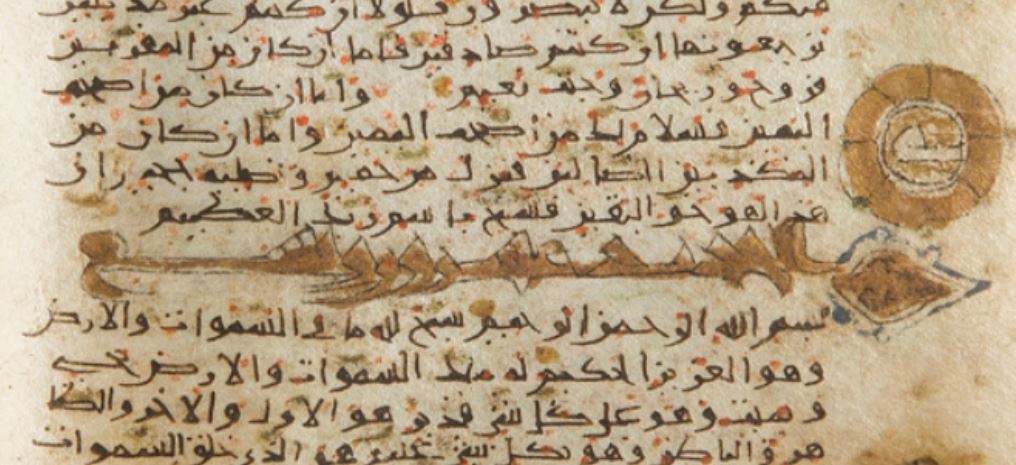
    The big surprise was the prices achieved in both auctions by Medieval North Africa and al-Andalus objects. For reminder, the last London Islamic week had left most of these lots unsold and I was expected similar results in Paris. Ader presented only one lot, a 12th-13th c. travel Qur’an (only 8.9×6.8cm). Valued at only 1,000-1,500€ due to a poor state of preservation, it reached an unexpected 37,120€, thus breaking the auction record. Millon presented five lots from 10th to 16th c. and five Modern revivals. The large Almohad water jar with an elegant tooled decoration took everybody by surprise by going at 54,600€ (against an estimation at 6,000-8,000€). The two Umayyad carbed marble capitals valued at 10,000-15,000€ reached 21,450€ and all the other lots went within their range. 

    To explain the success of North African and Andalusian items in Paris compared to London is not easy, but the most obvious explanation would be that buyers in Paris are not looking for the same kind of objects than London’s. The long lasting relationship between France and North Africa, and by historical extension south of Spain, has played a central role in the diffusion of art, in the constitution of private collections, but also in the elaboration of tast. The latter is demonstrated by the interest for Orientalist paintings, mainly focused on North Africa and Egypt, as well as the selection of books offered for auction, for instance Ader. The existence of documentation is, of course, a reassurance for buyers, as seen by the fact that Ader small Qur’an and Millon water jar both documented the provenance.

    Detail of Ader small Qur’an showing an interesting “proto-maghribi” script, golden surah title and reading mark

    What really made a difference for Millon lies in the manuscript section. 57 lots were presented and though some were left unsold, buyers displayed a rare enthousiasm for others. I was wondering prior to the Islamic week if isolated Qur’anic leaves on parchimen would still sell but after seeing the results, I had no doubt that the leaf with golden Kufic script and red diacritical dots would do well, and it did. The result went way above the range of 8,000-12,000€ with a total of 71,500€, a price comparable to those achieved by the Blue Qur’an bifolio sold by Christie’s in October, given the difference of valuation.

    If this Qur’an golden leaf was a given success, it was not the case for others whose results came as a complete surprise. A North African treatise of Maliki justice copied before 1692 (date of the waqf) was sold 39,000€, another one on sufism in Lybia copied around 1707 went at 13,000€. In other category, a Chinese Qur’an in 30 volumes from the 18th-19th c. and another 18th c. Chinese Qur’anic juz exceeded its range of 800-1,500€ by going at 5,850€. Usually these two kinds of manuscripts never break records, so I am wandering if we are seeing here a new trend developing in French auctions, or is it just a happy coincidence. Another Modern large Qur’an copied in the Arabic Peninsula in 1865 was sold at 52,000€ but this price is explained by the renown of its patron, the Sheikh Qasem b. Muhammad b. Thani (r. 1878-1913), second sheikh of the al-Thani family, considered like the funder of Qatar.

    A 18th c. Chinese Qur’an page, characterized by its golden illumination and script

    Qajar manuscripts and paintings are mostly stable without breaking any records. Two honorable mentions were sold at Ader, a Divan of Sa’adi from the beginning of the 19th c. including 10 paintings of high quality, for 9,216€, and an interesting litograph copy of the Shah Nama dated 1846, sold 12,800€.

    Finally, the category of Indian paintings was uneventful but both selections were not particularly remarkable. Parisian buyers don’t seem to be looking for secondary Indian paintings, while all Mughal high profile pieces are sent directly to London or to private merchants (see for instance Simon Ray current catalogue).

    In conclusion, the large difference of results between the two auction houses came mainly from their selection and what appears to be a shift on the Parisian market towards more high end art events. It will be interesting to see what the spring auctions will offer, and before that what the Carnet de Voyage auction will do in January. Will buyers be still interested in low value items? Time will tell.

    My favorite piece from the Millon auction, sold 3,380€. Click here to read the full catalogue entry written by yours trully