

The Islamic Art market is like some mystical creature living in a deep forest. Everybody has heard about it, and many will tell you they have seen it, but everybody gives different descriptions, apart that it has eyes and a tail. What I’m trying to say, with this unnecessarily convoluted metaphor, is that the art market keeps surprising me. Items surprise me, but also the ability of experts to unearth forgotten treasures and to slap completely random prices on them, that keeps surprising me.
Bonhams opens the week on the Tuesday 25th with a catalogue of 157 lots, but is also holding an online auction between the 20th and the 28th October with a catalogue of 249 lots. Sotheby’s, follows on the 26th with 195 lots. Christie’s offers a larger catalogue of 265 lots on the 27th, including 102 carpets. Finally, a probable organisational mishmash makes Chiswick and Roseberys share the Friday 28th, Chiswick with two catalogues of 89 and 360 lots, Roseberys with a catalogue of 497 lots, including 79 lots of antiquities and 30 lots of contemporary art.
The selection is large and include wonderful pieces for every budget, as well as intriguing items, such as a small Qajar painting in an extraordinary wooden frame, offered by Rosebery’s at £200-300, and a very amusing page showing Maharana Jagat Singh in the most lively margin of elephants and animals, offered at £500-700.

Manuscripts and Paintings, stars of the show
Bonhams seems to be shifting its strategy slightly by holding two auctions simultaneously, one in the auction room on the 25th, and another online, over 8 days starting on the 20th. The physical sale includes pieces between £200-300 and £90,000-120,000 and will appeal to the most fortunate collectors, while the online auction include more items, all between £200-300 and £5,000-7,000, with some lots sold without reserve, and some as low as £5. Both auctions include paintings and isolated pages, but only 3 manuscripts. Supply chain issue or deliberate choice to focus on other media, I cannot tell, but the absence is definitely intriguing given the popularity of manuscripts in past UK and French auctions, and the sheer volume of manuscripts presented by the other auction houses this autumn.
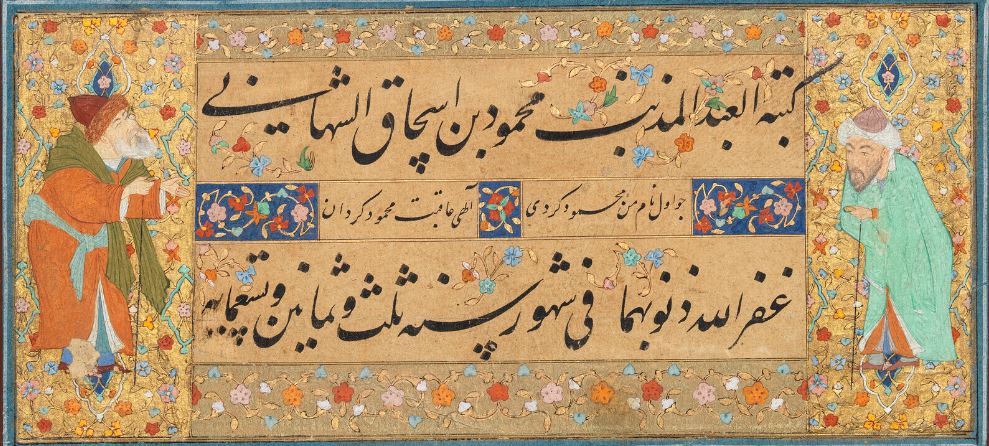
Chiswick offers several interesting manuscripts in both auctions, including a Mughal Qur’an signed and dated 1145 H./1732 valued at £6,000-8,000, and a Safavid poetic anthology from the 17th c., incomplete but interesting for it contains the full page drawing of a standing man, in a format usually reserved for album pages. The manuscript could probably be use as a case study on provenance: it bears seals, dedications, modern collection stickers and even comes with a letter from George Anavian on behalf of the late professor Ehsan Yarshater to Dr. Marilyn Jenkins Madina, one of the curators of the Islamic Art department at the Metropolitan Museum of Art, dated 27 September 1983. Offered at £800-1,200, it is a bargain for anyone interested in book history.
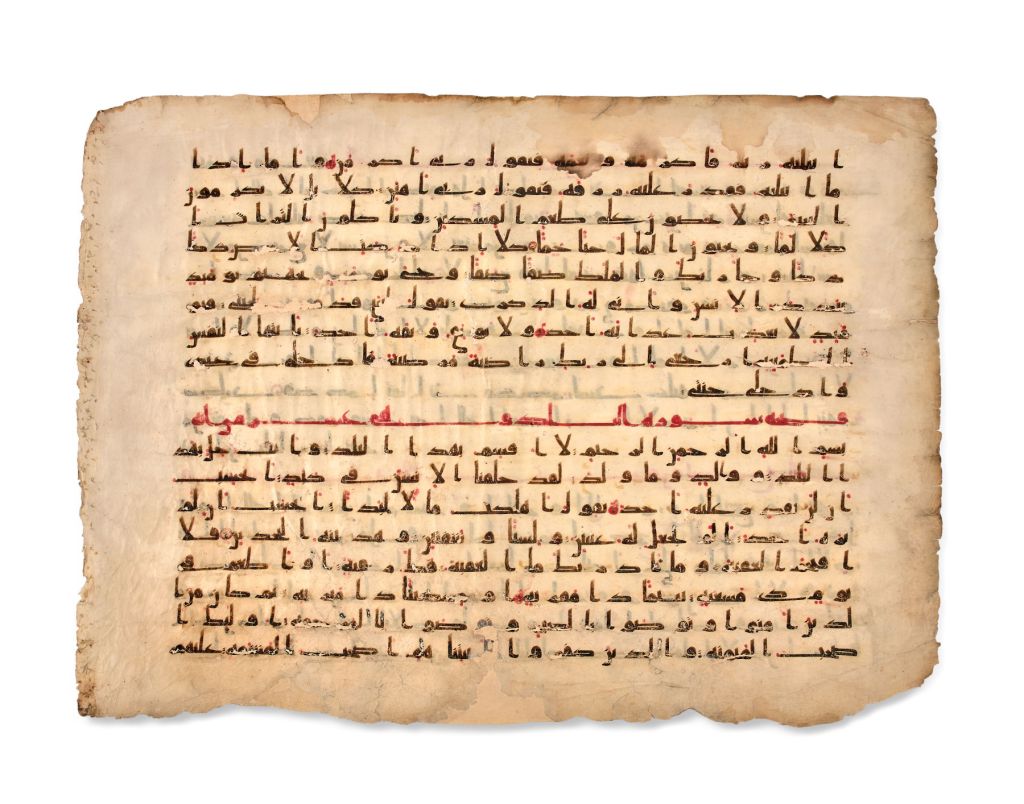
40% of Sotheby’s auction is composed of manuscripts, isolated pages and paintings, including 9 volumes from the Shakerine collection which was dispersed by Sotheby’s in October 2019. The sale had done well, but not all lots were sold. On the nine manuscripts offered this fall, only an illuminated Qur’an juz from Ottoman Turkey was previously sold £5,000 (incl. premium), and all the lots are now offered with estimations slashed by 25% or more. It will be interesting to see if they sell, this time around. Sotheby’s is clearly riding trends in this auction. A monumental Qur’an page from the 8th c. is offered for £250,000-350,000, from the same volume as the page sold by Millon Paris for €600,000 in June. The page was last sold by Sotheby’s in 2016 for £85,000, so given the result of the French auction earlier this year, we can understand the rush to resell.
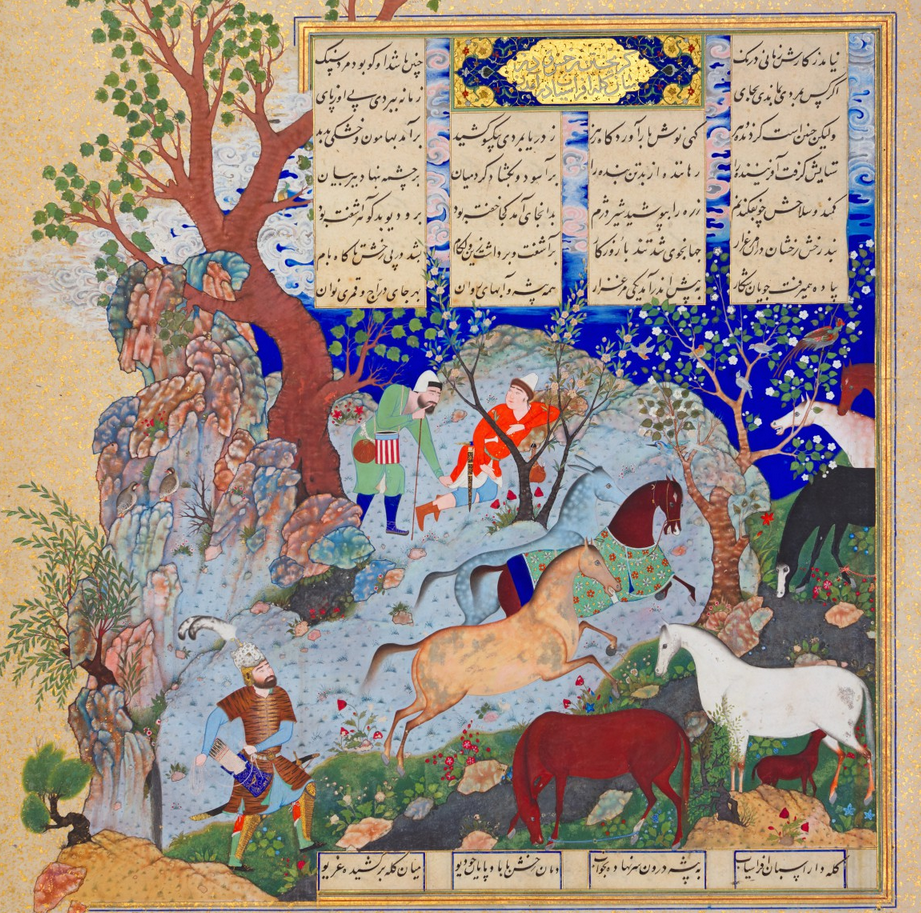
The star of the show is of course the page of Shah Tahmasp’s Shahnama, offered for £4,000,000- 6,000,000, following the page of the same manuscript sold at Christie’s in March this year for £4,842,000. This high price has encouraged Sotheby’s to push the estimation even higher. Every single one of this page is an event on its own, and the painting on this one is particularly glorious. William Dalrymple wrote about the page in the sale catalogue, which baffles me. Mr Dalrymple is a great historian and a fantastic author, but he is not a specialist of Safavid Persia, nor of the Shahnama, nor of the arts of the book. Why not ask one of the many experts of the field for their informed opinion? For this reason, I have invited Dr Firuza Melville, director of the Cambridge Shahnama Centre for Persian Studies, to speak about the manuscript on the ART Informant podcast. The episode will be out on the 17th October, so stay tuned!
Rosebery’s is also coming in strong with Shahnama pages, including one page of the so-called Freer Small Shahnama, produced in Iran c. 1300-1340 and bearing the illustration of “Sawa Shah slain in battle by Bahram Chubina” (£3,000-4,000), and an illustrated page of one of the so-called Small Mongol Shahnama, made around the same time as the Freer Shahnama (£3,000-5,000), as well as other, Deccani and Qajar.
Let’s mention here the painting of a black and white bird signed by the famous Persian painter Riza ‘Abbasi, offered by Christie’s for £100,000-120,000. This particular page hadn’t been seen since its first appearance on the market in 1961, until last summer when it was sold in France for €36,000 on an estimate of… €100-150. The snarky comments write themselves.
Finally, it is interesting to note the prominence of Indian painting. I mentioned this summer that Indian painting didn’t sell well in Paris, so I am particularly interested to see what it will do here in London, though previous auctions have showed that the medium usually encounters success. I never counted the Indian paintings in London auctions before, but because I found the catalogues particularly submerged in Indian paintings this time around, I decided to count. Christie’s catalogue includes 13,2% of Indian paintings, Roseberys 15%, Sotheby’s 15.3%, Bonhams live 17,8%, Bonhams online 25.3%, and Chiswick 30,2%, with a rough total of 310 isolated pages produced in India, excluding illustrated manuscripts, more than 17% of all lots combined. There are some really wonderful treasures among all this mass, but I don’t know where to start, I feel genuinely overwhelmed. As for manuscripts, I wonder when Indian paintings became so prominent, but more importantly I wonder if such volumes are sustainable in the mid to long term. Am I the only one feeling this “Indian painting fatigue”?

Provenance, prices … All these random things
In this day and age, it becomes risky to present a star lot without provenance. Of course, the interested buyer can contact the expert and ask, but it seems like good practice to put it directly in the catalogue, both ethically and commercially. The stakes are high to sell the most expensive lot, because even if auction houses often achieve better results with smaller items selling above their range, an unsold star lot represents a significant loss of investment (in terms of research and cataloguing time and resource, advertisement, freelance experts, etc.), as well as bad publicity. One will remember the two pairs of glasses presented by Sotheby’s last Autumn, which I had questioned on this blog; Sotheby’s had contracted William Dalrymple and an independent consulting firm, with additional support (paid or not) from Dr Usha R Balakrishnan and Pr Ebba Koch. These glasses had a number of issues, including the complete absence of provenance in the catalogue, and remained unsold.
Bonhams has a tendency to omit provenance, but it is never systematic. Their most expensive item is a late 13th century Mamluk silver-inlaid brass penbox offered for £90,000-120,000. At this price, potential buyers should not have to work to find out where it comes from. Oddly, the second star object, a group of Safavid niello and gem-set gold jewellery offered at £80,000-120,000, has a provenance line. Go figure.

Christie’s is changing gear with their top lot, presenting a Mughal pashmina carpet from the mid-17th century for £2,500,000-3,500,000. I imagine that this piece might be acquired by a museum, as the infrastructures required for conserving textiles are particularly complex. I am not a carpet specialist, so I couldn’t say if the very high price is justified or not. Let me know your opinion in the comments, and let’s see what the market decides.
For £15,000-20,000, Sotheby’s offers an 18th c. Ottoman Qur’an of 573 folios, 10 lines by page, measuring 26.6 x 16.4 cm, with no date, signature nor provenance. Christie’s offers for £2,000-3,000 an Ottoman Qur’an of 228 folios (no mention whether it is complete or not), 15 lines per page, 16.9 x 10.7 cm, signed Muhammad, known as Ferayazi, dated 1172 H./ 1758, from the collection of Michel Abemayor (1912-1975). The writing is of better quality in Sotheby’s manuscript, but it doesn’t fully justify the immense price gap between the two, and I struggle to understand how these prices were attributed. Sotheby’s Qur’an is too expensive and Christie’s Qur’an is too low-priced. Someone, somewhere, has some explaining to do.
Bold Attributions or Misleading Captions?

Christies’ second-highest lot gave me pause, and raises the issue of attributions on the art market. A beautiful album page bearing, on one side, a painting of a night hunt scene produced in India circa 1691, and a calligraphy signed ‘Imad al-Hasani on the other side. The page is presented as coming from the famous St Petersburg muraqqa’, an album produced in Persia after the sack of Delhi in 1739 by the army of Nadir Shah Afshar. Most of the album is kept in the Institute of Oriental Studies in St Petersburg, but some of the pages were dispersed before it arrived in Russia and sometimes appear on the market. One page was sold at Millon Paris in 2019, for instance. Other times, pages resembling to those of the album are wrongly attributed to the volume, such as one offered by Sotheby’s in 2018. The present page could be linked to the album for its size (47.8 x 32.5 cm, the St Petersburg album is 47.5 x 33 cm), and the fact it bears a calligraphy of the Persian master ‘Imad al-Hasani, predominant in the original volume, however (yes, in bold) the margins are signed Muhammad Yazdi and dated 1247 H./ 1831-32, some 80 years after the latest date in the album, 1172 H./1756-57. The catalogue entry deals with this crucial information like an afterthought, mentioning it in the very last paragraph and adding that: “The St. Petersburg Muraqqa’ was however never completed and we know that many of the margins and borders were not finished in the 1750s. This might be a later attempt to complete it.” The keyword is in the last sentence, “might”. There is no evidence whatsoever that the album decoration was continued after 1757, and we don’t even know what the complete album even looked like. This lack of nuance is extremely misleading.
Another jump to conclusions is the attribution of a Safavid papier-mâché mirror case to Muhammad Zaman, valued at £50,000-70,000. With the amount of scientific literature widely available on the topic, I simply do not understand that we can still give every random piece under the sun to the painter Muhammad Zaman, on the base that they look Safavid, and that they bear the inscription “ya saheb al-Zaman“. Many legitimate signatures are known for this painter, some in the aforementioned St Petersburg muraqqa‘, but the attribution of this inscription to him has been questioned many times, and the fact is that nothing tangibly links this “crypto-signature” to him. The scenes on the mirror case are indeed close to his style and can be compared with signed works such as the Khamsa of the British Library, but an attribution is not a signature.
Bonhams also drops Muhammad Zaman’s name for a page of the album made in 1888 for Nasir al-din Shah Qajar (£15,000-20,000), recognisable by its margins covered in decoupage motifs, but states that the painting is “in the manner of”, which is a lot better.
This album is problematic and needs to be briefly mentioned here. Pages have been frequently appearing on the market for the past few years, with little to no provenance. Also appearing on the market are empty margins from the same album: Chiswick is offering 6 in one lot as part of their morning, single-owner sale. The margin of Bonhams’ painting resembles very closely another margin offered by Chiswick last year (but is not identical), and because the complete album has never been seen, I think we need to keep an eye on the isolated margins being sold and potentially reappearing not empty. That or I’m being paranoid. In the same auction, Chiswick is also presenting two loose calligraphic panels from the same album, this time without their margins (except for a small band bearing the characteristic decoupaged motifs).
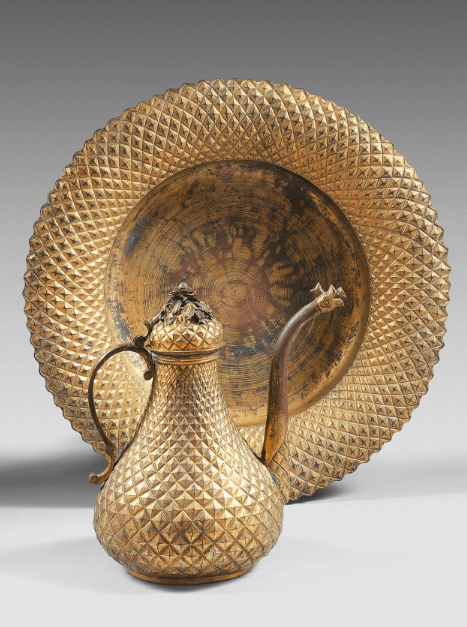
A lot more can be said about these catalogues, but this article is already too long. I am genuinely excited to go to London and see the exhibitions, but also to see what the market will decide. Bonhams is taking risks by focusing on metals in their live auction, Medieval ceramics are as strong as they have ever been, Iznik are full of promises, I could go on forever. Let’s meet on this blog after the auction to debrief!
- The catalogue can be downloaded in PDF here. Thank you to Benedict Carter for providing me with the link that I couldn’t find.
- Most recently by Dr Amy Landau in her doctoral dissertation “Farangī-Sāzī at Isfahan : The Court Painter Muhammad Zamān, the Armenians of New Julfa and Shāh Sulaymān (1666-1694)” and by Dr Mélisande Bizoirre in her doctoral dissertation: “a Hache et Le Rossignol: Productions Artistiques En Iran Après La Chute d’Esfahān (1135/1722-1163/1750)”.
- See Amy Landau’s article in Muqarnas 28 (2011).




 Isabelle Imbert